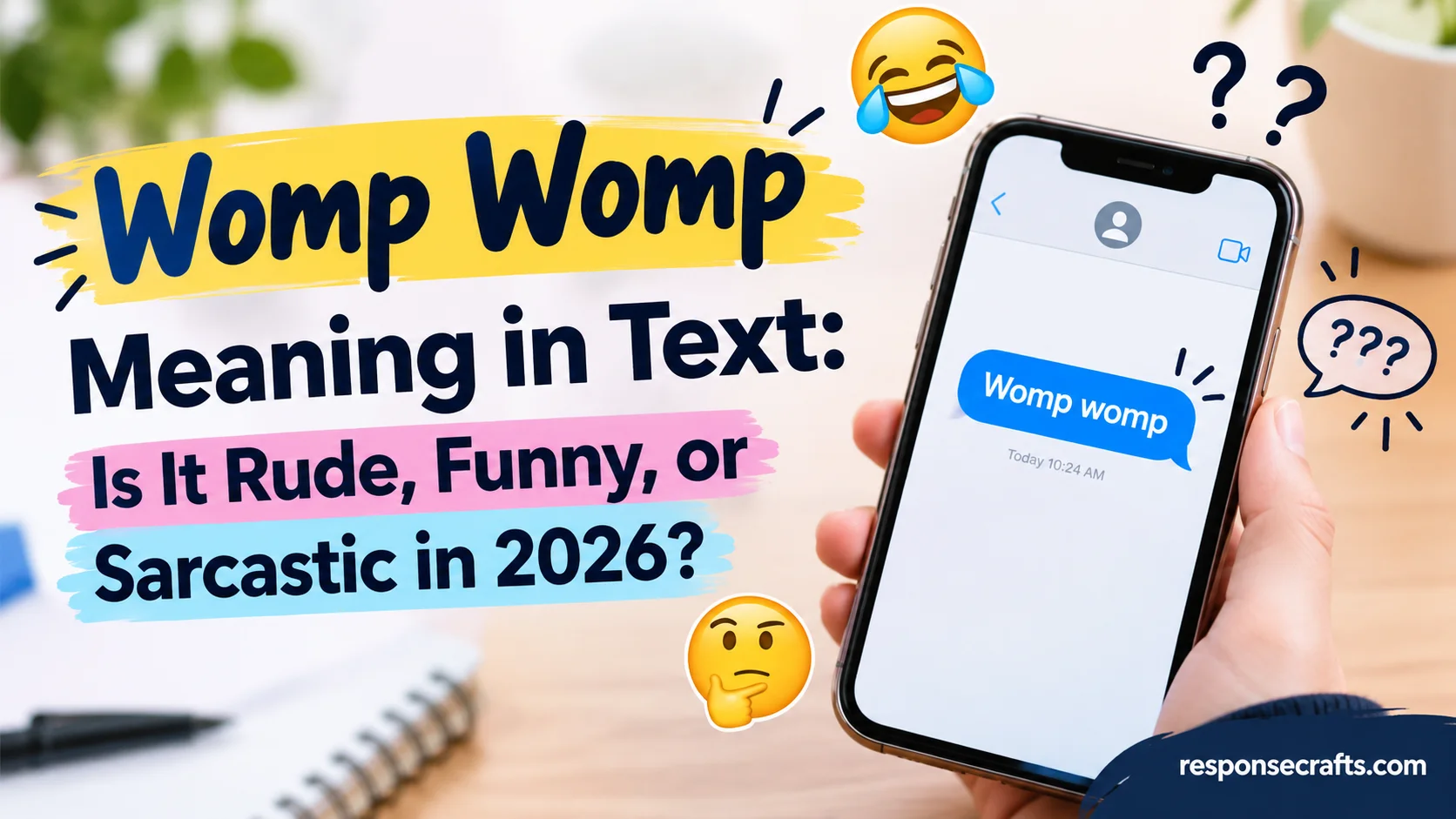
Have you ever received a message that says “womp womp” and wondered whether the person was joking, mocking you, or simply saying “too bad”? This popular internet expression appears in text messages, TikTok comments, Instagram posts, memes, and everyday online conversations. Although it looks simple, its meaning can change depending on the situation.
The womp womp meaning in text usually relates to disappointment, sarcasm, or a reaction to someone’s bad luck. Sometimes, friends use it to make a small problem sound funny. In other situations, the same words can feel dismissive, especially when someone shares a genuine concern and receives little sympathy in return.
So, how can you tell what someone really means? The key is to consider the conversation, the relationship between the people involved, and the seriousness of the situation. This guide explains womp womp slang, its connection to the sad-trombone sound, its use on social media, and the best ways to respond without making a conversation awkward.
Quick Answer
Womp womp is an informal internet expression that usually means “too bad,” “that’s unfortunate,” or “I don’t feel sorry for you.” People often use it sarcastically to react to someone’s disappointment, mistake, complaint, or failure.
The expression comes from the familiar sad-trombone sound effect associated with failure or an anticlimactic moment. In texting, it can communicate humor, teasing, sarcasm, or a lack of sympathy.
For example:
Person A: “I stayed up all night studying, but I forgot the test was today.”
Person B: “Womp womp 😂”
Here, Person B is probably teasing the other person about an unfortunate mistake. However, if someone uses “womp womp” after hearing about a serious personal loss, the response may sound cruel rather than funny.
Comparison Overview
The meaning of womp womp in text depends on the speaker’s intention and the situation. This table highlights its most common uses.
| Meaning or Use | What It Communicates | Example Situation |
| Funny reaction | Playful amusement about a minor problem | A friend loses a video game |
| Sarcasm | Mocking someone’s disappointment | Someone complains about a predictable result |
| Dismissal | Showing little concern for a complaint | A person shares a frustration and gets brushed off |
| Friendly teasing | Joking about a harmless mistake | A friend misses a bus |
| Lack of sympathy | Suggesting someone doesn’t deserve much sympathy | Someone faces a consequence they could have avoided |
| Ironic humor | Making an unfortunate moment sound amusing | A funny meme about failed plans |
The most important distinction is that “womp womp” doesn’t always express genuine sympathy. It often does the opposite. Whether it feels harmless or offensive depends on how the speaker uses it and how the other person receives it.
Main Differences Between Womp Womp Meanings in Text
What Does Womp Womp Mean in Text Messages?
In everyday texting, “womp womp” is a short reaction to something disappointing, unfortunate, embarrassing, or unsuccessful. Instead of offering comfort, the sender may respond with a playful or sarcastic acknowledgment of the problem.
Think of it as a verbal shrug accompanied by a sad sound effect. The speaker recognizes that something went wrong but doesn’t necessarily offer help or sympathy.
For example, imagine that your friend messages you:
Friend: “My favorite team lost again. That’s three games in a row!”
You: “Womp womp 😭”
If you regularly joke about sports together, this response might make your friend laugh. However, the same expression could sound dismissive if your friend is genuinely upset and expects support.
People commonly use the phrase when:
- Someone makes a silly mistake.
- A plan fails at the last minute.
- A person complains about a minor inconvenience.
- Someone experiences an embarrassing moment.
- A friend loses a friendly competition.
- A social media user shares a complaint that others find exaggerated.
The phrase doesn’t have one fixed emotional meaning. Context determines whether it sounds playful, sarcastic, or insensitive.
What Is the Origin of Womp Womp?
The expression is closely associated with the sad-trombone sound effect, a musical cue often used in comedy to highlight failure, disappointment, or an anticlimactic ending.
You may have heard this sound in an old comedy show when a character makes a mistake or expects something exciting but receives an embarrassing result instead. The descending musical notes make the failure seem funny.
Over time, people began representing similar sounds with written expressions such as “womp womp.” Online conversations made the phrase useful because it delivers a recognizable reaction without requiring a long explanation.
For example:
- Someone misses a concert because they forgot to buy tickets.
- A player loses a game at the last second.
- A person confidently predicts something and gets it completely wrong.
In each situation, “womp womp” works like a tiny comedic soundtrack.
However, it’s best to distinguish the expression’s cultural association from its exact history. The sad-trombone effect predates modern social media, but the phrase doesn’t have one universally established first use or a single confirmed date when it entered texting slang.
Is Womp Womp Rude or Sarcastic?
It can be both, but it isn’t automatically rude. The expression often carries sarcasm because it acknowledges someone’s problem without offering much sympathy.
Consider these two situations.
Situation one: Friendly teasing
Your friend burns a batch of cookies after insisting they could bake without following a recipe.
You reply, “Womp womp 😂.”
Because the mistake is minor and you share a playful relationship, your comment may sound funny rather than mean.
Situation two: Genuine distress
A friend tells you they lost an important opportunity and feel deeply disappointed.
You reply, “Womp womp.”
Now the phrase may suggest that you don’t care about their feelings. Your friend might interpret it as an insult or a sign that you’re unwilling to listen.
Several factors influence the tone:
- Relationship: Close friends may understand jokes that would offend strangers.
- Situation: A missed bus is different from a serious personal setback.
- Delivery: A laughing emoji can signal playfulness, although it doesn’t guarantee a friendly interpretation.
- Timing: A sarcastic reply may land poorly when someone is still processing bad news.
- History: If someone regularly mocks another person’s problems, even a short joke can feel hurtful.
The simplest rule is this: If the other person expects empathy, don’t assume sarcasm will be welcome.
What Does Womp Womp Mean on TikTok?
On TikTok, “womp womp” commonly appears in comments, captions, reaction videos, and humorous conversations. Users may write it when someone experiences an embarrassing moment, complains about a situation, or faces an outcome viewers find predictable.
For example, a creator might post a video about confidently attempting a difficult dance and getting every step wrong. A viewer could comment, “Womp womp 💀.”
In this context, the phrase is likely meant as a joke about the failed attempt.
TikTok’s video format also makes the expression easy to understand through visual clues. Facial expressions, background sounds, editing, and captions can help viewers identify whether the creator is joking or criticizing someone.
Common uses include:
- Reaction comments: Responding to a funny failure.
- Sarcastic replies: Mocking a complaint or an exaggerated reaction.
- Meme captions: Adding humor to a disappointing outcome.
- Friendly banter: Teasing a creator or friend about a harmless mistake.
- Dismissive comments: Showing little sympathy toward someone else’s frustration.
Remember that a TikTok comment may reach someone who doesn’t know the commenter personally. A joke that works between friends can appear much harsher in a public comment section.
What Does Womp Womp Mean on Snapchat, Instagram, and WhatsApp?
The basic meaning stays the same across messaging apps. However, the setting can change how people interpret it.
On Snapchat: Friends may use “womp womp” in response to a funny story, an embarrassing moment, or a disappointing update. A laughing emoji can make the message feel more playful.
On Instagram: The phrase may appear under Reels, memes, Stories, or posts about failed plans. Public comments can sound more mocking because the person posting them may not know the creator personally.
On WhatsApp: The expression often appears in private messages and group chats. Friends may use it to tease someone who lost a game, missed an event, or made a silly mistake.
For example:
You: “I ordered food and realized I left my wallet at home.”
Friend: “Womp womp 😂”
In a relaxed conversation, the reply may simply be a joke. If you need actual help paying for your food, however, the same response may feel unhelpful.
The platform doesn’t determine the meaning. The conversation does.
How to Use Womp Womp in Different Situations
Knowing the definition is only half the story. To use womp womp slang naturally, you need to understand when the expression fits the conversation and when it might cause trouble.
Womp Womp as a Funny Reaction
Among friends, “womp womp” can turn a small disappointment into a shared joke. It works best when nobody faces a serious consequence and everyone understands the playful tone.
Imagine your friend spends an hour searching for their phone, only to discover it tucked inside their jacket pocket.
You might say:
“Womp womp. Detective of the year! 😂”
The comment pokes fun at the situation rather than attacking your friend’s character.
Here are a few other examples:
- Missing the bus: “You left two minutes late? Womp womp 😭”
- Losing a game: “You talked all that trash and still lost. Womp womp!”
- Burning dinner: “MasterChef called. They said womp womp.”
- Missing a sale: “You waited until the last day? Womp womp 😂”
The humor comes from the gap between the problem and the reaction. A minor inconvenience receives a dramatic, almost theatrical response.
Still, pay attention to your friend’s mood. If they’re already embarrassed or frustrated, a joke may not help.
Womp Womp as a Sarcastic Response
Sarcasm adds a sharper edge to the phrase. Instead of simply acknowledging disappointment, the speaker may imply that the person is overreacting or brought the problem upon themselves.
For example:
Person A: “I ignored every reminder and now my assignment is late.”
Person B: “Womp womp. Maybe next time, start earlier.”
Here, the response combines mock sympathy with criticism. The speaker isn’t simply saying that the situation is unfortunate. They’re pointing out that the person could have avoided it.
People may also use the expression when someone complains about a consequence they consider fair.
For example:
Person A: “My friends won’t let me choose the movie after I made everyone watch my pick last time.”
Person B: “Womp womp 😂”
Depending on their relationship, this might be harmless banter. In a tense conversation, it could sound judgmental.
Sarcasm works best when both people understand the joke. Without that shared understanding, a short reaction can quickly become an argument.
Womp Womp as a Dismissive Reply
Sometimes, “womp womp” communicates something closer to “I don’t care.” This use is more likely to upset someone because it shuts down their complaint rather than engaging with it.
Consider this exchange:
Person A: “I’ve been working overtime all week, and my manager still criticized my work.”
Person B: “Womp womp.”
The reply offers no comfort, curiosity, or useful advice. It may sound as though the speaker thinks the other person’s frustration doesn’t matter.
A dismissive use can communicate several things:
- The speaker doesn’t consider the problem important.
- They believe the person is complaining unnecessarily.
- They don’t want to discuss the issue.
- They’re intentionally provoking a reaction.
- They disagree with the person’s expectation of sympathy.
Of course, a short message doesn’t reveal someone’s entire personality or intentions. Someone might use the phrase thoughtlessly without realizing how it sounds.
If you’re the recipient, consider the wider conversation before deciding how to respond.
Womp Womp in Memes and Internet Culture
Internet humor often turns ordinary frustrations into exaggerated comedy. “Womp womp” fits this style because it’s short, recognizable, and easy to attach to a disappointing outcome.
Imagine a meme showing someone confidently announcing that they’ll finish a week’s worth of work in one evening. The next image shows them asleep beside an unopened laptop.
The caption might simply read, “Womp womp.”
The phrase supplies the punchline. It doesn’t need a lengthy explanation because the audience already understands the contrast between the person’s plan and the result.
This kind of humor commonly involves:
- Expectation versus reality: A plan goes completely wrong.
- Overconfidence: Someone makes a bold prediction and fails.
- Everyday bad luck: A small inconvenience ruins an otherwise good day.
- Ironic complaints: Someone complains about a predictable consequence.
- Awkward moments: A person’s actions lead to an embarrassing result.
The expression can make a meme funnier by adding mock disappointment. However, humor aimed at someone’s real hardship can easily cross the line from playful to cruel.
Womp Womp Texting Examples and Conversations
Examples make it easier to understand how the expression changes with context. The following conversations illustrate common ways people might use it in digital messages.
Examples Between Friends
Example: Losing a game
Alex: “I lost the final round by one point.”
Jordan: “Womp womp 😭”
Meaning: Jordan is teasing Alex about the loss. The crying emoji may signal exaggerated disappointment rather than genuine sadness.
Example: Missing an event
Mia: “I arrived at the theater after the movie started.”
Sam: “Womp womp. That’s what happens when you take forever to get ready 😂”
Meaning: Sam is joking about Mia’s lateness.
Example: Forgetting something
Chris: “I packed everything except my headphones.”
Taylor: “Womp womp. Enjoy the peaceful journey.”
Meaning: Taylor playfully points out the inconvenience.
Examples in Group Chats
Group chats often encourage quick reactions because several people participate in the same conversation.
Example: Failed plans
Ryan: “We planned a picnic, and now it’s raining.”
Jamie: “Womp womp 🌧️”
Meaning: Jamie acknowledges the disappointment with a lighthearted response.
Example: Friendly competition
Ava: “I told everyone I was going to win the tournament. I came last.”
Noah: “Womp womp 😂”
Meaning: Noah teases Ava about the difference between her confidence and the result.
Examples on Social Media
Example: A failed attempt
Someone posts a video of a cake that collapses immediately after leaving the oven.
Comment: “Womp womp. The bakery era lasted five minutes.”
Meaning: The commenter jokes about the failed baking attempt.
Example: An exaggerated complaint
Someone posts, “My parents asked me to clean my room before going out.”
Comment: “Womp womp 😭”
Meaning: The commenter playfully suggests that the complaint isn’t especially serious.
More Womp Womp Text Examples
| Message | Likely Meaning |
| “You forgot your own birthday reminder? Womp womp 😂” | Playful teasing |
| “Your team lost again? Womp womp.” | Sarcasm or sports banter |
| “You spent your whole budget on snacks? Womp womp.” | A joke about a poor decision |
| “They rejected your application? Womp womp.” | Could sound dismissive or insensitive |
| “You broke the rules and got caught. Womp womp.” | Mocking an avoidable consequence |
| “My vacation got canceled.” “Womp womp.” | Potentially insensitive, depending on the relationship |
Notice that the same expression can communicate different attitudes. The words alone don’t always tell you whether the speaker is being friendly or dismissive.
How to Respond to Womp Womp in Text
If someone sends you “womp womp,” you don’t need to overthink every instance. Your response should match the situation, your relationship with the sender, and what you want to communicate.
Funny Responses to Womp Womp
If the person is joking and you want to keep things light, respond with humor.
Try these replies:
- “Please respect my suffering 😂”
- “I’m going through a historic tragedy.”
- “Wow, where’s the sympathy?”
- “Thanks for your emotional support.”
- “This is the worst day of my life. Probably.”
- “I’ll remember this betrayal.”
- “Not you laughing at my downfall 😭”
- “And I thought we were friends!”
These responses exaggerate your disappointment for comedic effect. They work particularly well when the original problem is minor and everyone understands the joke.
For example:
Friend: “You lost your winning streak? Womp womp.”
You: “Please respect the legacy I built.”
Rather than taking offense, you turn the exchange into another joke.
Sarcastic Comebacks to Womp Womp
Sometimes, you may want to answer with a little sarcasm of your own. The goal is to be witty without turning a harmless exchange into a personal attack.
Consider these options:
- “Your sympathy is overwhelming.”
- “Thanks. I’ll put that in my gratitude journal.”
- “Wow, such compassion.”
- “And here I was expecting a parade.”
- “I’ll try to recover from this devastating lack of support.”
- “Someone give this person an award for kindness.”
Use these responses when the other person is clearly joking or when you want to show that their comment didn’t bother you.
However, if you’re genuinely upset, a sarcastic comeback may hide what you actually need. A direct response often works better.
Calm Responses to Womp Womp
If the phrase feels dismissive, you can explain your feelings without escalating the conversation.
Here are some straightforward options:
- “I was actually being serious.”
- “I know you’re joking, but this matters to me.”
- “I could use some support right now.”
- “That wasn’t really helpful.”
- “I’m not looking for a joke. I just wanted to talk.”
- “Can you hear me out for a minute?”
For example:
You: “I didn’t get the job, and I’m really disappointed.”
Friend: “Womp womp.”
You: “I know you might be joking, but I’m genuinely upset about it.”
This response gives your friend a chance to understand the situation. They may apologize or respond more thoughtfully.
When Should You Ignore Womp Womp?
Not every sarcastic comment deserves a reply. Sometimes, ignoring it is the easiest way to keep a minor situation from becoming a bigger problem.
Consider ignoring the message when:
- The sender is clearly trying to provoke you.
- The comment appears under a random social media post.
- The situation isn’t important enough to argue about.
- You know the sender enjoys getting a reaction.
- You’d rather spend your time on something more useful.
However, ignoring someone isn’t the only option. If the sender is a close friend who repeatedly dismisses your feelings, it may be worth discussing the pattern privately.
The goal isn’t to win every exchange. It’s to decide which conversations deserve your energy.
Read More: Bomboclaat Meaning in Text: From Jamaican Patois to Internet Slang in 2026
Womp Womp vs. Similar Internet Slang
Several internet expressions communicate sarcasm, teasing, or a lack of sympathy. However, they don’t all mean the same thing. Understanding these differences helps you choose the right phrase and interpret messages more accurately.
Womp Womp vs. Too Bad
“Womp womp” and “too bad” both acknowledge an unfortunate situation. The main difference is their usual tone.
“Too bad” can express genuine disappointment, mild sympathy, or sarcasm. “Womp womp” more often adds a playful or mocking reaction.
For example:
- Too bad: “Too bad your concert got canceled. I know you were excited.”
- Womp womp: “You forgot to buy tickets? Womp womp.”
The first message can express sympathy. The second makes light of a mistake.
Neither phrase has a guaranteed emotional meaning. A sarcastic “too bad” can sound just as dismissive as “womp womp.”
Womp Womp vs. Cry About It
“Cry about it” is generally more confrontational than “womp womp.” It often tells someone to stop complaining or implies that their frustration deserves no attention.
For example:
- Womp womp: “You lost the game? Womp womp 😂”
- Cry about it: “You lost the game. Cry about it.”
The first can sound like playful teasing. The second more directly challenges the other person’s reaction.
Both expressions can be rude, especially when used to dismiss a genuine concern. However, “cry about it” usually carries a more openly antagonistic tone.
Womp Womp vs. Skill Issue
“Skill issue” is internet slang used to suggest that someone’s difficulty results from a lack of ability rather than bad luck.
For example:
Person A: “I lost because the game is impossible.”
Person B: “Skill issue 💀”
The reply suggests that the person should improve their skills instead of blaming the game.
By comparison, “womp womp” focuses more broadly on disappointment or an unfortunate outcome. It doesn’t necessarily suggest that the person caused the problem.
| Expression | Main Implication | Common Tone |
| Womp womp | Too bad; that’s disappointing | Sarcastic or playful |
| Too bad | An unfortunate outcome | Neutral or sympathetic |
| Cry about it | Stop complaining | Confrontational |
| Skill issue | Your ability caused the problem | Mocking or teasing |
| LOL | Something is funny or amusing | Playful, amused, or sometimes sarcastic |
Womp Womp vs. LOL
“LOL” usually stands for “laughing out loud.” People use it to express amusement, soften a message, or signal that something is funny.
“Womp womp” is more specific. It reacts to disappointment, failure, or a situation that the speaker finds unfortunate or amusing.
For example:
Person A: “I accidentally sent my boss a meme meant for my friends.”
Person B: “LOL, how did that happen?”
The response focuses on the humor of the mistake.
Now consider:
Person A: “I accidentally sent my boss a meme meant for my friends.”
Person B: “Womp womp 😭”
This response emphasizes the unfortunate outcome and may tease the person about it.
Both expressions can appear together, but they serve slightly different purposes.
Womp Womp vs. Sad Trombone
The sad trombone is the sound effect associated with a disappointing or anticlimactic result. “Womp womp” is a written expression that evokes a similar reaction.
Think of the difference this way:
- Sad trombone: The musical sound used to highlight a failure.
- Womp womp: The written reaction people use in conversation.
- Internet slang: The broader use of the phrase to mock disappointment or make a situation seem funny.
The expression works because readers can imagine the sound. It’s like adding a tiny comedy soundtrack to a text message.
Is Womp Womp Offensive?
“Womp womp” isn’t inherently offensive, but it can be hurtful when it dismisses someone’s genuine problems. Its impact depends on the situation and the relationship between the people involved.
When friends use it after a minor mistake, it may be completely harmless. When someone shares serious news, the phrase can suggest that their feelings don’t matter.
When Womp Womp Is Usually Harmless
The expression is more likely to be acceptable when:
- The problem is minor and temporary.
- Both people regularly tease each other.
- The person sharing the story is already laughing about it.
- The conversation has an established joking tone.
- Nobody is being targeted for a personal hardship.
For example, responding “womp womp” when a friend loses a casual video game may be perfectly fine.
When Womp Womp Can Be Hurtful
The phrase can come across as insensitive when someone discusses:
- The death of a loved one.
- A serious illness or injury.
- Financial hardship.
- Losing a job or an important opportunity.
- A painful breakup.
- Bullying, harassment, or another distressing experience.
Imagine that someone tells a friend they lost their job and are worried about paying rent. Responding with “womp womp” offers no support and may deepen their distress.
In that situation, a more thoughtful reply would be:
“I’m sorry you’re dealing with this. Do you want to talk about what happened?”
The difference is simple. One response dismisses the problem; the other acknowledges it.
How to Make Sure Your Joke Doesn’t Go Too Far
Before using “womp womp,” ask yourself three quick questions:
- Is the situation actually funny to the other person?
- Do we have the kind of relationship where this joke is welcome?
- Could my message sound like I don’t care about their feelings?
If you’re unsure, choose a more neutral response. You can always joke later when the person feels better.
Why Do People Say Womp Womp?
The expression has several useful features that make it fit naturally into digital conversations. It’s short, recognizable, and capable of communicating an attitude without a long explanation.
It Makes Disappointment Sound Funny
People often use humor to make small frustrations easier to discuss. “Womp womp” turns an ordinary setback into a miniature comedy scene.
For example, someone might write, “I made coffee and immediately spilled it on my desk. Womp womp.”
The phrase adds humor without requiring a detailed explanation of how frustrating the moment felt.
It Communicates Sarcasm Quickly
Text messages don’t always convey tone clearly. A phrase like “womp womp” can signal that the speaker is being sarcastic rather than offering a serious response.
For instance, someone who ignores several alarms and misses an appointment might receive “Womp womp” from a friend.
The reply suggests that the outcome was predictable and perhaps avoidable.
It Fits Internet Humor
Internet conversations often favor short, reusable reactions. Like “skill issue” or “too bad,” “womp womp” can be applied to many different situations.
It also works well in memes and comment sections because readers can understand the intended joke quickly when the context is clear.
It Doesn’t Always Mean a Person Lacks Empathy
Someone who uses “womp womp” in a group chat isn’t necessarily uncaring. They may be responding to an established joke or repeating a phrase they see online.
However, intent doesn’t erase impact. A person may mean to be funny and still hurt someone’s feelings.
The best way to understand the expression is to look at the complete interaction rather than judge someone’s intentions from two words alone.
Common Mistakes When Using Womp Womp
Although the phrase is easy to understand, a few mistakes can change how others interpret it.
Assuming It Always Means “Too Bad”
“Too bad” is a useful shorthand, but “womp womp” often adds sarcasm or mockery. The phrase may imply that the speaker doesn’t feel particularly sorry for the person.
Using It During a Serious Conversation
A joke about a missed bus may be welcome. A joke about losing a loved one usually isn’t. Consider the seriousness of the situation before responding.
Confusing Teasing With an Insult
Close friends may understand the expression as friendly banter. Someone outside that relationship may interpret it as an attack.
Don’t assume everyone shares the same sense of humor.
Believing Emojis Always Make It Friendly
Adding 😂 or 😭 can suggest that a message is playful. However, emojis don’t automatically make a hurtful comment harmless.
For example, “Your bad news is hilarious 😂” may still feel cruel even with a laughing emoji.
Assuming Every Platform Uses It Differently
The core meaning generally remains consistent across TikTok, Instagram, Snapchat, and WhatsApp. The surrounding conversation influences the tone more than the platform itself.
How to Know What Someone Means by Womp Womp
If someone sends you “womp womp” and you’re unsure how to interpret it, examine the conversation rather than focusing on the phrase alone.
Look at what came before it. Did you share a funny mistake, complain about something minor, or discuss a serious problem? The preceding message provides useful clues.
Consider your relationship. A close friend who regularly jokes with you may intend playful teasing. A stranger replying to a vulnerable post may sound dismissive.
Pay attention to emojis and punctuation. A laughing emoji may suggest humor, while a blunt reply without additional context can feel colder. Still, these clues aren’t definitive.
Notice the person’s usual communication style. Some people use sarcasm frequently, while others prefer direct and supportive replies.
Ask for clarification when necessary. If a message leaves you confused, you can simply ask, “Are you joking, or are you being serious?”
A Practical Case Study: One Phrase, Three Meanings
Consider three people who receive disappointing news and hear the same response: “Womp womp.”
These are illustrative examples showing how context changes interpretation.
Case one: Friendly teasing
A person loses a friendly basketball game after bragging about their skills. Their teammate says, “Womp womp 😂.”
Likely interpretation: Playful teasing about a low-stakes loss.
Case two: Sarcastic criticism
Someone complains that they received a late fee after ignoring several payment reminders. A friend replies, “Womp womp.”
Likely interpretation: Sarcasm suggesting the consequence was predictable.
Case three: Insensitive dismissal
Someone shares that a close friend betrayed their trust. Another person replies, “Womp womp.”
Likely interpretation: A dismissive reaction to a painful experience.
These examples demonstrate why the phrase can’t be classified as friendly or offensive in every situation. The words stay the same, but the emotional context changes.
Conclusion
The womp womp meaning in text usually relates to disappointment, sarcasm, teasing, or a lack of sympathy. People use it in text messages, memes, TikTok comments, and group chats to react to mistakes, failed plans, and unfortunate situations. Although the expression often sounds funny, it isn’t always friendly. Between close friends, it can be a harmless joke. During a serious conversation, however, it may come across as dismissive or insensitive. To understand what someone means, consider the context, your relationship, and the tone of the conversation. If you want to use the phrase yourself, make sure the other person is likely to appreciate the joke.
FAQs:
What does womp womp mean in texting?
In texting, “womp womp” usually means “too bad” or “that’s unfortunate.” People often use it sarcastically to react to someone’s disappointment, mistake, or bad luck.
Is womp womp rude?
Womp womp can be rude, but it isn’t always offensive. Friends may use it to tease each other about minor problems.
What does womp womp mean on TikTok?
On TikTok, “womp womp” commonly appears in comments, captions, and reaction videos. Users employ it to mock a failed attempt, joke about an embarrassing moment.
How do you respond to womp womp?
You can respond with humor, sarcasm, or a calm explanation, depending on the situation. For a playful exchange, try “Please respect my suffering.”
Is womp womp the same as saying too bad?
The expressions are similar, but their tone can differ. “Too bad” may communicate genuine sympathy or disappointment, while “womp womp” more often adds sarcasm or mockery.






1 thought on “Womp Womp Meaning in Text: Is It Rude, Funny, or Sarcastic in 2026?”