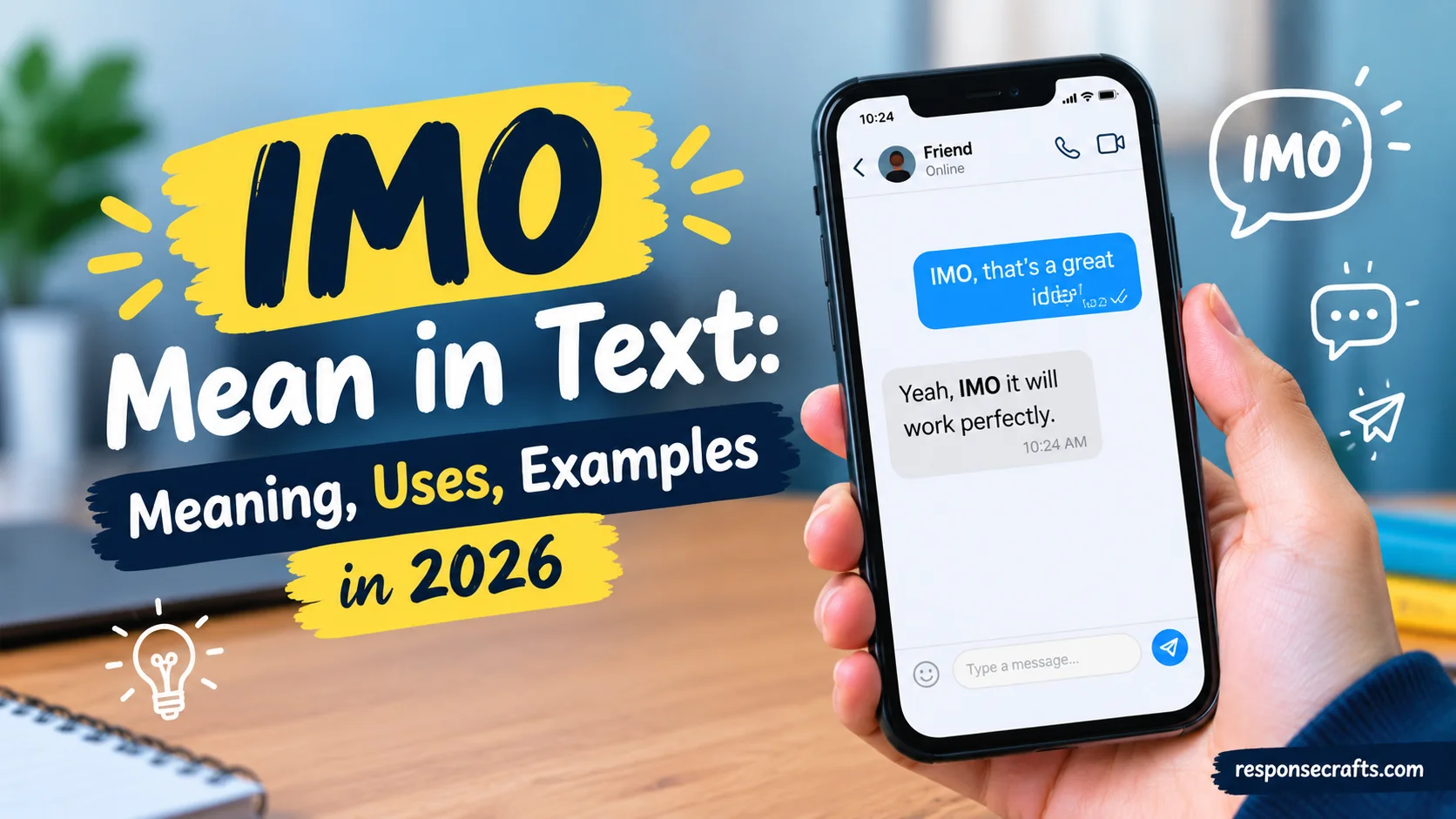
If you have seen IMO in a text, chat, or social media post, you may wonder what this short abbreviation really means. In most conversations, IMO means “In My Opinion,” and people use it to share a personal view. You can find IMO in messages, comments, captions, and online discussions when someone wants to state their thoughts. Unlike a statement of fact, IMO tells the reader that the following idea reflects someone’s personal judgment. For example, someone might text “IMO, this movie is great” to show that the comment is their own opinion. Understanding IMO meaning in text can help you follow casual conversations without misunderstanding the writer’s intention.
The abbreviation IMO has become common in digital communication, especially on platforms where people prefer short and quick messages. You may see it in WhatsApp chats, Instagram comments, TikTok discussions, Reddit posts, and other social platforms. People often place IMO at the beginning of a sentence, but it can also appear later in a message. Its tone usually feels casual and conversational, making it useful when sharing preferences or judgments. For instance, “IMO, this is better” sounds softer than simply saying “This is better” because it clearly marks the statement as personal. That small distinction can make online conversations feel more polite, flexible, and less absolute.
Knowing IMO meaning in text is useful because the abbreviation can appear in many everyday online situations. Someone may use IMO while discussing movies, music, games, food, relationships, trends, or personal choices. It can also introduce a strong viewpoint without suggesting that everyone should agree with it. In some conversations, people may combine IMO with other slang, such as TBH, IMHO, or IDK, depending on the context. For example, “IMO, that was the best option” simply tells you that the speaker is expressing their own perspective. Once you understand this common abbreviation, reading texts and social media conversations becomes much easier in 2026.
Quick Answer: What Does IMO Mean in Text?
- Define IMO = “In My Opinion.”
- Explain that people use it to introduce a personal view, judgment, or preference.
- Clarify that IMO usually signals that the statement is an opinion rather than an established fact.
- Give a few short texting examples.
IMO Meaning at a Glance
| Term | Meaning | Typical Use | Tone |
| IMO | In My Opinion | Sharing a personal view | Neutral/casual |
| IMHO | In My Humble Opinion | Giving an opinion more softly | Casual/polite |
| IMNSHO | In My Not-So-Humble Opinion | Strong or playful opinion | Humorous |
| I think | Personal belief | Everyday conversation | Neutral |
| Personally | Personal perspective | Emphasizing individual preference | Neutral |
What Does IMO Stand For?
- Break down each word in “In My Opinion.”
- Explain why the abbreviation became popular in online communication.
- Distinguish IMO from a factual statement.
- Explain why people often place IMO at the beginning of a sentence.
Read More: WYF Meaning in Text: How Teenagers Use This Slang in 2026
What Does IMO Mean in Different Texting Contexts?
IMO in Text Messages
- How friends use IMO during casual conversations.
- Examples involving opinions about plans, movies, food, music, or people.
IMO in Group Chats
- How IMO can signal that a message represents one person’s perspective.
- How it can soften disagreement without removing the speaker’s position.
IMO on Social Media
- Use of IMO in comments, posts, replies, and discussions.
- How the abbreviation works in short-form online communication.
IMO on Reddit, Discord, and Online Forums
- Why opinion-based discussions frequently use IMO.
- How context and community culture affect its tone.
IMO in Online Arguments or Debates
- How IMO can separate personal judgment from factual claims.
- Why adding IMO doesn’t automatically make an argument correct or polite.
How to Use IMO Correctly
- Put IMO before a personal opinion.
- Use it when the statement reflects personal judgment or preference.
- Explain when IMO isn’t necessary because the conversational context already makes the opinion obvious.
- Discuss punctuation and capitalization in casual writing.
- Explain IMO, imo, and Imo as common variations with the same meaning.
Correct IMO Examples
- “IMO, this is the best option.”
- “IMO, the first movie was better.”
- “That restaurant is overrated IMO.”
When Not to Use IMO
- When stating an objectively verifiable fact.
- When quoting someone else’s opinion.
- When the phrase would make a formal statement sound unnecessarily casual.
IMO Texting Examples With Different Tones
Friendly
- “IMO, you should go for it.”
Neutral
- “IMO, the second option makes more sense.”
Strong Opinion
- “IMO, that’s easily the best episode.”
Disagreement
- “I get your point, but IMO, the original is better.”
Playful or Sarcastic
- Examples showing how context can make IMO humorous.
IMO vs. Similar Texting Abbreviations
IMO vs. IMHO
- Both introduce opinions.
- Explain the difference between ordinary and deliberately softened opinion language.
- Examples showing when each fits better.
IMO vs. IMNSHO
- Explain the longer, humorous variation.
- Show how IMNSHO can sound more assertive or sarcastic.
IMO vs. TBH
- TBH = “To Be Honest.”
- Explain that TBH emphasizes honesty or frankness while IMO specifically marks an opinion.
- Provide side-by-side examples.
IMO vs. IIRC
- IIRC = “If I Recall Correctly.”
- Explain that IIRC expresses uncertainty about memory rather than personal opinion.
IMO vs. IME
- IME = “In My Experience.”
- Explain the difference between an opinion and something based on personal experience.
IMO vs. IMHO vs. TBH vs. IME
- Create a concise comparison table covering meaning, purpose, tone, and example usage.
Is IMO Formal or Informal?
- Explain that IMO is primarily an informal internet and texting abbreviation.
- Discuss where it fits naturally:
- Text messages
- Social media
- Online communities
- Casual emails
- Explain why spelling out “in my opinion” may work better in formal writing.
- Mention that familiarity with the abbreviation varies by audience and age group.
Does IMO Have Different Meanings?
- Explain that “In My Opinion” is the standard meaning in texting and online communication.
- Discuss why context still matters when interpreting abbreviations.
- Distinguish IMO from unrelated meanings that may exist outside texting.
- Advise readers to examine the surrounding sentence when an abbreviation seems unclear.
Is IMO Rude, Arrogant, or Disrespectful?
- Explain that IMO itself is generally neutral.
- Show how the wording around IMO determines whether a message sounds respectful or dismissive.
- Compare:
- “IMO, I’d choose the first one.”
- “IMO, your idea makes no sense.”
- Explain how punctuation, wording, and context affect tone.
How to Reply When Someone Says IMO
- You don’t need a special response simply because someone uses IMO.
- Give natural responses depending on whether you agree, disagree, or want more information.
If You Agree
- “I agree.”
- “Same here.”
- “I think so too.”
If You Disagree
- “I see it differently.”
- “Fair point, but I prefer the other one.”
If You Want to Discuss It
- “What makes you think that?”
- “Why do you prefer it?”
Common Mistakes With IMO
- Assuming IMO means the statement is a fact.
- Confusing IMO with IMHO or TBH.
- Treating every use as sarcastic.
- Using IMO in highly formal writing without considering the audience.
- Misreading the abbreviation when the surrounding context suggests another meaning.
Real-World IMO Conversation Examples
Example 1: Choosing a Movie
- Short conversation demonstrating a personal preference.
Example 2: Discussing Food
- Show how IMO introduces a subjective judgment.
Example 3: Group Project
- Demonstrate a polite disagreement using IMO.
Example 4: Social Media Comment
- Show how IMO works in a public online discussion.
Example 5: Debate
- Demonstrate the difference between expressing an opinion and claiming something as fact.
Why Do People Use IMO Instead of “In My Opinion”?
- Saves time and characters.
- Fits the fast pace of digital communication.
- Clearly signals that the following statement is subjective.
- Can make disagreement sound less absolute.
- Has become recognizable across many online communities.
IMO in 2026: Is It Still Common?
- Discuss IMO’s continued recognition in digital communication.
- Explain how established abbreviations can remain useful even as newer slang appears.
- Compare traditional internet abbreviations with newer social-media language.
- Avoid claiming a specific usage statistic unless supported by reliable current data.
Frequently Confused Terms
- IMO: In My Opinion
- IMHO: In My Humble Opinion
- TBH: To Be Honest
- IME: In My Experience
- IIRC: If I Recall Correctly
- AFAIK: As Far As I Know
- FWIW: For What It’s Worth
Quick Comparison Table
| Abbreviation | Full Form | Main Purpose |
| IMO | In My Opinion | Expressing an opinion |
| IMHO | In My Humble Opinion | Expressing an opinion more softly |
| TBH | To Be Honest | Giving a candid statement |
| IME | In My Experience | Sharing personal experience |
| IIRC | If I Recall Correctly | Signaling uncertain memory |
| AFAIK | As Far As I Know | Limiting certainty |
| FWIW | For What It’s Worth | Offering an additional viewpoint |
Key Takeaways About IMO
- IMO means “In My Opinion.”
- It introduces a personal viewpoint.
- It’s common in texts, chats, comments, and online discussions.
- It usually has a neutral or casual tone.
- Context determines whether the overall message sounds friendly, blunt, sarcastic, or respectful.
- IMO differs from abbreviations such as TBH, IME, and IMHO because each serves a different conversational purpose.
Conclusion
IMO means “In My Opinion,” and it’s one of the most recognizable abbreviations used in texting and online conversations. People use it when they want to share a personal view without presenting that view as an absolute fact. Whether you’re discussing a movie, choosing a restaurant, debating an idea, or commenting on social media, IMO quickly tells the reader that the statement reflects personal judgment.
The tone of IMO usually feels casual and neutral. However, the words surrounding it can change how the message comes across. “IMO, this is the better option” sounds fairly friendly, while a harsh statement after IMO can still sound dismissive or argumentative. Context matters more than the abbreviation itself. IMO also differs from similar expressions such as IMHO, TBH, IME, IIRC, and FWIW. Each one serves a slightly different purpose. Once you understand those differences, you can read online conversations more accurately and use the right abbreviation when expressing your own thoughts.
FAQs
What does IMO mean in texting?
IMO means “In My Opinion.” People use it before or after a statement to show that they’re sharing a personal viewpoint.
What does IMO stand for?
IMO stands for “In My Opinion.” The abbreviation comes from the first letters of the three words: In My Opinion.
Is IMO rude in a text?
No, IMO isn’t inherently rude. It usually has a neutral and conversational tone because it simply identifies something as the speaker’s opinion.
What is the difference between IMO and IMHO?
IMO means “In My Opinion,” while IMHO means “In My Humble Opinion.” Both introduce a personal viewpoint, so they’re often interchangeable in casual conversations.
Can you use IMO in formal writing?
You can, but it usually works better in informal communication. IMO is strongly associated with texting, social media, online discussions, and casual messages.











1 thought on “IMO Mean in Text: Meaning, Uses, Examples in 2026”