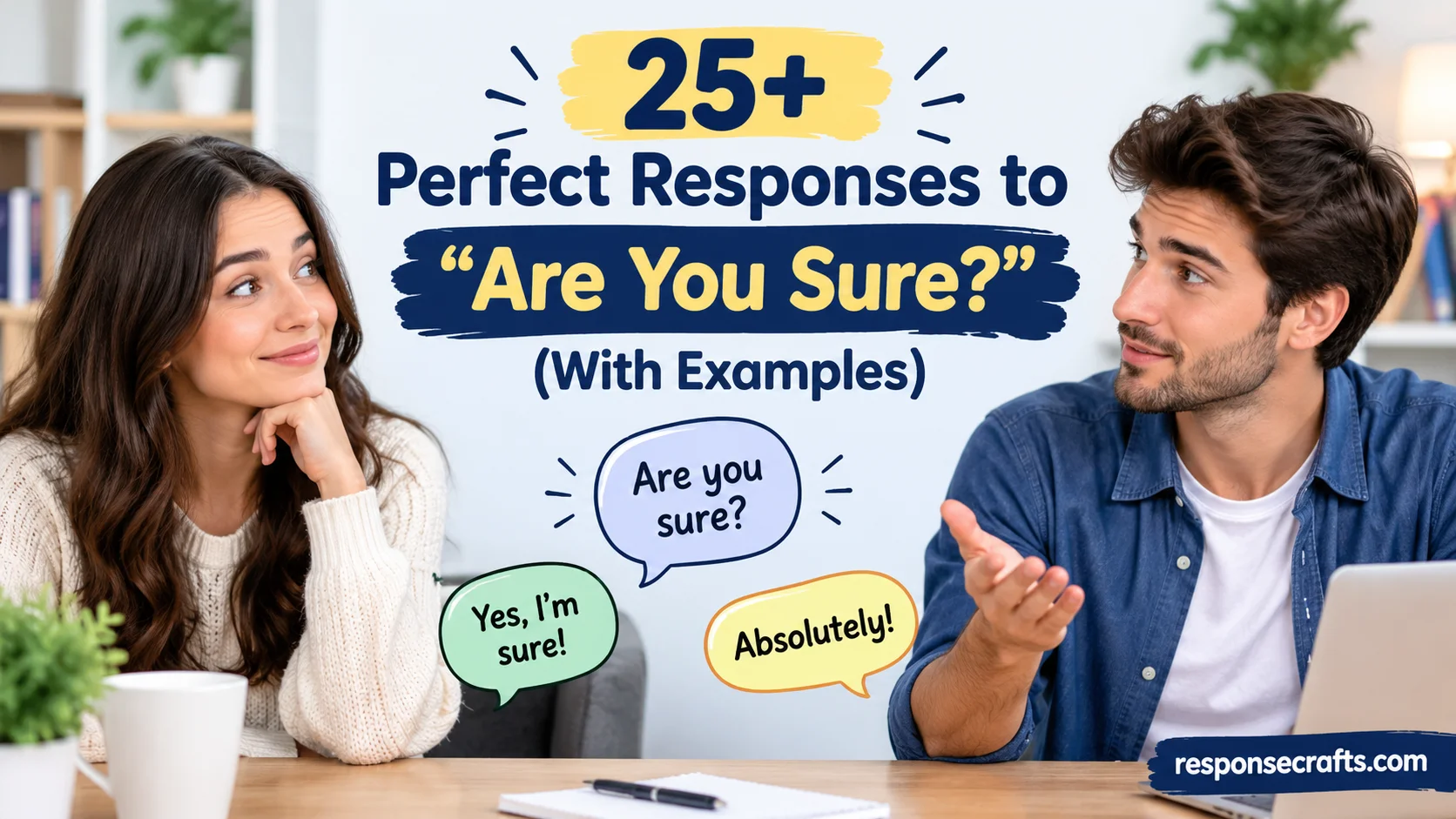
Knowing the best responses to “Are you sure?” can help you communicate with confidence, clarity, and ease in everyday conversations. People ask this question when they want confirmation, reassurance, or clarification about something you have said or decided. Whether you are chatting with friends, family members, coworkers, or someone special, your response can depend on the situation and the tone of the conversation. Sometimes, a simple “Yes, absolutely!” is enough to show that you are confident in your answer. In other situations, a polite, funny, or thoughtful reply can make the conversation more natural and engaging.
There are many ways to respond to “Are you sure?” without repeating the same words every time. If you want to sound professional at work, you might say, “Yes, I have double-checked everything.” When talking to friends, a playful answer like “One hundred percent!” or “Never been more sure!” can keep things lighthearted. If you are uncertain, you can also respond honestly with “Let me think about it for a moment” or “I’m fairly sure, but I’ll check.” Choosing the right response helps you express your true feelings, level of certainty, and personality while avoiding unnecessary confusion.
In this guide, you will discover 25+ perfect responses to “Are you sure?”, complete with practical examples to help you use each phrase naturally. We will explore replies for casual conversations, professional situations, funny exchanges, and romantic chats, making it easier to find the right words for every occasion. You will also learn how to respond when you are completely confident, when you need to reassure someone, or when you are not entirely certain about your decision. By understanding these different expressions, you can improve your everyday communication skills and handle the question “Are you sure?” with greater confidence and clarity.
Quick Answer
The best response to “Are you sure?” depends on whether you want to sound confident, reassuring, funny, flirty, polite, or honest about uncertainty.
Here are some excellent responses you can use:
- Confident: “Yes, I’m absolutely sure.”
- Casual: “Yep, no doubt!”
- Reassuring: “Yes, I mean it.”
- Funny: “Sure enough to bet my last slice of pizza!”
- Flirty: “Want me to prove it?”
- Professional: “Yes, I’ve verified the details.”
- Honest: “I’m fairly certain, but let me double-check.”
- Firm: “Yes, I’ve thought it through.”
- Polite: “Yes, thanks for checking.”
- Playful: “Why, do I sound unsure?”
If you don’t feel completely certain, don’t pretend otherwise. Saying “Let me check first” is often more helpful than giving an answer you might regret.
Comparison Overview
Different responses to “Are you sure?” communicate different feelings. Some show confidence, while others offer reassurance or invite a more meaningful conversation.
| Response | Best situation | Tone |
| “Yes, absolutely!” | Everyday conversations | Confident |
| “I’m positive.” | When you know the answer | Direct |
| “Trust me on this.” | Casual conversations with friends | Friendly |
| “I mean it.” | Relationships and emotional conversations | Reassuring |
| “Want to bet?” | Lighthearted exchanges | Playful |
| “Want me to prove it?” | Mutual flirtation | Flirty |
| “I’ve checked the details.” | Workplace discussions | Professional |
| “Let me double-check.” | When you’re uncertain | Honest |
| “Why do you ask?” | When you want to understand their concern | Curious |
| “I’ve made my decision.” | When someone repeatedly questions you | Firm |
The key difference: You don’t have to respond with an enthusiastic yes every time. A good reply reflects what you genuinely know and feel.
Main Differences Between Perfect Responses to “Are You Sure?”
The phrase “Are you sure?” can mean different things depending on the speaker’s intention. Understanding those differences helps you choose a response that feels appropriate rather than rehearsed.
Confident Responses vs. Reassuring Responses
A confident response communicates that you trust your knowledge or decision.
For example, “I’m absolutely certain” works when you’ve checked the facts or made a well-considered choice. It tells the other person that you aren’t guessing.
A reassuring response focuses more on the other person’s feelings. “Yes, I mean it” works when someone needs emotional clarity, especially in a personal relationship.
Funny Responses vs. Flirty Responses
Funny responses aim to make the conversation lighter. You might say, “Sure enough to put my snack money on it!” when a friend playfully questions you.
Flirty responses create romantic tension or show interest. “Want me to prove it?” may work when two people already share that kind of chemistry.
However, humor and flirting depend on context. A joke can sound dismissive during a serious conversation, while a flirty response might feel uncomfortable if the interest isn’t mutual.
Honest Responses vs. Defensive Responses
An honest response acknowledges what you know and what you still need to confirm.
For example, “I’m pretty sure, but I’ll check” shows that you value accuracy more than appearing infallible.
A defensive response, such as “Why would you even question me?” can turn a simple clarification into an argument. Unless someone is deliberately being disrespectful, start with a calm answer.
Short Responses vs. Detailed Responses
Sometimes, “Yes” is enough. If a friend asks whether you’re sure about meeting at 6 p.m., a short confirmation keeps things simple.
However, a decision involving money, work, travel, or an important commitment may deserve an explanation. In those situations, briefly sharing your reasoning can build trust.
Best Responses to “Are You Sure?” in Everyday Conversations
Not every conversation needs a witty comeback or a long explanation. Most of the time, a natural, straightforward response works best.
Here are five reliable replies you can use in everyday situations.
“Yes, I’m Sure.”
This is a simple and versatile answer. It works when someone asks you to confirm a choice, statement, or plan.
Example:
Friend: “Are you sure you want to order that?”
You: “Yes, I’m sure. I’ve been craving it all week!”
The answer feels relaxed because it confirms your decision without making the exchange unnecessarily serious.
“Absolutely!”
Use this response when you feel confident and want to sound enthusiastic.
Example:
Friend: “Are you sure you can make it tomorrow?”
You: “Absolutely! I’ll see you there.”
It works particularly well for plans, invitations, and promises you’re confident you can keep.
“Positive.”
“Positive” is a short way of saying you’re certain. It often sounds casual and direct, especially in familiar conversations.
Example:
Friend: “Was the appointment at 3 p.m.?”
You: “Positive. I wrote it in my calendar.”
For important appointments, though, make sure you’ve checked the information before confirming it.
“Without a Doubt.”
This phrase communicates strong confidence. It works when you want to emphasize that your answer isn’t a guess.
Example:
Friend: “Are you sure this is the right address?”
You: “Without a doubt. I’ve been here before.”
Use it when you genuinely have good reason to feel certain. Otherwise, a more cautious answer is better.
“I’m Certain About It.”
This reply sounds slightly more formal than “Yep, absolutely.” It’s useful when the topic matters and you want to communicate confidence clearly.
Example:
Colleague: “Are you sure these figures are correct?”
You: “I’m certain about them. I checked the calculations this morning.”
The explanation strengthens the response because it tells the other person why you feel confident.
Confident Responses to “Are You Sure?”
When someone questions your answer or decision, you can respond confidently without sounding arrogant. The trick is to communicate certainty while remaining open to reasonable questions.
“I’m 100% Sure.”
This phrase conveys strong certainty and works well in casual conversations.
Example:
Friend: “Are you sure the store closes at 9?”
You: “I’m 100% sure. I checked the hours before leaving.”
Use this wording when you have reliable information. If the details could have changed, verify them first.
“I Stand by My Decision.”
This response works when someone questions a choice you’ve considered carefully.
Example:
Friend: “Are you sure you want to turn down that offer?”
You: “Yes, I’ve considered the options, and I stand by my decision.”
It communicates independence without insulting the other person’s opinion.
“I’ve Thought It Through.”
Sometimes, the other person isn’t questioning a fact. They’re wondering whether you’ve considered the consequences.
This response acknowledges that concern.
Example:
Sibling: “Are you sure you want to move to another city?”
You: “I’ve thought it through. I’ve considered the costs, the job opportunity, and the adjustment.”
You don’t have to list every detail. A short explanation can show that your choice comes from careful thought rather than impulse.
“You Can Count on It.”
This reply works when someone needs reassurance about a promise or commitment.
Example:
Friend: “Are you sure you’ll help me move on Saturday?”
You: “You can count on it. I’ll be there at 9.”
Only use this response when you can reasonably keep the commitment. Confidence means little if your actions don’t support your words.
“I Know What I’m Doing.”
This phrase can sound confident, but its tone matters. Said calmly, it may reassure someone who worries unnecessarily. Said sharply, it can sound defensive.
Example:
Friend: “Are you sure you can fix that yourself?”
You: “Yes, I know what I’m doing. I’ve handled this before.”
If the person is genuinely trying to help, consider a softer alternative: “Yes, I’ve done this before, but I’ll ask if I need a hand.”
Casual and Friendly Responses to “Are You Sure?”
When you’re chatting with friends, siblings, or people you know well, you can keep your answer relaxed. Casual replies often sound more natural than formal declarations of certainty.
“Yep, Pretty Sure!”
This response works when you’re reasonably confident but don’t want to sound overly serious.
Example:
Friend: “Is the café on the next street?”
You: “Yep, pretty sure! Let’s check the sign when we get there.”
It’s especially useful when the stakes are low and a little uncertainty doesn’t matter much.
“Yep, No Doubt.”
This reply sounds upbeat and direct.
Example:
Friend: “Are you coming to the game tonight?”
You: “Yep, no doubt. I’ve already got my ticket.”
It confirms your plans while keeping the conversation friendly.
“Trust Me on This.”
Use this phrase when you have experience or knowledge that supports your answer.
Example:
Friend: “Are you sure that restaurant is worth trying?”
You: “Trust me on this. Their pasta is excellent.”
However, don’t use it as a substitute for evidence when the question involves something important. If someone is making a major decision, explain what you know.
“You Bet!”
“You bet!” is an informal way to say yes with enthusiasm.
Example:
Friend: “Are you sure you want to come along?”
You: “You bet! I’ve been looking forward to it.”
It’s a good choice for friendly conversations, invitations, and plans.
“As Sure as I Can Be.”
This response is useful when you feel confident but recognize that absolute certainty isn’t always possible.
Example:
Friend: “Are you sure we’ll finish the project today?”
You: “As sure as I can be. We’re nearly finished, but we still need to test everything.”
It sounds realistic rather than hesitant. You’re communicating confidence without promising something beyond your control.
Funny and Witty Responses to “Are You Sure?”
A little humor can turn a repetitive question into a fun exchange. These replies work best when the conversation is relaxed and both people enjoy playful banter.
“Unless My Brain Is Playing Tricks on Me!”
This reply adds a little self-deprecating humor without becoming too dramatic.
Example:
Friend: “Are you sure we parked on this floor?”
You: “Unless my brain is playing tricks on me, yes!”
It’s particularly effective when the situation is unimportant and you can laugh at a possible mistake.
“Sure Enough to Bet Lunch on It.”
This response adds a playful challenge.
Example:
Friend: “Are you sure your team will win?”
You: “Sure enough to bet lunch on it!”
Keep the stakes imaginary or friendly. The point is to make the conversation entertaining, not to pressure anyone into a real bet.
“I’d Put My Favorite Snack on It.”
Food-based humor makes an ordinary answer more memorable.
Example:
Friend: “Are you sure the movie starts at 7?”
You: “I’d put my favorite snack on it!”
This works best when you have a good reason to be confident. If you haven’t checked the time, don’t risk your favorite snack just yet.
“Do I Look Unsure?”
This short comeback is playful and slightly cheeky.
Example:
Friend: “Are you sure you want another slice of pizza?”
You: “Do I look unsure?”
It’s ideal for lighthearted exchanges among people who understand your sense of humor. With someone unfamiliar, it might sound sarcastic.
“Let’s Call It Expert-Level Guessing.”
This is a good response when you’re making an educated guess rather than stating a confirmed fact.
Example:
Friend: “Are you sure that’s the right answer?”
You: “Let’s call it expert-level guessing. I’ll check before we submit it.”
The joke works because it acknowledges uncertainty instead of disguising it. That’s especially helpful when the consequences of being wrong matter.
Flirty Responses to “Are You Sure?”
When someone you’re attracted to asks “Are you sure?”, you might want to answer with a little charm. The best flirty replies feel natural and welcome rather than forced.
“Want Me to Prove It?”
This response adds playful confidence and invites the other person to continue the banter.
Example:
Them: “Are you sure you like spending time with me?”
You: “Want me to prove it? How about dinner this weekend?”
It works well when the other person is comfortable with flirtation and your intentions are clear.
“Would You Like to Find Out?”
This reply creates a little mystery. It can work when you’re teasing someone about a playful challenge or a shared joke.
Example:
Them: “Are you sure you can beat me at bowling?”
You: “Would you like to find out?”
The response keeps the conversation light and gives the other person an easy way to respond.
“I’m Sure About You.”
This is a warmer, more romantic option. Use it when you want to reassure someone that your interest is genuine.
Example:
Them: “Are you sure you want to keep seeing me?”
You: “I’m sure about you. I enjoy what we’re building together.”
This answer works better than a joke when the question reflects genuine vulnerability.
“You Sound Like You Want to Convince Me Otherwise.”
This is a teasing reply that can keep a playful conversation going.
Example:
Them: “Are you sure you don’t want to stay a little longer?”
You: “You sound like you want to convince me otherwise.”
The tone should remain light. If the other person is expressing a serious concern, answer that concern directly instead.
“Come Closer and Ask Again.”
This is a more intimate response that works when mutual attraction and comfort are already established.
Example:
Them: “Are you sure you want to tell me that secret?”
You: “Come closer and ask again.”
Use it only when the situation supports that level of closeness. If you’re unsure how the other person feels, a gentler response is a safer choice.
Polite Responses to “Are You Sure?”
Polite replies help you acknowledge someone’s concern without sounding defensive. They’re particularly useful when a person is double-checking information or trying to prevent a mistake.
“Yes, Thank You for Checking.”
This response recognizes that the other person may be trying to help.
Example:
Colleague: “Are you sure the meeting is tomorrow?”
You: “Yes, thank you for checking. It’s on my calendar for 10 a.m.”
It confirms the information while maintaining a cooperative tone.
“I Appreciate You Double-Checking.”
Use this when someone takes the time to verify an important detail.
Example:
Friend: “Are you sure you booked the right date?”
You: “I appreciate you double-checking. Let me look at the confirmation email.”
You don’t need to treat every question as a challenge. Sometimes, a second check prevents a simple mistake.
“Yes, I’ve Confirmed the Details.”
This reply works when you have already reviewed the relevant information.
Example:
Colleague: “Are you sure the shipment arrives Friday?”
You: “Yes, I’ve confirmed the details with the supplier.”
It sounds professional because it identifies the basis for your confidence.
“I’m Confident, but I Can Check Again.”
This is a useful middle ground when you feel certain but understand why someone might want confirmation.
Example:
Friend: “Are you sure we need to turn left here?”
You: “I’m confident, but I can check the map again.”
It shows that you can stand by your answer without refusing to reconsider it.
Professional Responses to “Are You Sure?” at Work
At work, “Are you sure?” often serves a practical purpose. A manager might want to confirm a deadline, a colleague might question a calculation, or a client might need reassurance before approving a decision.
Your response should match the stakes. Be concise when the answer is straightforward, and explain your reasoning when accuracy matters.
When You’re Certain About the Information
Use a direct answer supported by the relevant facts.
Example:
Manager: “Are you sure the report is due Thursday?”
You: “Yes, the project schedule lists Thursday as the deadline.”
This response gives a clear answer and identifies the source of your confidence.
When You’ve Reviewed the Details
If you’ve checked the information yourself, mention that briefly.
Example:
Colleague: “Are you sure these totals are correct?”
You: “Yes, I’ve reviewed the spreadsheet and checked the totals against the source data.”
This answer is stronger than simply saying, “Of course.” It tells your colleague what you did to verify the result.
When You Need to Verify Something
Professional communication doesn’t require you to know every answer immediately.
Example:
Client: “Are you sure the revised proposal includes all the changes?”
You: “I want to make sure I give you an accurate answer. I’ll review the latest version and confirm.”
This response protects your credibility. It’s better to verify a detail than to provide false reassurance.
When a Manager or Colleague Challenges Your Decision
A challenging question doesn’t always mean someone doubts your ability. They may have information you haven’t considered.
Example:
Manager: “Are you sure we should launch this week?”
You: “Based on our current testing results, I believe we’re ready. However, I’d like to review the remaining issues before confirming the launch date.”
This answer communicates your position while leaving room for evidence that could change it.
Read More: How to Respond to “I’ve Been Busy” Without Overthinking in 2026
Responses to “Are You Sure?” When You’re Not Completely Certain
You don’t have to sound completely confident to communicate effectively. In fact, acknowledging uncertainty can help others trust your judgment.
The important thing is to distinguish between what you know, what you believe, and what you still need to verify.
“I’m Fairly Certain, but Let Me Check.”
This reply works when you believe your answer is correct but want to confirm the details.
Example:
Friend: “Are you sure the restaurant is open on Sundays?”
You: “I’m fairly certain, but let me check the current hours.”
It’s direct, responsible, and easy to use in everyday conversation.
“I Think So, but I Don’t Want to Guess.”
Use this when you have some knowledge but lack enough information to give a firm answer.
Example:
Colleague: “Are you sure that feature is available in our plan?”
You: “I think so, but I don’t want to guess. I’ll check the plan details.”
This approach helps prevent misunderstandings, particularly when the answer affects a decision.
“Let Me Verify That First.”
This is a concise option for situations where accuracy matters.
Example:
Manager: “Are you sure the client approved the latest draft?”
You: “Let me verify that first. I’ll check the email thread.”
It communicates that you’re taking the question seriously rather than avoiding it.
“I Could Be Wrong, So I’ll Confirm.”
This response is useful when you recognize that your memory might not be reliable.
Example:
Friend: “Are you sure the event starts at 6?”
You: “I could be wrong, so I’ll confirm before we leave.”
It shows good judgment. You don’t need to defend every first impression when checking the facts is easy.
Responses to “Are You Sure?” When Someone Keeps Questioning You
Repeated questions can become frustrating, especially when you’ve already explained your reasoning. However, it’s worth understanding whether the person needs more information or simply refuses to accept your answer.
Start calmly. If the questioning continues, you can become more direct without resorting to insults.
Calm: “Yes, I’ve Already Confirmed.”
This response works when you’ve checked the facts and explained your answer.
Example:
Friend: “Are you sure? Really sure?”
You: “Yes, I’ve already confirmed the reservation.”
It’s firm enough to end unnecessary repetition without turning the exchange into a confrontation.
Firm: “I’m Confident in My Answer.”
Use this when you want to acknowledge the question without reopening the entire discussion.
Example:
Colleague: “Are you sure this approach will work?”
You: “I’m confident in my answer based on the testing we’ve completed.”
Adding the reason for your confidence can help distinguish a considered decision from stubbornness.
Boundary-Setting: “I’ve Explained My Reasoning.”
Sometimes, the discussion keeps going even after you’ve answered clearly.
Example:
Friend: “Are you sure you don’t want to come?”
You: “Yes, I’ve explained my reasoning, and I’d appreciate it if you respected my decision.”
This response is appropriate when someone repeatedly pressures you about a personal choice. You can set a boundary without attacking their character.
Clarifying: “Is There Something Specific You’re Concerned About?”
This may be the most useful reply when repeated questioning has a practical reason.
Example:
Manager: “Are you sure we have enough time?”
You: “Is there something specific you’re concerned about? I can review the schedule with you.”
The question invites the other person to identify a problem. It can turn a frustrating exchange into a productive conversation.
How to Respond to “Are You Sure?” Over Text
Text messages remove many of the signals that make face-to-face conversations easier to understand. Without facial expressions or vocal tone, a short message can sound colder or more sarcastic than intended.
Choose a reply that makes your meaning clear.
Short Replies to “Are You Sure?”
Use these when the conversation is casual and the answer is straightforward.
- “Yep, absolutely!”
- “For sure.”
- “Definitely.”
- “100%.”
- “No doubt.”
- “Yes, I mean it.”
- “Positive!”
Example:
Friend: “Are you sure you’re free tonight?”
You: “Yep, absolutely! See you at 7.”
Short replies work well when you don’t need to explain your reasoning.
Reassuring Replies Over Text
If someone is looking for emotional reassurance, a thoughtful response can prevent unnecessary confusion.
- “Yes, I really mean it.”
- “You don’t have to second-guess me.”
- “I’m sure, and I want you to know that.”
- “Yes, I’ve thought about it.”
- “I wouldn’t say it if I didn’t mean it.”
Example:
Partner: “Are you sure you want to work things out?”
You: “Yes, I mean it. I want us to talk honestly and figure things out together.”
This answer communicates intention rather than simply ending the conversation.
Funny Replies to “Are You Sure?” Over Text
When you’re messaging a friend, a playful response can keep things light.
- “Sure enough to bet my fries on it.”
- “My imaginary lawyer says yes.”
- “I’d stake my last cookie on it.”
- “Unless I’ve entered an alternate universe!”
- “Should I submit a signed declaration?”
Example:
Friend: “Are you sure that’s the right movie?”
You: “Should I submit a signed declaration? 😂”
Use emojis only when they suit your usual texting style. A joke that feels natural between close friends may not work in a professional chat.
Replies That Keep the Conversation Going
Sometimes, the best response invites the other person to explain their question.
- “Yes! Why do you ask?”
- “I think so. Did you hear something different?”
- “I’m pretty sure. What makes you doubt it?”
- “Yes, but let’s check together.”
- “I am. Is there something I missed?”
These responses are useful when you suspect the other person has additional information.
Example:
Friend: “Are you sure this is the right route?”
You: “I think so. Did you spot another way?”
Instead of arguing over who is right, you give both people an opportunity to solve the problem.
How to Choose the Right Response to “Are You Sure?”
The same words can sound confident, rude, playful, or reassuring depending on the situation. Before replying, consider a few practical factors.
Consider Your Relationship With the Person
Your response to a close friend can be more relaxed than your response to a client.
For example, “Yep, trust me!” may work with a friend. At work, “Yes, I’ve verified the details” sounds clearer and more appropriate.
Think about the level of formality your relationship requires.
Identify Why They’re Asking
Listen to the question instead of assuming the worst.
Someone might ask “Are you sure?” because they want to:
- Confirm a date, time, or location.
- Make sure you understand the consequences.
- Offer help before you make a mistake.
- Seek reassurance about your feelings.
- Challenge your reasoning or decision.
When you understand the likely purpose, you can respond to the real concern.
Match Your Tone to the Situation
A joke may work when you’re choosing a movie. It probably won’t help when someone asks about an important deadline.
Similarly, a firm response may be appropriate when someone repeatedly pressures you. It may be unnecessary when a colleague simply wants to double-check a number.
A useful rule: Match the seriousness of your response to the seriousness of the question.
Be Honest About Your Confidence
You don’t need to claim absolute certainty to sound capable.
If you’ve checked the facts, say so. If you’re relying on memory, acknowledge that. If you need more information, explain what you’ll verify.
Honesty is especially important when your answer could affect another person’s plans or decisions.
Stay Calm When the Question Feels Challenging
It’s natural to feel irritated when someone repeatedly questions you. Still, reacting defensively can distract from the issue itself.
Try responding with a clear statement and a brief explanation. If the person continues, ask what specifically concerns them.
If the discussion becomes disrespectful, you can set a boundary without escalating the argument.
Responses to “Are You Sure?” by Situation
Use this table as a quick reference when you need a suitable response.
| Situation | Suggested response | Why it works |
| A friend asks casually | “Yep, absolutely!” | Sounds natural and friendly |
| A partner wants reassurance | “Yes, I mean it.” | Communicates sincerity |
| A coworker checks a fact | “I’ve verified the details.” | Shows that you’ve checked |
| You’re uncertain | “Let me double-check.” | Avoids pretending to know |
| Someone repeatedly challenges you | “I’m confident in my decision.” | Sets a firm tone |
| Someone is teasing you | “Sure enough to say it twice!” | Keeps the exchange playful |
| A client needs confirmation | “I’ll review the latest version and confirm.” | Prioritizes accuracy |
| A friend questions your plans | “Yes, I’ve thought it through.” | Shows consideration |
| Someone offers helpful advice | “Thanks for checking. I’ll take another look.” | Acknowledges their concern |
| You don’t understand the question | “What makes you ask?” | Opens a useful conversation |
The most effective response is one that answers the question and addresses the other person’s actual concern.
Common Mistakes to Avoid When Responding to “Are You Sure?”
Even a simple question can lead to an awkward exchange if your response doesn’t fit the moment. Avoid these common mistakes to keep conversations clear and respectful.
Sounding Defensive When Someone Is Just Checking
A question isn’t automatically an accusation.
If someone asks whether you’ve confirmed a booking, they may simply want to prevent a mistake. Responding with “Why don’t you trust me?” can create tension where none existed.
Try saying, “Yes, I’ve checked the confirmation email.”
Claiming Certainty When You Have Doubts
Saying “I’m absolutely sure” may feel easier than admitting uncertainty. However, it can cause problems if the information turns out to be wrong.
Instead, say, “I’m fairly certain, but I’ll verify it.”
That answer shows confidence in your judgment while leaving room for new information.
Using Sarcasm in a Serious Conversation
Sarcasm can be funny among friends, but it may sound dismissive when someone is genuinely worried.
For example, “Obviously, genius!” doesn’t help when a colleague needs clarification.
A direct answer will usually serve you better: “Yes, I’ve checked the figures.”
Giving a Long Explanation When a Short Answer Works
Not every question needs a detailed defense.
If someone asks whether you’re coming to dinner, “Yes, I’ll be there at 7” is enough. Explaining your entire schedule may make a simple exchange feel complicated.
Save longer explanations for situations where the details matter.
Ignoring the Concern Behind the Question
Sometimes, the other person isn’t looking for a simple yes or no.
A partner might need reassurance. A manager might be worried about a deadline. A friend might remember something you’ve overlooked.
When the question seems important, try asking, “Is there something you’re concerned about?” That gives the person room to explain.
FAQs:
How Do You Reply to “Are You Sure?” Over Text?
For a quick confirmation, reply with “Yep, absolutely!” or “Definitely.” If someone needs reassurance, try “Yes, I really mean it.”
How Do You Respond to “Are You Sure?” Professionally?
Use a concise answer supported by facts. For example, “Yes, I’ve reviewed the figures and confirmed the totals.”
What Should You Say When You’re Not Sure?
Be honest about your uncertainty. You can say, “I’m fairly certain, but let me check,” or “I don’t want to guess, so I’ll verify it.” These replies show that you take accuracy seriously.
How Do You Respond When Someone Keeps Asking “Are You Sure?”
This helps you understand whether they have a valid reason for questioning you. If they’re repeatedly pressuring you about a personal decision, state your boundary clearly and respectfully.
Is “Are You Sure?” Rude?
Not necessarily. The phrase can express concern, surprise, a need for clarification, or doubt. Its meaning depends on the speaker’s tone, the situation, and your relationship.
Conclusion
The best responses to “Are you sure?” aren’t always the cleverest or most confident. They’re the ones that fit the situation and communicate what you genuinely mean. When you’re certain, a simple “Yes, absolutely!” works well. If someone needs reassurance, “I mean it” can communicate sincerity. For casual conversations, a funny comeback may keep things light. At work, a clear explanation or a quick verification can build trust.
Most importantly, don’t confuse confidence with refusing to reconsider. You can stand by your decisions while remaining open to useful information. And when you’re uncertain, saying so is better than pretending otherwise. Choose your words based on the person, the context, and what the question really means. A thoughtful response can settle doubts, strengthen relationships, and keep even an awkward conversation moving in the right direction.












1 thought on “25+ Perfect Responses to “Are You Sure?” (With Examples)”