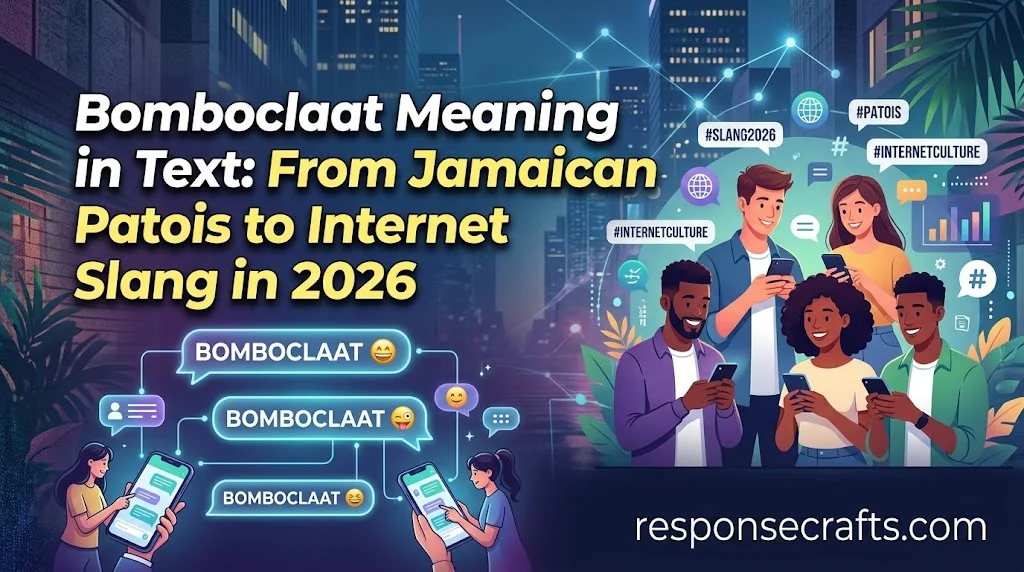
If you’ve seen “bomboclaat” in a TikTok comment, text message, meme, or social media caption, you may wonder what the word actually means. It looks like ordinary internet slang at first glance, but its story goes much deeper. Bomboclaat is a Jamaican Patois expression with a vulgar and culturally specific background. Online communities later adopted the term in ways that often differ sharply from its traditional use.
The bomboclaat meaning in text depends heavily on context. Someone might use it to show shock, anger, frustration, disbelief, or strong emotion. On social media, however, the word can also appear as a meme label or reaction phrase. That newer usage became especially visible during a viral 2019 Twitter trend, when many users treated “bomboclaat” as though it meant something like “caption this” or “give your reaction.” That interpretation wasn’t the original Jamaican meaning.
The spelling can also vary. You may encounter bomboclaat, bomboclat, bumboclaat, bumbaclot, or related forms. These variations appear across Jamaican English, Jamaican diaspora communities, and internet spaces. The important point is that the word isn’t simply a harmless replacement for “wow.” It carries profanity, cultural history, and strong emotional force, which makes context especially important.
Quick Answer
Bomboclaat is a vulgar Jamaican Patois expression traditionally used as an expletive, insult, or strong emotional outburst. Depending on the situation, it can express anger, disgust, shock, frustration, excitement, or disbelief. Dictionary.com describes bumbaclot/bumboclaat as Jamaican slang and notes that the expression can refer literally to a menstrual pad or material used for wiping.
In internet conversations, the meaning can shift.
For example:
- “Bomboclaat!” → A strong reaction to something shocking or frustrating.
- “What the bomboclaat?” → A vulgar expression of confusion or disbelief.
- “That bomboclaat guy…” → Potentially an insult or derogatory reference.
- “Bomboclaat” under a funny picture → Could simply function as an exaggerated meme reaction.
- “Bomboclaat” on a 2019-style meme post → It may relate to the viral “caption this” format rather than the traditional Jamaican meaning.
So, if you’re searching for the bomboclaat meaning in text, the safest short definition is:
Bomboclaat is a vulgar Jamaican Patois expletive used to express strong emotion. Its meaning can shift in internet slang depending on context.
The word is not traditionally a greeting, and it doesn’t literally mean “caption this.” The “caption this” association came from a particular internet meme trend rather than from the original Jamaican usage.
Comparison Overview
| Context | Meaning or Function | Tone | Appropriate for Formal Use? |
| Jamaican Patois | Vulgar expletive, insult, or emotional expression | Very strong | No |
| Private texting | Shock, anger, frustration, disbelief, or emphasis | Vulgar | No |
| TikTok comments | Reaction, joke, meme expression | Informal/vulgar | No |
| Meme captions | Exaggerated reaction or meme label | Humorous/informal | No |
| Directed at another person | Possible insult | Offensive | No |
| Professional communication | Generally inappropriate profanity | Highly informal | No |
This comparison matters because internet slang doesn’t always preserve the meaning of the original expression. A person might type “bomboclaat” after seeing a ridiculous video without intending the same meaning or intensity that a Jamaican speaker would associate with the term.
Main Differences Between Bomboclaat Meaning in Text and Traditional Jamaican Usage
The biggest difference lies in context and cultural function.
Traditional Jamaican usage connects bomboclaat with vulgarity and strong emotional expression. Internet users, especially those outside Jamaica, sometimes treat it as a generic reaction word. The viral meme culture surrounding the term created another layer of meaning that can confuse people trying to understand it literally.
| Feature | Traditional Jamaican Usage | Internet Usage |
| Cultural origin | Jamaican Patois | Global social media |
| Main function | Expletive, insult, emotional outburst | Reaction, meme, joke, emphasis |
| Emotional force | Often strong | Can be exaggerated or playful |
| Meaning | Context-dependent but culturally rooted | Often loosely interpreted |
| “Caption this” meaning | No | Associated with a specific meme trend |
| Profanity | Yes | Sometimes overlooked by users |
| Cultural context | Important | Frequently missing |
Understanding this distinction prevents one of the most common mistakes: assuming that a viral internet definition represents the word’s entire linguistic history.
What Does Bomboclaat Mean in Jamaican Patois?
To understand bomboclaat meaning in text, it helps to start with the expression’s Jamaican roots.
The term appears in forms including bumboclaat and bumbaclot. Dictionary.com explains that the expression has been recorded in Jamaican English since around 1956. Its explanation connects bombo or bumba with West African linguistic roots and clot/claat with “cloth.” The resulting literal reference relates to cloth used around the lower body, including historical uses involving menstrual material or wiping.
That literal background doesn’t mean speakers use the word by mentally translating it every time. Profanity rarely works that way.
Consider the English word “damn.” Its historical meaning doesn’t explain every modern situation in which someone says it. In much the same way, bomboclaat developed a broader emotional and insulting function in Jamaican speech.
Is Bomboclaat a Jamaican Swear Word?
Yes. Bomboclaat is generally treated as vulgar Jamaican profanity.
It can work as an expletive when someone reacts strongly to an event. It can also appear as an insult when directed toward another person.
The emotional setting matters.
Someone who blurts out the expression after receiving terrible news isn’t necessarily addressing another person. They’re using profanity as an emotional release. On the other hand, directing a vulgar term at someone can make the interaction much more aggressive.
That’s why translating bomboclaat into one neat English word doesn’t work perfectly.
Why Literal Translation Can Be Misleading
A literal translation gives you the physical reference behind the word. It doesn’t automatically explain how Jamaican speakers use the expression conversationally.
A better approach considers three layers:
- Literal layer: The word has a vulgar bodily/cloth-related origin.
- Linguistic layer: It developed into Jamaican profanity.
- Contextual layer: Speakers can use it as an emotional outburst, insult, or emphatic reaction.
That three-part distinction gives you a much clearer picture than a one-word dictionary equivalent.
Bomboclaat Meaning in Text Messages
In texting, bomboclaat usually functions as an emotional intensifier rather than a precise noun.
Imagine receiving a message saying:
“I just missed my flight. Bomboclaat!”
The sender isn’t asking you to identify a particular object. They’re expressing frustration and disbelief.
Now consider:
“Bomboclaat, you actually did it!”
Here, the expression could add surprise or excitement depending on the relationship and situation.
The same word can therefore produce different shades of emotion.
Common Emotional Meanings of Bomboclaat in Texting
Depending on context, it can signal:
- Shock
- Disbelief
- Anger
- Frustration
- Disgust
- Excitement
- Confusion
- Strong emphasis
However, don’t assume that every use has the same emotional weight.
A Jamaican speaker may understand cultural and linguistic nuances that an outsider misses. Meanwhile, someone who learned the word from memes may use it simply because they think it sounds funny or dramatic.
Bomboclaat Examples in Texting
Here are several examples that show how context changes the interpretation.
Shock
“Bomboclaat! You paid how much for that?”
Here, the expression emphasizes surprise and disbelief.
Frustration
“The computer crashed again. Bomboclaat.”
In this situation, it works as a frustrated exclamation.
Excitement
“Bomboclaat! We actually won!”
The emotional tone is much more positive, although the word itself remains vulgar.
Insult
“Get out of here, bomboclaat.”
Now the term can function as a direct insult. That makes the message more confrontational.
Meme Reaction
“Bomboclaat 😭”
On social media, this may simply communicate “this is absolutely ridiculous” or an exaggerated reaction.
The emoji doesn’t erase the profanity. It only helps readers interpret the speaker’s emotional tone.
Bomboclaat on TikTok, Instagram, and Social Media
The modern online story of bomboclaat became particularly interesting in 2019.
According to Know Your Meme, the expression became a Twitter meme in September 2019 after a post featuring characters from CatDog used “Bomboclaat” as a caption. Other users began copying the format with reaction images. The trend became associated with the idea of adding captions or reactions to images.
That created a major semantic split.
The traditional expression had one cultural history. The meme gave it another online association.
The Bomboclaat Meme Explained
The 2019 meme format often involved:
Image + “Bomboclaat” + user-generated caption/reaction
People could post an image and allow others to interpret it creatively.
Because this resembled other “caption this” trends, some users began treating bomboclaat as though it itself meant “caption this.”
That wasn’t accurate.
Know Your Meme documents criticism from users who pointed out that bomboclaat did not actually mean “sco pa tu manaa” or function as a phrase asking for someone’s opinion.
This distinction remains important in 2026.
A meme format can create a temporary online meaning without replacing the original meaning of a word.
Why Did Bomboclaat Go Viral?
Several factors helped the expression spread online.
It Was Short
Internet slang thrives on words that are easy to type, remember, and reuse.
It Sounded Unfamiliar to Many Users
For people who hadn’t encountered Jamaican Patois, the unusual spelling made the term stand out.
Meme Culture Reused It Quickly
Once users saw one successful image format, they could reproduce it within seconds.
It Carried Strong Emotional Energy
A vulgar expletive naturally fits exaggerated reaction culture.
Social Media Removed Some Cultural Context
Users could copy a phrase without knowing its Jamaican background. That helped the meme spread while also creating misunderstandings.
Case Study: The 2019 Bomboclaat Meme
The 2019 trend offers a useful example of how internet language evolves.
A September 2019 Twitter post used “Bomboclaat” alongside an image of Winslow from CatDog. According to Know Your Meme, the post accumulated more than 13,000 likes and 3,300 retweets in less than two months. Other users then adopted the format for reaction and caption memes.
The important lesson isn’t just that the meme became popular.
It’s that the word’s online function changed.
People who encountered the term through memes could reasonably assume it was simply another internet phrase. Yet its established Jamaican meaning was much stronger and more vulgar.
That is a classic example of how social media can turn a culturally specific expression into a global meme while leaving many users unaware of its original context.
Bomboclaat in 2026: The “Bomboclat Wallahi” Meme
The word hasn’t disappeared from internet culture.
In 2026, a new meme cycle called “Bomboclat Wallahi” gained attention through TikTok and other social platforms. Know Your Meme describes it as a viral catchphrase connected to comedian and actor Jacob Berger’s skit involving an NYPD character and a Caribbean food vendor.
The phrase combines “bomboclat”, the Jamaican Patois expletive, with “wallahi,” an Arabic expression meaning roughly “by God.”
According to the documented meme history, clips and edits spread widely during April and May 2026, with users turning the original footage into increasingly exaggerated meme edits.
This is another important development in the word’s online history.
The 2019 trend associated bomboclaat with a caption/reaction format. The 2026 trend uses it as part of a viral catchphrase and remixable meme sound.
Neither trend should be mistaken for the traditional Jamaican definition.
Bomboclaat vs. Similar Expressions
People often search for a direct English equivalent. That’s understandable, but there isn’t always a perfect match.
| Expression | General Function | Cultural Background | Similarity |
| Bomboclaat | Strong expletive/reaction | Jamaican Patois | Strong emotional force |
| Bloodclaat | Jamaican profanity/exclamation | Jamaican Patois | Similar vulgar register |
| Rasclaat | Strong expletive | Jamaican Patois | Similar emotional use |
| WTF | Shock, confusion, disbelief | Internet English | Similar reaction function |
| Damn | Surprise, anger, emphasis | English | Usually less culturally specific |
| OMG | Surprise or excitement | Internet English | Generally much milder |
These aren’t perfect synonyms.
For example, OMG can appear in a workplace chat without causing much concern. Bomboclaat carries a much stronger vulgar association.
Similarly, translating every Jamaican profanity into the nearest English swear word can flatten important cultural differences.
Read More: UWU Meaning in Text: Is It Cringe, Cute, or Just Internet Slang in 2026?
Bomboclaat vs. Bumboclaat: Are They the Same?
You may notice several spellings online:
- Bomboclaat
- Bomboclat
- Bumboclaat
- Bumbaclot
- Bumbclaat
These forms appear in different contexts and communities. Dictionary.com specifically lists bumbaclot and bumboclaat while noting bomboclaat among the alternate spellings.
Online spelling is especially inconsistent because people often write Jamaican expressions according to what they heard rather than following one standardized spelling convention.
So, if someone writes “bomboclat” instead of “bumboclaat,” that doesn’t automatically mean they’re referring to an entirely different slang term.
The context still matters.
Is Bomboclaat Offensive?
Yes. Bomboclaat can be highly offensive.
Its status as profanity doesn’t disappear simply because social media users employ it casually.
That creates an interesting gap between intention and impact.
Someone might write the word because they saw it in a meme and think it means “that’s crazy.” Another reader, especially someone familiar with Jamaican usage, may recognize the stronger profanity behind it.
When You Should Avoid Bomboclaat
It’s safest to avoid the term in:
- Professional emails
- Job interviews
- School assignments
- Business conversations
- Formal public statements
- Conversations with people you don’t know well
- Situations where cultural context is unclear
Internet familiarity isn’t the same as universal acceptability.
A word can be common in memes and still be inappropriate in ordinary conversation.
Common Misunderstandings About Bomboclaat
Several misconceptions appear repeatedly online.
Bomboclaat Doesn’t Simply Mean “Wow”
It can express surprise, but “wow” doesn’t capture its vulgarity or cultural background.
Bomboclaat Isn’t Traditionally a Greeting
It shouldn’t automatically be interpreted as a casual “hello” or “what’s up.”
Bomboclaat Doesn’t Literally Mean “Caption This”
That association came from the 2019 meme format rather than the traditional Jamaican definition.
Bomboclaat Isn’t Automatically Friendly
A person might use it jokingly with friends, but the expression itself remains vulgar.
Viral Usage Doesn’t Erase Cultural Meaning
A meme can change how people use a word online. It doesn’t erase where that word came from.
How to Understand Bomboclaat in a Text
If someone sends you “bomboclaat,” don’t interpret the word in isolation.
Look at the whole message.
Check the Surrounding Words
Compare:
“Bomboclaat, that’s expensive!”
with:
“You bomboclaat.”
The first looks like an emotional reaction. The second may be directed at another person as an insult.
Consider the Relationship
Friends often use stronger language with each other than coworkers do.
That doesn’t make every use acceptable. It simply changes how the message may be intended.
Look at the Platform
A TikTok comment may use the term as meme slang. A private text from someone familiar with Jamaican Patois may carry a more culturally grounded meaning.
Watch the Emojis
An emoji can help clarify tone.
For example:
- 😭 → exaggerated disbelief or humor
- 😡 → anger
- 😂 → joking or amusement
- 🤦 → frustration
- 😳 → shock
Still, emojis aren’t a perfect translation. Context remains king.
Practical Case Study: Three Different Messages
Consider these three messages:
“Bomboclaat! I can’t believe he did that.”
This likely expresses shock or disbelief.
“That bomboclaat ruined everything.”
Here, the word may function as a strong insult.
“Bomboclaat 😂😭”
On social media, this could simply mean “this is unbelievably funny or ridiculous.”
The spelling never changed.
The context did.
That’s why a dictionary definition alone can’t always explain slang accurately.
Is Bomboclaat Appropriate to Use?
With Jamaican Friends
Don’t assume that knowing a Jamaican person automatically makes the expression acceptable. Personal preferences differ.
If you’re unfamiliar with Jamaican Patois, understanding the term first is better than trying to imitate it.
With Non-Jamaican Friends
Some people may recognize bomboclaat entirely through memes. Others may understand it as Jamaican profanity.
That difference can create awkward situations.
At Work or School
Avoid it.
There’s little practical benefit to using strong profanity in formal settings when clearer alternatives exist.
On Social Media
Context becomes more complicated.
A meme audience may understand the expression as exaggerated internet slang. A wider audience may interpret it through its Jamaican meaning.
If cultural context matters to your post, make sure you’re not accidentally reducing a culturally rooted expression to a random meme catchphrase.
How Internet Culture Changed the Bomboclaat Meaning in Text
Internet slang often behaves like a river. It picks up new meanings as it moves through different communities.
Bomboclaat is a strong example.
Its Jamaican meaning existed long before social media. Then the expression entered global meme culture. Users began applying it to reaction images. Later, newer meme formats brought it back into viral circulation.
This doesn’t create one single “correct” internet meaning.
Instead, several layers now exist:
Jamaican profanity → global slang → meme expression → viral catchphrase
Each layer has its own context.
That is why someone searching “bomboclaat meaning in text 2026” may find conflicting explanations. Different websites and users are describing different stages of the word’s journey.
Cultural Context Matters
Jamaican Patois isn’t simply a collection of funny slang words for the internet.
It is a real language variety with its own vocabulary, grammar, pronunciation, history, and cultural identity.
Jamaicans.com notes that Jamaican society includes many different cultural and linguistic experiences and cautions against reducing Jamaican identity to stereotypes involving Patois or expressions such as bomboclaat.
That matters because internet culture sometimes strips expressions from their original communities.
A term becomes viral. People repeat it. The original cultural context fades.
Understanding the source helps you avoid that trap.
How to Respond When Someone Texts “Bomboclaat”
Your response should depend on the context.
If They’re Clearly Joking
You can respond naturally without copying the profanity.
For example:
“😂 Okay, that reaction says everything.”
If They’re Angry
Don’t automatically respond with another insult.
A calmer reply can prevent the conversation from becoming a profanity contest.
If You Don’t Understand
Ask what they mean.
That’s especially useful if the person uses Jamaican Patois or another dialect you aren’t familiar with.
If You Find It Offensive
You can simply set a boundary:
“I get that you’re joking, but I’d rather you not use that language with me.”
Clear communication beats guessing.
Key Facts About Bomboclaat
- Bomboclaat is associated with Jamaican Patois.
- Bumboclaat and bumbaclot are common spelling variants.
- The term has a documented history in Jamaican English dating to around 1956, according to Dictionary.com.
- Its literal background relates to cloth used around the lower body.
- It developed into a vulgar expletive and insult.
- It became a major internet meme in 2019.
- The 2019 meme helped associate the term with caption and reaction posts.
- That meme usage did not replace the traditional Jamaican meaning.
- In 2026, “Bomboclat Wallahi” became another viral meme phrase and generated new online usage.
- The expression remains vulgar, even when used humorously online.
FAQs:
What does bomboclaat mean in text?
Bomboclaat is a vulgar Jamaican Patois expletive that can express shock, anger, frustration, disbelief, disgust, or other strong emotions. Online users sometimes use it as a meme reaction.
Is bomboclaat a Jamaican swear word?
Yes. Bomboclaat is Jamaican profanity. Its traditional use can function as an expletive or insult. Dictionary.com describes related forms such as bumbaclot and bumboclaat as vulgar Jamaican slang.
Does bomboclaat mean “caption this”?
Not traditionally. The “caption this” association came from the 2019 internet meme trend, where users placed the word beside images and encouraged reaction or caption-style responses.
Is bomboclaat offensive?
Yes. It can be strongly offensive, particularly when directed at another person. Its use as a meme doesn’t remove its vulgar Jamaican background.
Are bomboclaat and bumboclaat the same?
They are commonly treated as variant spellings of the same Jamaican expression. Other forms include bumbaclot and bomboclat. The exact spelling varies across communities and online spaces.
Conclusion
The bomboclaat meaning in text can’t be reduced to one simple English word. At its roots, bomboclaat is a vulgar Jamaican Patois expression used as an expletive, insult, or powerful emotional reaction. Its literal history relates to cloth used around the lower body, but its everyday force comes from its development as Jamaican profanity.
The internet added another chapter. In 2019, the word became associated with a viral Twitter meme in which users paired it with images and created captions or reactions. That caused many people to misunderstand the term as meaning “caption this.” The meme format was real, but that wasn’t the original meaning of the Jamaican expression.
By 2026, the term continues to appear in evolving meme culture, including the “Bomboclat Wallahi” trend documented during the first half of the year. The lesson is simple: online slang can evolve quickly, but cultural context still matters. If you encounter bomboclaat in a text, look at the surrounding words, the platform, the relationship between the speakers, and the tone before deciding what it means.












1 thought on “Bomboclaat Meaning in Text: From Jamaican Patois to Internet Slang in 2026”