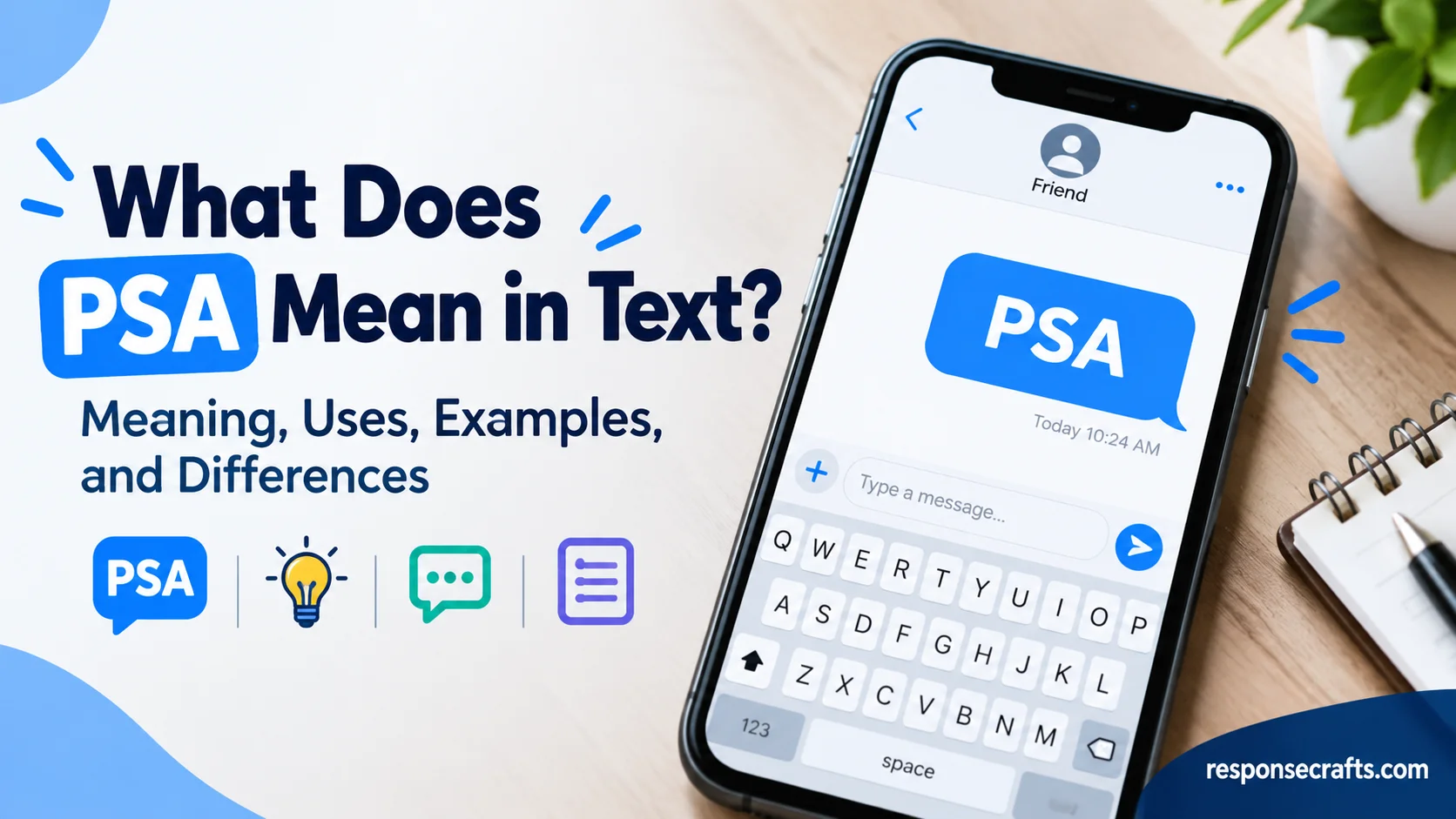
Have you ever received a text that starts with “PSA:” and wondered what the sender actually meant? You’re not alone. This short abbreviation appears in text messages, group chats, social media posts, workplace conversations, and online communities. In most everyday conversations, PSA means “Public Service Announcement.” People use it to introduce information they think others should know. The message might be serious, helpful, practical, or even funny.For example, someone might text, “PSA: The store closes at 6 today.” Another person might post, “PSA: Always check the return policy before buying online.”
In both cases, “PSA” tells readers to pay attention to the information that follows. However, the modern use of PSA has expanded beyond its traditional meaning. You don’t need to represent a government agency, nonprofit, or public organization to use it. Online, PSA has become a casual attention-grabber for sharing reminders, warnings, advice, corrections, and useful information. This guide explains what PSA means in text, how people use it, what it means on social media, how it differs from similar abbreviations such as FYI, and how to respond when someone sends you a PSA.
Quick Answer: What Does PSA Mean in Text?
PSA usually means “Public Service Announcement” in text messages and online conversations.
People use PSA before a message to signal that the following information is useful, important, or worth noticing.
Examples
- “PSA: The meeting starts at 9 instead of 10.”
- “PSA: Don’t forget your passport.”
- “PSA: The deadline is tomorrow.”
- “PSA: Back up your phone before installing the update.”
The abbreviation originally referred to public messages designed to inform or educate people about issues affecting the public. In texting and social media, however, people often use it much more casually.
A simple way to understand it is:
PSA = “Here’s something you should know.”
The tone can range from serious and informative to playful and sarcastic.
Comparison Overview
The meaning of PSA becomes clearer when you compare it with other common internet abbreviations.
| Abbreviation | Full Meaning | Typical Purpose | Example |
| PSA | Public Service Announcement | Share useful or important information | “PSA: The deadline changed.” |
| FYI | For Your Information | Give someone information | “FYI, the meeting moved.” |
| BTW | By the Way | Add another point | “BTW, I called the office.” |
| IMO | In My Opinion | Express a personal view | “IMO, that movie was better.” |
| TIL | Today I Learned | Share something newly learned | “TIL that octopuses have three hearts.” |
| PS | Postscript | Add something after a message | “PS: Bring an umbrella.” |
The biggest distinction is purpose and emphasis.
A PSA often tells readers that the information deserves their attention. FYI usually sounds more neutral. It simply passes information along.
For instance:
- PSA: “PSA: The parking lot closes at 8.”
- FYI: “FYI, the parking lot closes at 8.”
Both sentences communicate the same fact. The first gives the information a stronger announcement-like feel.
Main Differences Between PSA in Text and Other Abbreviations
The PSA meaning in text overlaps with several other abbreviations. Yet each one carries a slightly different tone.
PSA vs. FYI
PSA and FYI are probably the easiest abbreviations to confuse.
PSA suggests that the information may matter to several people or deserves attention.
FYI, which means “for your information,” sounds more like a straightforward information-sharing phrase.
Consider these examples:
“PSA: The building entrance has moved.”
This sounds like a notice intended for everyone who might enter the building.
“FYI, the building entrance has moved.”
This sounds more personal. The sender may simply want one person to know.
PSA vs. Reminder
A reminder directly tells someone not to forget something.
A PSA can contain a reminder, but it doesn’t have to.
For example:
- Reminder: “Don’t forget the meeting tomorrow.”
- PSA: “PSA: The meeting starts at 8 tomorrow.”
The second sentence feels more like a general announcement.
PSA vs. Warning
A warning focuses specifically on potential danger, trouble, or a negative consequence.
A PSA can deliver a warning, but it can also provide harmless information.
For example:
- Warning: “Don’t click that suspicious link.”
- PSA: “PSA: That email contains a suspicious link.”
The PSA introduces the information. The warning tells you what action to take.
What Does PSA Stand For?
PSA stands for “Public Service Announcement.”
The phrase has traditionally described messages created to inform the public about topics that may affect people’s health, safety, behavior, or general well-being.
Traditional PSAs have appeared through:
- Television
- Radio
- Newspapers
- Posters
- Public websites
- Community campaigns
- Educational programs
A traditional PSA might encourage people to wear seat belts, avoid dangerous driving, prepare for emergencies, or protect themselves from health risks.
The term eventually moved into everyday internet language.
Today, someone doesn’t need to create an official public campaign to use PSA. A person can write a two-line message in a group chat and jokingly call it a PSA.
That’s one reason the abbreviation feels so natural online.
What Does PSA Mean on Social Media?
On social media, PSA usually means that the writer wants followers or other users to pay attention to a particular piece of information.
You may see it at the beginning of posts, captions, comments, videos, or replies.
For example:
PSA: Check the expiration date before using that coupon.
Or:
PSA: The event begins at 6 PM, not 7 PM.
Social media makes PSA especially useful because users often communicate with large audiences. A person may post something for hundreds or thousands of followers rather than sending the information individually.
Common social media PSA topics
People frequently use PSA to introduce:
- Public reminders
- Product information
- Schedule changes
- Safety tips
- Community notices
- Event updates
- Corrections
- Helpful advice
- Consumer warnings
- Everyday observations
- Humorous opinions
The abbreviation works almost like a verbal highlighter. It tells readers, “Pay attention to this part.”
Why Do People Say “PSA” Before a Message?
The word PSA gives a message an immediate sense of importance.
That doesn’t necessarily mean the information is urgent. Instead, it tells the reader that the sender considers the information worth sharing.
PSA can signal several things
The information affects other people.
A sender may use PSA when a message applies to an entire group.
The information corrects a misconception.
Someone might write a PSA after noticing that many people believe something inaccurate.
The information serves as a reminder.
PSA can introduce deadlines, schedules, appointments, or important dates.
The information provides practical advice.
People often use PSA before tips that could save time, money, or trouble.
The message is intentionally humorous.
Online users sometimes use PSA dramatically to introduce an obvious or silly observation.
For example:
“PSA: Eating an entire pizza at midnight may affect your sleep.”
The information isn’t exactly breaking news. That’s the joke.
How Is PSA Used in Texting?
The abbreviation usually appears at the beginning of a message, followed by a colon.
PSA before a reminder
“PSA: Bring your ID tomorrow.”
Here, the sender wants everyone to remember something.
PSA before a warning
“PSA: Don’t share your password over text.”
The abbreviation introduces information that could help people avoid a problem.
PSA before a correction
“PSA: The store actually closes at 7, not 8.”
The sender wants to correct information that may have been misunderstood.
PSA before useful information
“PSA: You can renew your parking permit online.”
The message provides a practical tip.
PSA in a humorous message
“PSA: Coffee doesn’t count as eight hours of sleep.”
The sender isn’t making an official announcement. The exaggerated format creates humor.
What Does PSA Mean in a Group Chat?
A group chat is one of the most natural places to use PSA.
Why? Because the information often applies to several people at once.
Imagine a group of friends planning a trip. One person discovers that the museum closes earlier than expected.
They could send:
“PSA: The museum closes at 4 PM on Sundays.”
Everyone in the group now knows the information.
The same pattern works in workplace, school, family, and community chats.
Examples of group-chat PSAs
Workplace:
“PSA: The office will close at noon on Friday.”
School:
“PSA: The assignment deadline moved to Thursday.”
Family:
“PSA: Dinner starts at 7 tonight.”
Friends:
“PSA: The concert venue changed.”
In each example, PSA makes the message feel like a shared announcement rather than a private comment.
What Does PSA Mean in a Funny or Casual Text?
One of the most interesting parts of modern PSA slang usage is its humorous side.
People often borrow formal language to make ordinary observations sound much more dramatic.
For example:
“PSA: Never go grocery shopping when you’re hungry.”
That’s not an official public service announcement. The writer uses the phrase because it makes the advice sound amusingly serious.
Another example:
“PSA: Monday mornings should come with a warning label.”
The humor comes from treating a personal opinion like an official announcement.
Why does this work?
PSA carries a formal, public-facing tone. Putting it before something trivial creates a contrast.
It’s similar to wearing a business suit to buy a carton of milk. The mismatch makes the situation funny.
Read More: JS Meaning in Texting: What “JS” Means in DMs in 2026?
Is PSA Always Serious?
No.
The context determines the tone.
A PSA can be:
| Tone | Example | Purpose |
| Serious | “PSA: Never share your banking password.” | Safety advice |
| Informative | “PSA: The event starts at 6.” | Useful information |
| Helpful | “PSA: Save your receipt for returns.” | Practical advice |
| Corrective | “PSA: The deadline is Friday.” | Fix misinformation |
| Humorous | “PSA: Snacks disappear faster during movie night.” | Entertainment |
The same abbreviation can therefore appear in a serious warning and a joke.
Look at the words around PSA rather than assuming the tone from the abbreviation alone.
PSA Meaning in Different Contexts
Context plays a major role when interpreting abbreviations.
| Context | What PSA Usually Means | Typical Example |
| Text message | Public Service Announcement | “PSA: Don’t forget your appointment.” |
| Group chat | Shared notice or reminder | “PSA: Plans changed to Saturday.” |
| Social media | Information for followers | “PSA: This feature is now available.” |
| Workplace chat | General workplace announcement | “PSA: The system goes offline tonight.” |
| School chat | Student or class notice | “PSA: The exam starts at 9.” |
| Online community | Helpful information or warning | “PSA: Read the rules before posting.” |
| Casual conversation | Attention-grabbing advice | “PSA: Always check the weather.” |
This flexibility explains why PSA appears across so many online spaces.
How to Use PSA Correctly in a Text
Using PSA isn’t complicated. The key is knowing when the announcement-style tone makes sense.
Good situations for PSA
Use PSA when you’re sharing:
- Information that affects a group
- An important reminder
- A useful warning
- A correction
- A practical tip
- An event update
- A change people should know about
When PSA may feel unnecessary
You probably don’t need PSA for every ordinary statement.
For example:
“PSA: I bought milk.”
That doesn’t usually communicate anything useful to a wider audience.
Likewise, sending “PSA: How are you?” would sound strange because the message isn’t really an announcement.
The abbreviation works best when the information has some value beyond the immediate sentence.
Real-Life Examples of PSA in Text
The best way to understand the PSA meaning in texting is to see it in realistic situations.
Friends making plans
“PSA: The movie starts at 8, not 8:30.”
The sender wants the group to arrive on time.
Workplace communication
“PSA: The conference room is reserved until 3 PM.”
The message prevents people from relying on outdated information.
School communication
“PSA: The professor moved the exam to Thursday.”
This gives classmates an important update.
Family communication
“PSA: Grandma’s birthday dinner is Saturday.”
The sender reminds everyone about a shared event.
Online shopping
“PSA: Read the return policy before ordering.”
The sender offers consumer advice.
Safety
“PSA: Don’t use the same password for every account.”
The message provides a practical security reminder.
Humor
“PSA: Four hours of sleep isn’t a personality trait.”
The formal opening makes an everyday observation sound deliberately official.
Case Study: How One “PSA” Changes the Tone
Consider two versions of the same message:
Version A:
“The parking lot closes at 9.”
Version B:
“PSA: The parking lot closes at 9.”
Both communicate the same fact.
However, Version B feels more like a notice intended for everyone. The abbreviation creates a small shift in emphasis.
Now consider a third version:
“PSA: The parking lot closes at 9, so don’t leave your car there overnight.”
Here, the PSA introduces information followed by a practical consequence.
This illustrates an important point: PSA doesn’t change the factual content of a message. It changes how the sender frames that information.
How Should You Respond When Someone Texts “PSA”?
You don’t need a special response.
Your reply should match the content and tone of the announcement.
If the PSA contains useful information
You could say:
- “Thanks for the heads-up!”
- “Good to know.”
- “Thanks for letting everyone know.”
- “Got it.”
- “I didn’t know that. Thanks!”
If the PSA is a warning
Acknowledge the information:
“Thanks for the warning.”
If the PSA is funny
Match the tone:
“Noted 😂.”
Or:
“Honestly, that’s true.”
The best response depends less on the abbreviation and more on what comes after it.
Other Meanings of PSA
Although “Public Service Announcement” is the usual meaning in texting, PSA has other established meanings in specific fields.
PSA in medicine
In medicine, PSA commonly refers to prostate-specific antigen, a protein measured through a blood test.
This meaning has nothing to do with texting slang.
If a medical article discusses PSA levels, the context makes the intended meaning clear.
PSA in sports-card collecting
Professional Sports Authenticator, commonly known as PSA, is a major authentication and grading company in the sports and collectibles industry.
Collectors may discuss PSA grades, PSA-certified cards, or PSA slabs.
Again, context determines the meaning.
PSA in media
In broadcasting and communications, PSA still means Public Service Announcement in its traditional sense.
This is the meaning that directly connects to texting and social media usage.
PSA meaning depends on context
| Field | PSA Meaning |
| Texting | Public Service Announcement |
| Social media | Public Service Announcement |
| Media | Public Service Announcement |
| Medicine | Prostate-specific antigen |
| Sports cards | Professional Sports Authenticator |
If someone writes “PSA: Don’t forget your meeting,” they’re almost certainly using the communication-related meaning rather than the medical or collecting-related one.
Common Misunderstandings About PSA
PSA always means a serious warning
Not necessarily.
People frequently use PSA for casual reminders and jokes. The surrounding message determines the seriousness.
Only governments can use PSA
That’s true only if you’re talking about the traditional institutional use of the term.
Online, anyone can use PSA as an informal label for information they want to share.
PSA and FYI mean exactly the same thing
They overlap, but they aren’t identical.
PSA often has a stronger announcement or attention-grabbing quality. FYI tends to sound more neutral.
PSA always requires action
No.
A PSA can simply provide information. The reader may not need to do anything.
PSA has one meaning everywhere
Definitely not.
The abbreviation has established meanings in several fields. Context is the deciding factor.
Conclusion
Understanding what PSA means in text is simple once you know the context. In most texts, group chats, and social media posts, PSA means “Public Service Announcement.” People use it to introduce information they believe others should know, whether that’s a reminder, warning, correction, helpful tip, or simple update.
Unlike a formal public announcement, an online PSA doesn’t need to come from an organization or government agency. Anyone can use the abbreviation. It can also be serious or completely playful, depending on the message that follows. The easiest way to remember the PSA meaning in texting is: “Here’s something you should know.” If you see “PSA:” at the beginning of a message, pay attention to what comes next. That’s usually where the useful information is.
FAQS:
What does PSA mean in text?
PSA usually means “Public Service Announcement” in text messages. People use it to introduce information, reminders, warnings, corrections, or advice that they want others to notice.
What does PSA mean on social media?
On social media, PSA means “Public Service Announcement.” Users commonly put it before helpful information, warnings, announcements, or even humorous observations they want their followers to see.
Is PSA the same as FYI?
Not exactly. FYI means “For Your Information,” while PSA means “Public Service Announcement.” FYI usually sounds neutral, whereas PSA often gives the message a stronger announcement or attention-grabbing tone.
Can PSA be used in a funny way?
Yes. People frequently use PSA humorously online. For example, someone might write “PSA: Never go grocery shopping when you’re hungry.” The formal wording makes an ordinary observation sound amusingly important.
What should you say when someone texts PSA?
You can respond naturally with “Thanks for the heads-up,” “Good to know,” “Got it,” or “Thanks for letting everyone know.” If the PSA is clearly a joke, a humorous reply or emoji can work just as well.












1 thought on “What Does PSA Mean in Text? Meaning, Uses, Examples”