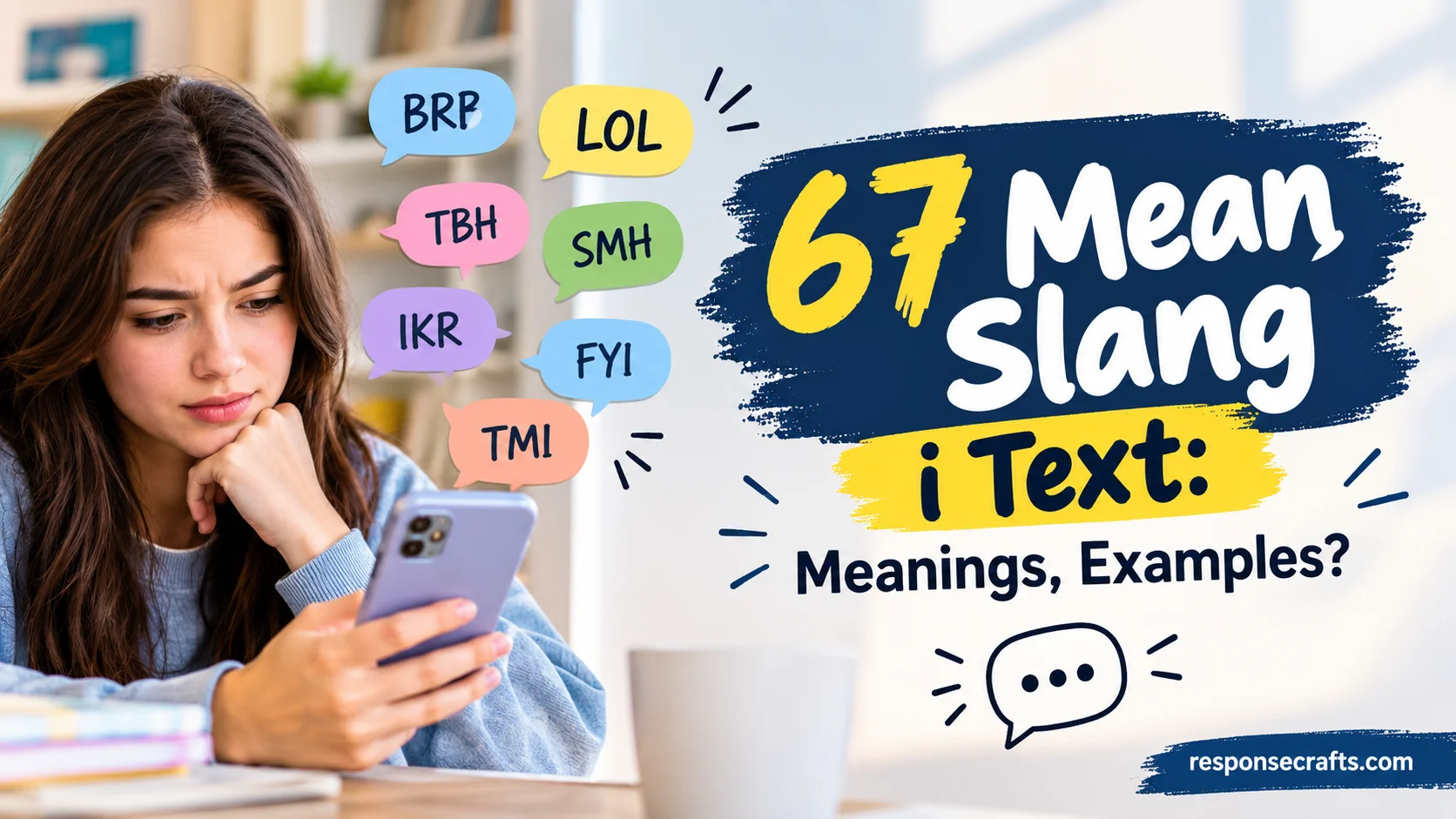
If someone sends you a message like “L,” “clown,” “STFU,” “cap,” or “touch grass,” the meaning usually goes beyond the literal words. These expressions can mock someone, dismiss an opinion, show frustration, or simply tease a friend. That’s what makes 67 meaning slang in text worth understanding. Text slang changes quickly, and the same expression can feel funny or insulting depending on the situation.
A close friend might call you a “clown” after you make a silly mistake, and you may both laugh about it. However, a stranger using the same word could be trying to put you down or start an argument. The same idea applies to many internet slang terms, including numbers and short expressions that people use in texts, comments, and social media posts. Understanding the context and tone can help you figure out what someone actually means.
If you’ve recently seen “67” in a text, comment, or social media conversation, you may be wondering what it means and why people use it. Like other forms of modern online slang, its meaning can depend on the conversation, the people involved, and the platform where you see it. In this guide, we’ll explain 67 meaning in text, explore its common uses, and give you clear examples so you can understand the expression more easily.
Quick Answer
Mean slang in text refers to slang words, abbreviations, and internet expressions that can insult, mock, dismiss, criticize, or provoke someone.
Common examples include:
- Clown — someone behaving foolishly or embarrassingly
- L — a “loss,” often used to mock someone’s failure or bad opinion
- Cap — a lie or false statement
- Sus — suspicious or questionable
- Try-hard — someone perceived as trying too hard to impress others
- Loser — an insulting term for someone viewed as unsuccessful
- STFU — “shut the fuck up”
- Touch grass — telling someone to get offline and return to real life
- Ratioed — used when a post receives more negative or opposing engagement than support
- Ragebait — content deliberately designed to provoke anger
However, mean slang isn’t automatically offensive every time someone uses it. Friends often use insults jokingly as part of playful banter. The relationship, situation, wording, and tone all matter.
Comparison Overview
The easiest way to understand mean slang is to compare the different ways people use it.
| Type of slang | What it usually communicates | Example |
| Insulting slang | Attacks someone’s character or behavior | “You’re such a jerk.” |
| Mocking slang | Makes fun of someone’s mistake or behavior | “Bro is a clown.” |
| Dismissive slang | Rejects someone’s comment or opinion | “Whatever.” |
| Profane slang | Uses strong swear words | “WTF?” |
| Internet slang | Uses online culture to criticize or mock | “L take.” |
| Deceptive-person slang | Calls someone dishonest or fake | “You’re capping.” |
| Provocative slang | Attempts to trigger a reaction | “Ragebait.” |
| Playful teasing | Insults someone without serious hostility | “You idiot 😂” |
The key distinction is intent. Someone can use the same word as a joke, an insult, or a friendly nickname depending on the circumstances.
Main Differences Between Mean Slang in Text
Mean slang doesn’t form one single category. Some expressions directly insult a person, while others criticize an opinion, dismiss a conversation, or describe suspicious behavior.
Direct insults
Terms such as jerk, idiot, moron, asshole, and dumbass directly target someone.
These expressions usually carry more emotional weight because they focus on the person’s character or intelligence.
Mocking expressions
Words such as clown, cringe, lame, poser, and try-hard often ridicule someone’s behavior rather than simply calling them a bad person.
For example:
“That was such a cringe post.”
This criticizes the post. It doesn’t necessarily attack the person’s entire character.
Dismissive expressions
Terms such as IDC, IDGAF, whatever, K, and L can shut down a conversation without directly explaining why.
They often sound colder in text because the recipient can’t hear the speaker’s tone.
Internet-based insults
Expressions such as ratioed, skill issue, touch grass, NPC, and L take come from online culture.
They often work as shorthand. A person can communicate a fairly complicated criticism using only two or three words.
67 Mean Slang Words and Phrases in Text
The following list covers common expressions that can sound insulting, dismissive, mocking, or hostile. Meanings can vary by community and context.
1. Asshole
Meaning: A vulgar insult for someone who behaves badly, selfishly, or inconsiderately.
Example: “He was being an asshole about the whole thing.”
Tone: Strong and openly insulting.
The word usually carries more force than simply calling someone rude.
2. Jerk
Meaning: A person who behaves rudely, selfishly, or inconsiderately.
Example: “Don’t be a jerk.”
Tone: Mild to moderate.
Compared with stronger profanity, “jerk” can sound relatively tame.
3. Idiot
Meaning: An insulting way to describe someone as foolish or unintelligent.
Example: “I can’t believe I forgot that. I’m such an idiot.”
The word can also be self-directed, which makes it less aggressive in some situations.
4. Dumbass
Meaning: A vulgar insult for someone behaving foolishly.
Example: “You dumbass, you left the keys inside.”
Among close friends, this may be teasing. From a stranger, it can sound hostile.
5. Moron
Meaning: A harsh insult suggesting that someone lacks intelligence or judgment.
Example: “Only a moron would do that.”
The term is generally more aggressive than “fool.”
6. Loser
Meaning: An insulting label for someone viewed as unsuccessful, uncool, or pathetic.
Example: “Stop acting like a loser.”
Its meaning depends heavily on the relationship between the people texting.
7. Clown
Meaning: Someone behaving foolishly, ridiculously, or embarrassingly.
Example: “Bro really thought that would work. What a clown.”
Online, clown has become a common way to mock someone’s behavior.
8. Fool
Meaning: Someone acting without good judgment.
Example: “You made the same mistake twice, fool.”
It can sound playful in some contexts because it isn’t always as harsh as profanity.
9. Douchebag
Meaning: A vulgar insult for an obnoxious, arrogant, selfish, or unpleasant person.
Example: “That guy acted like a total douchebag.”
This term is clearly negative and generally doesn’t fit professional communication.
10. Prick
Meaning: A vulgar insult for someone perceived as unpleasant or mean.
Example: “He’s being a prick today.”
It’s stronger and more aggressive than “jerk.”
11. Dick
Meaning: A vulgar insult for someone behaving badly or unpleasantly.
Example: “Don’t be a dick.”
Although the literal word has another meaning, slang commonly uses it as an insult.
12. Tool
Meaning: A person who behaves foolishly or allows others to use or manipulate them.
Example: “He’s acting like a tool.”
The insult often targets someone’s behavior rather than intelligence alone.
13. Weirdo
Meaning: Someone perceived as strange or socially unusual.
Example: “That guy is such a weirdo.”
The term can be playful or genuinely insulting.
14. Creep
Meaning: A person whose behavior seems disturbing, inappropriate, or unsettling.
Example: “That message was creepy. What a creep.”
Unlike lighter insults, “creep” can signal a serious concern about someone’s behavior.
15. Punk
Meaning: A person viewed as disrespectful, troublesome, weak, or insignificant.
Example: “Don’t let that punk bother you.”
Its exact meaning varies by context and region.
16. Lame
Meaning: Boring, uncool, disappointing, or unimpressive.
Example: “That excuse is lame.”
It usually criticizes something rather than attacking someone’s identity.
17. Cringe
Meaning: Embarrassing, awkward, or uncomfortable to watch.
Example: “That video was so cringe.”
The term has become particularly common in social-media conversations.
18. Basic
Meaning: Predictable, unoriginal, or strongly associated with mainstream tastes.
Example: “That opinion is pretty basic.”
It can be playful, but it can also belittle someone’s preferences.
19. Corny
Meaning: Overly sentimental, cliché, or uncool.
Example: “That pickup line was corny.”
The word isn’t always deeply insulting. Often, it simply means something feels cheesy.
20. Cheesy
Meaning: Excessively sentimental, cliché, or lacking subtlety.
Example: “That message was cheesy.”
Someone may call a romantic message “cheesy” without intending serious hostility.
21. Try-hard
Meaning: Someone perceived as putting excessive effort into appearing impressive, cool, or successful.
Example: “He’s such a try-hard in every game.”
The criticism focuses on perceived behavior.
22. Wannabe
Meaning: Someone who wants to be perceived as something they aren’t.
Example: “He’s a wannabe influencer.”
The expression usually implies that the person hasn’t earned the identity they claim.
23. Poser
Meaning: Someone pretending to have an identity, interest, skill, or lifestyle they don’t genuinely possess.
Example: “He’s just a poser.”
It often appears in conversations about music, fashion, hobbies, and online identities.
24. NPC
Meaning: Internet slang comparing someone to a non-player character because they seem predictable, repetitive, or lacking independent thought.
Example: “He just repeats whatever everyone else says. NPC behavior.”
The term comes from video-game terminology.
25. Bot
Meaning: Someone behaving mechanically, predictably, or without original thought.
Example: “This guy replies like a bot.”
It can also be used jokingly when someone gives repetitive answers.
26. Clown behavior
Meaning: Foolish, embarrassing, or ridiculous behavior.
Example: “Posting that after what happened is clown behavior.”
Unlike simply calling someone a clown, this phrase focuses more specifically on an action.
27. L take
Meaning: A dismissive way to say someone’s opinion is bad or misguided.
Example: “L take. You clearly didn’t watch the game.”
Here, L represents “loss,” turning disagreement into a kind of scorekeeping.
28. Skill issue
Meaning: A sarcastic way to say someone’s problem happened because they lack ability.
Example: “You lost again? Skill issue.”
Gaming culture helped popularize the phrase, although people now use it more broadly.
29. Touch grass
Meaning: Telling someone to spend less time online and reconnect with ordinary real-world activities.
Example: “You’ve been arguing about this for six hours. Touch grass.”
It’s usually dismissive and often sarcastic.
30. Get a life
Meaning: A blunt way to tell someone they spend too much time on something pointless.
Example: “You’re still arguing about this? Get a life.”
The phrase can sound especially hostile when directed at a stranger.
31. STFU
Meaning: “Shut the fuck up.”
Example: “STFU, you’re making no sense.”
This is a strong and vulgar way to tell someone to stop talking.
32. GTFO
Meaning: “Get the fuck out.”
Example: “GTFO with that excuse.”
Depending on context, it can express anger, disbelief, or joking surprise.
33. FOH
Meaning: Commonly short for “fuck outta here.”
Example: “FOH with that nonsense.”
It often dismisses a claim or rejects someone’s behavior.
34. WTF
Meaning: “What the fuck?”
Example: “WTF just happened?”
It can express anger, confusion, surprise, or disbelief.
35. WTH
Meaning: “What the hell?”
Example: “WTH are you talking about?”
It’s generally milder than WTF.
36. IDC
Meaning: “I don’t care.”
Example: “IDC what they think.”
Depending on context, it can communicate genuine indifference or deliberate dismissal.
37. IDGAF
Meaning: “I don’t give a fuck.”
Example: “IDGAF about that argument.”
This expression is considerably more aggressive than IDC.
38. IDK
Meaning: “I don’t know.”
Example: “IDK what happened.”
Unlike many terms on this list, IDK isn’t inherently mean. A short or abrupt use can nevertheless sound dismissive.
39. K
Meaning: A shortened version of “okay.”
Example: “K.”
In text conversations, the brevity can sometimes signal irritation, coldness, or disinterest.
40. Whatever
Meaning: A dismissive response showing disagreement, indifference, or frustration.
Example: “Whatever. Believe what you want.”
The word often ends a discussion rather than advancing it.
41. Bye
Meaning: A way to end a conversation.
Example: “You clearly don’t want to listen. Bye.”
When used sarcastically, “bye” can mean “I’m done arguing with you.”
42. Blocked
Meaning: A statement indicating that someone will be blocked from contacting or interacting with the speaker.
Example: “Keep messaging me like that and you’re blocked.”
It can function as a boundary rather than an insult.
43. Leave me alone
Meaning: A direct request to stop contacting or bothering someone.
Example: “Seriously, leave me alone.”
Unlike many slang terms, this phrase is usually straightforward rather than ambiguous.
44. Don’t @ me
Meaning: A way of signaling that the speaker doesn’t want people arguing with their opinion.
Example: “Pineapple belongs on pizza. Don’t @ me.”
It’s often humorous, although people can use it seriously.
45. Fake
Meaning: Someone or something perceived as dishonest, insincere, or inauthentic.
Example: “Your apology feels fake.”
The word can criticize behavior, personality, or intentions.
46. Cap
Meaning: A lie or false statement.
Example: “That’s cap.”
When someone says “no cap,” they mean they’re speaking seriously or honestly.
47. Capping
Meaning: Lying, exaggerating, or making a false claim.
Example: “You’re capping right now.”
It’s common in casual online conversations.
48. Liar
Meaning: Someone accused of deliberately saying something untrue.
Example: “You’re a liar.”
Although simple rather than highly specialized, the word frequently appears in slang-heavy arguments.
49. Two-faced
Meaning: Someone who acts differently around different people in a dishonest way.
Example: “She’s two-faced. She says one thing to me and another to them.”
The term implies hypocrisy and dishonesty.
50. Snake
Meaning: A person viewed as deceitful, disloyal, or treacherous.
Example: “I can’t trust him. He’s a snake.”
The metaphor comes from the snake’s long association with deception in popular culture.
51. Shady
Meaning: Suspicious, dishonest, questionable, or morally dubious.
Example: “That deal sounds shady.”
Unlike a direct insult, shady can describe an action, situation, or person.
52. Sketchy
Meaning: Suspicious, questionable, unreliable, or potentially unsafe.
Example: “That website looks sketchy.”
The term doesn’t necessarily accuse someone of deliberate wrongdoing.
53. Sus
Meaning: Short for “suspicious” or “suspect.”
Example: “That’s pretty sus.”
The term became especially widespread through online gaming and social media.
54. Clout chaser
Meaning: Someone accused of seeking attention, popularity, or status through association with influential people or events.
Example: “People think he’s just a clout chaser.”
It usually criticizes someone’s motivation.
55. Attention seeker
Meaning: Someone perceived as deliberately doing things to attract attention.
Example: “Posting that just for reactions makes you look like an attention seeker.”
The phrase can be insulting because it questions someone’s intentions.
56. Coward
Meaning: Someone accused of lacking courage.
Example: “Calling him privately instead of publicly? Coward.”
It’s a direct attack on someone’s bravery or character.
57. Scaredy-cat
Meaning: A playful or mocking term for someone who seems afraid.
Example: “Come on, scaredy-cat.”
This is usually much lighter than calling someone a coward.
58. Wimp
Meaning: Someone perceived as weak, timid, or unable to handle difficulty.
Example: “Don’t be a wimp.”
It can be insulting but often appears in joking banter.
59. Soft
Meaning: Slang suggesting that someone is overly sensitive or unable to tolerate criticism or difficulty.
Example: “You’re too soft for the internet.”
The term is often used during arguments.
60. Weak
Meaning: Used to describe a poor argument, unimpressive behavior, or perceived lack of toughness.
Example: “That’s a weak excuse.”
It can criticize an idea rather than a person.
61. Bum
Meaning: A person perceived as lazy, unsuccessful, or unproductive.
Example: “Stop sitting around like a bum.”
The term can be playful among friends but insulting in serious situations.
62. Deadbeat
Meaning: Someone viewed as irresponsible, especially regarding important personal or financial responsibilities.
Example: “He never supports his family. He’s a deadbeat.”
This carries more serious criticism than casual insults such as “lame.”
63. Flake
Meaning: Someone who repeatedly cancels plans or fails to follow through.
Example: “He’s such a flake. He canceled again.”
It often describes unreliable behavior.
64. Ratioed
Meaning: On social platforms, being “ratioed” generally means a post or comment receives a large amount of opposing engagement compared with supportive engagement.
Example: “That post got ratioed.”
The term can mock someone for appearing to lose public support online.
65. L
Meaning: Short for “loss,” used to mock a failure, mistake, unpopular opinion, or embarrassing outcome.
Example: “You really said that? L.”
A single letter can therefore communicate ridicule in online conversations.
66. Troll
Meaning: Someone who deliberately provokes others online for a reaction.
Example: “Don’t argue with him. He’s just a troll.”
The defining feature is usually intentional provocation.
67. Ragebait
Meaning: Content deliberately designed to make people angry so they respond, comment, share, or otherwise engage.
Example: “That post is obvious ragebait.”
Unlike an insult aimed directly at a person, ragebait describes content designed to trigger an emotional reaction.
How to Tell Whether Mean Slang Is Actually an Insult
A slang term doesn’t exist in a vacuum. Context determines tone.
Before deciding that someone insulted you, look at several clues.
Consider the relationship
A close friend may say:
“You absolute clown 😂”
and mean it affectionately.
A stranger saying the same thing during an argument probably has a different intention.
Look at what happened before the message
If someone sends “LMAO you idiot 😂” after a friend makes an obviously silly mistake, the comment may be playful.
If the same phrase follows a serious disagreement, it may be deliberately insulting.
Check emojis and punctuation
Emojis often soften slang.
For example:
- “You clown 😂” can sound playful.
- “You clown.” can sound colder.
- “YOU CLOWN.” can sound openly aggressive.
That’s not a universal rule. It simply illustrates how text lacks the vocal cues that normally carry emotion.
Pay attention to repetition
One sarcastic comment doesn’t necessarily indicate hostility. Repeated insults, especially after someone asks the sender to stop, are more likely to represent genuine disrespect.
Mean Slang vs. Playful Slang
One of the biggest mistakes people make when reading text slang is assuming every insult represents serious anger.
Friends often use mock insults as a form of bonding. This is sometimes called playful roasting or banter.
Consider:
“Bro, you’re such a dumbass 😂”
If two close friends regularly joke this way, the expression may carry little hostility.
However, context can change everything:
“You’re a dumbass. Everyone knows you’re useless.”
The second message contains a much more sustained personal attack.
Signs that an insult may be playful
- The people know each other well.
- Both people regularly joke this way.
- The conversation remains light.
- The sender uses laughing emojis or memes.
- The comment targets a harmless mistake.
- The recipient normally responds positively.
Signs that it may be genuinely mean
- The conversation already involves conflict.
- The sender repeatedly attacks the recipient.
- The insult targets a sensitive personal issue.
- The sender continues after being asked to stop.
- The language becomes increasingly aggressive.
- The message includes threats or intimidation.
Read More: What Does PSA Mean in Text? Meaning, Uses, Examples
Rude, Offensive, and Mean Slang Aren’t the Same Thing
These categories overlap, but they aren’t identical.
| Category | Main feature | Example |
| Rude | Shows disrespect | “Whatever.” |
| Mean | Deliberately belittles someone | “You’re a loser.” |
| Profane | Uses strong swear words | “WTF?” |
| Offensive | Can seriously demean a person or group | Identity-based slurs |
| Threatening | Suggests potential harm | Threatening language |
A swear word isn’t automatically an insult.
For example, “WTF?” can express surprise without attacking anyone. By contrast, calling someone an “asshole” directly targets the person.
Why People Use Mean Slang in Text Messages
Mean slang serves several social purposes.
Anger and frustration
People often reach for stronger language when they’re upset.
Humor
A deliberately exaggerated insult can make a conversation funnier.
Social bonding
Friends sometimes use teasing language to signal familiarity.
Showing confidence
Internet slang can make a response sound blunt and self-assured.
Provoking a reaction
Trolls and ragebait creators intentionally use provocative language because reactions generate attention.
Ending an argument
Expressions such as “whatever,” “bye,” and “IDC” can shut down a conversation quickly.
How Tone Changes the Meaning of Mean Slang
Text doesn’t carry a voice. That’s why tiny details matter.
Compare these three messages:
“Bro 💀”
“Bro.”
“BRO.”
The first may communicate amusement or disbelief. The second can feel cold. The third may suggest excitement, shock, or anger depending on the surrounding conversation.
Other tone signals include:
- Capitalization
- Repeated punctuation
- Emojis
- GIFs
- Memes
- Deliberately short replies
- Elongated words
- Message timing
- Previous conversations
None of these clues works perfectly. They simply provide additional context.
Mean Slang You Should Avoid at Work or School
Some expressions that feel normal in a group chat can create problems in professional or academic settings.
Strong profanity and direct personal insults are especially risky.
| Casual slang | More professional alternative |
| STFU | Please stop |
| IDC | I don’t have a preference |
| Whatever | I don’t think we agree |
| You’re a clown | I disagree with your approach |
| GTFO | Please leave |
| That’s cap | I don’t think that’s accurate |
| You’re a liar | I don’t believe that information is correct |
The goal isn’t to make every conversation sound stiff. It’s to choose language that fits the relationship and setting.
How Mean Slang Can Be Misunderstood
Texting creates a strange communication problem: you can read the words but can’t hear the person.
Imagine someone replies:
“K.”
One person may read it as a normal acknowledgment. Another may interpret it as irritation.
The same problem happens with slang.
A phrase that’s normal in one friend group may sound offensive to someone unfamiliar with that group’s humor.
Common causes of misunderstanding
- Different cultures
- Different age groups
- Regional slang
- Online communities
- Sarcasm
- Missing facial expressions
- Different expectations about humor
- Different relationships between the people involved
When the intent isn’t obvious, asking for clarification can prevent an unnecessary argument.
Is Mean Slang Always Offensive?
No.
Some expressions have insulting definitions but aren’t always used with serious hostility.
The best way to judge a message is to consider:
- The exact words
- The relationship between the people
- The conversation’s subject
- The sender’s usual communication style
- The presence of humor or sarcasm
- Whether the target feels uncomfortable
- Whether the sender respects boundaries
For example, “scaredy-cat” can be playful between siblings. Calling someone an “asshole” during a serious dispute is much more likely to be hostile.
Mean Slang vs. Hate Speech
Not every insult qualifies as hate speech.
Ordinary mean slang usually attacks an individual’s behavior, intelligence, attitude, or personality.
Hate speech can involve derogatory attacks against people because of characteristics such as race, ethnicity, religion, nationality, sex, or other protected or identity-related traits.
That distinction matters because some identity-based slurs have histories and social consequences far beyond ordinary internet insults.
A slang glossary should therefore explain common expressions without treating hateful language as harmless internet humor.
How to Respond When Someone Uses Mean Slang Against You
You don’t always need to match someone’s aggression.
If you aren’t sure what they meant
Ask:
“What do you mean by that?”
This gives the sender an opportunity to clarify.
If the comment crosses a boundary
Say:
“I don’t appreciate being spoken to like that.”
It’s direct without escalating the argument.
If the person is clearly trying to provoke you
Don’t reward the behavior.
Ignoring, muting, or blocking someone can be more effective than trading insults.
If it’s a friend
Ask whether they were joking. Friends sometimes misjudge how their jokes land.
The goal isn’t to win every exchange. Sometimes the smartest response is to end the exchange.
Case Study: When the Same Slang Means Two Different Things
Consider two conversations involving the word “clown.”
Conversation A: Friendly teasing
Alex: “I tried to open the door by pushing it for five minutes.”
Sam: “You’re such a clown 😂”
Here, the insult targets a harmless mistake. The laughing emoji also signals amusement.
Conversation B: Genuine hostility
Alex: “I don’t agree with your decision.”
Sam: “You’re a clown. Nobody takes you seriously.”
The second example adds personal degradation and dismisses Alex’s credibility.
The word stayed the same. The context changed.
That’s the central lesson behind mean slang in text.
Conclusion:
67 meaning in text can be confusing when you first come across it, especially because slang often depends on context, tone, and online culture. The number may appear in texts, comments, memes, or social media conversations, and its meaning can vary depending on how someone uses it.
Before assuming what “67” means, look at the words around it and consider who sent the message. A friend may use it casually or jokingly, while another person may use it as part of a specific internet trend. Understanding the conversation and context is the easiest way to interpret slang correctly.
FAQs:
What does 67 mean in text?
67 meaning in text depends on the context where it appears. It can be used as internet slang, a joke, or a trend-based expression, so the surrounding conversation is important.
Is 67 a slang word?
Yes, 67 can be used as slang in online conversations. Its meaning may come from a particular internet trend or community, rather than having one fixed dictionary definition.
What does 67 mean on social media?
On social media, 67 may have a trend-related meaning that users understand from videos, memes, or comments. Its exact interpretation can depend on the platform and context.
Is 67 an insult?
Not necessarily. 67 is not automatically an insult. Whether it sounds rude, funny, or neutral depends on how the sender uses it and the relationship between the people communicating.
How should I respond when someone texts 67?
The best response depends on the conversation and intended meaning. If you’re unsure, you can simply ask, “What do you mean by 67?” This avoids misunderstanding the slang.






1 thought on “67 Mean Slang i Text: Meanings, Examples?”