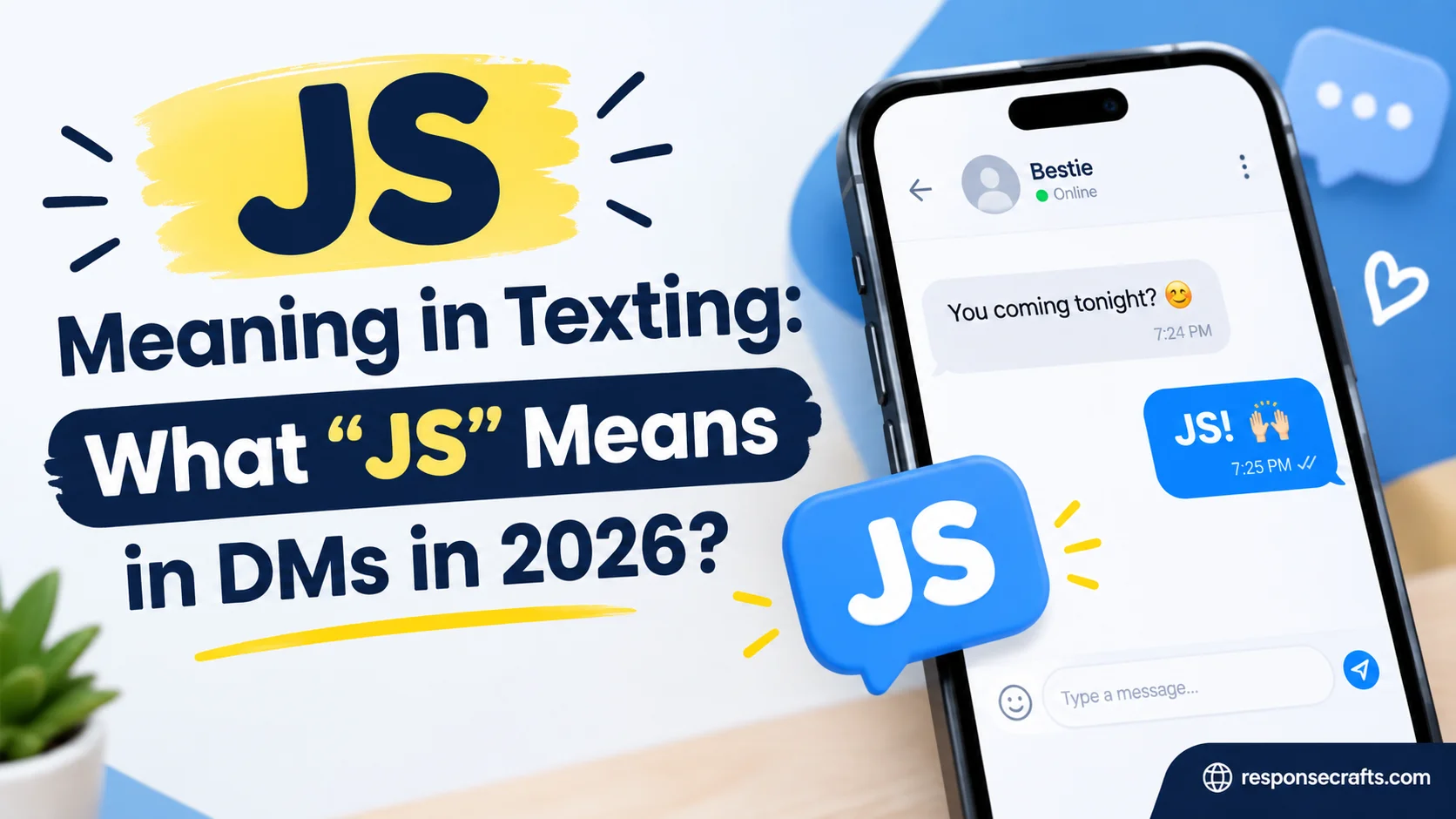
If someone sends you a message ending with “JS” or “js,” you may wonder what these two letters actually mean. In casual texting, the most common interpretation is “just saying.” People often use it after sharing an opinion, observation, suggestion, or criticism. The abbreviation helps make the message sound more casual and less forceful. You may see JS in DMs, group chats, comments, and everyday text messages. Understanding the context can help you figure out the intended meaning quickly.
For example, someone might text, “That restaurant is overrated, JS.” In this case, JS means “just saying,” so the person is simply expressing their personal opinion. They aren’t necessarily trying to start an argument or offend anyone. Instead, they’re adding their thoughts while keeping the statement relatively casual. You may also see JS after a suggestion, joke, or observation in a friendly conversation. The exact tone can change depending on the relationship, wording, and situation.
However, JS doesn’t have one universal meaning, so the surrounding conversation always matters. In a casual chat, it usually means “just saying,” but another context can give the abbreviation a completely different meaning. For example, in a conversation about programming, JS almost certainly refers to JavaScript, the widely used programming language. You might also encounter other meanings in specific communities, workplaces, or online spaces. Looking at the topic and nearby messages will usually make the intended meaning clear.
Quick Answer
JS in texting usually means “just saying.”
People use it to add an opinion, observation, suggestion, or mild criticism without making the comment sound overly formal or forceful.
For example:
“You should probably talk to her, JS.”
This means:
“You should probably talk to her, just saying.”
The tone can vary. JS may sound friendly, playful, honest, teasing, blunt, or even passive-aggressive depending on the rest of the message.
In technical conversations, however, JS usually means JavaScript rather than “just saying.”
JS at a glance
| Term | Most likely meaning | Typical context |
| JS | Just saying | Texts, DMs, chats, comments |
| js | Just saying | Informal texting and online conversations |
| JS | JavaScript | Programming and technology |
| IJS | I’m just saying | Informal online conversations |
| JS | Context-dependent abbreviation | Specialized conversations |
So, if a friend sends “JS, you looked better in the first outfit,” think “just saying.” If a developer says “The JS isn’t loading,” think JavaScript.
Comparison Overview
The easiest way to understand JS meaning in text is to compare it with other common abbreviations.
| Abbreviation | Full meaning | Main purpose | Typical tone |
| JS | Just saying | Adds an opinion or observation | Casual |
| IJS | I’m just saying | Emphasizes a personal observation | Casual or emphatic |
| IMO | In my opinion | Clearly marks a personal view | Neutral |
| IMHO | In my humble opinion | Softens a personal opinion | Casual |
| TBH | To be honest | Introduces a candid statement | Direct |
| NGL | Not gonna lie | Signals honesty | Casual |
| FYI | For your information | Shares information | Neutral |
| BTW | By the way | Adds another point | Casual |
The important difference is that JS often acts as a tone marker. It doesn’t simply identify an opinion. It can also change how the preceding statement feels.
Compare these two messages:
“You should leave earlier next time.”
and:
“You should leave earlier next time, JS.”
The first sounds like direct advice. The second sounds more like a casual observation, although it can still carry criticism.
That doesn’t mean adding JS automatically makes a message polite. Context still wins.
Main Differences Between JS Meaning in Texting
The meaning and tone of JS can shift considerably depending on where it appears.
JS at the Beginning of a Message
When JS appears at the beginning, it often introduces an opinion or observation.
Examples:
- “JS, I think you should go.”
- “JS, that color looks better.”
- “JS, you handled that pretty well.”
Here, the sender essentially signals, “I’m putting this thought out there.”
JS at the End of a Message
Ending a sentence with JS can make the statement feel more like an afterthought.
For example:
“That movie was way too long, JS.”
The abbreviation frames the preceding comment as a personal observation rather than an official judgment.
This placement can also make criticism feel less direct:
“You could’ve told me earlier, JS.”
That message might sound harmless. It might also sound irritated. The surrounding conversation determines which interpretation makes sense.
Lowercase “js” vs. Uppercase “JS”
In casual texting, “js” and “JS” generally carry the same intended meaning when the context points to “just saying.”
Lowercase text often reflects the relaxed nature of messaging.
For example:
“that outfit is actually fire js”
and:
“That outfit is actually fire, JS.”
Both can communicate the same basic idea.
Capitalization alone doesn’t reliably tell you whether the sender feels friendly, annoyed, sarcastic, or serious.
What Does JS Mean in Texting?
The most common JS meaning in texting is “just saying.”
People use the phrase in ordinary conversation when they want to make a point without presenting it as an absolute truth.
Consider:
“I think you should apologize, JS.”
The sender isn’t necessarily ordering the recipient to apologize. They’re offering an opinion and framing it as such.
The phrase can perform several conversational jobs:
- Share an opinion
- Offer advice
- Point something out
- Add a personal observation
- Soften a blunt statement
- Make a comment feel less formal
- Signal that the sender isn’t necessarily demanding agreement
That last point matters. “Just saying” can create a little distance between the speaker and the statement.
It’s similar to putting an idea on the table and saying, “That’s my take. Do with it what you will.”
Why do people use JS instead of “just saying”?
Digital conversations favor speed and brevity. Short abbreviations let people communicate quickly without typing the entire phrase.
But speed isn’t the only reason.
JS also preserves the conversational function of “just saying.” The sender can make an observation while keeping the message informal.
For example:
“Maybe don’t text him again, JS.”
That sounds less formal than:
“I recommend that you stop contacting him.”
The second sentence sounds almost like professional advice. The first sounds like something a friend might send during a late-night conversation.
JS Meaning in DMs
In direct messages, JS usually works the same way it does in ordinary texting.
However, DMs often contain more personal or emotionally loaded conversations. That can make the tone more important.
Giving Advice
“You should probably tell her how you feel, JS.”
Here, JS makes the advice feel casual rather than commanding.
Giving a Compliment
“JS, you looked really good in that picture.”
In this context, the abbreviation can make a compliment sound spontaneous.
Making an Observation
“JS, you two talk a lot.”
Depending on the relationship, this could be playful teasing or a genuine observation.
Making a Criticism
“You could’ve handled that better, JS.”
This is where things get interesting. The sender may be trying to soften criticism. At the same time, the criticism remains.
That’s why JS isn’t a magic politeness button. Adding it doesn’t erase the emotional weight of the sentence.
JS Meaning in Group Chats
Group chats create another common setting for JS meaning in text.
When several people are discussing plans, opinions, or disagreements, someone might use JS to introduce their own perspective without making it sound like they’re trying to control the conversation.
For example:
“JS, I think we should leave around 7.”
Or:
“JS, we’ve already changed the plan three times 😂.”
The abbreviation can make a contribution feel less formal.
It also gives the writer some rhetorical distance. Instead of saying, “Everyone should do this,” the sender says, in effect, “Here’s what I think.”
A group-chat example
Alex: “Should we order pizza or burgers?”
Sam: “Burgers.”
Mia: “Pizza is probably easier for everyone, JS.”
Alex: “Good point.”
Here, JS simply introduces an opinion.
Now change the context:
Alex: “I’m running late again.”
Mia: “You might want to leave earlier next time, JS.”
Suddenly, the same abbreviation can sound more critical.
The words around JS matter more than JS itself.
JS Meaning on Snapchat, Instagram, TikTok, and Discord
The abbreviation isn’t tied to one particular social platform. Its basic meaning can carry across different types of online conversations.
Snapchat
On Snapchat, JS may appear in quick messages, reactions, or casual conversations.
“That was actually funny js 😂.”
The sender is casually emphasizing an opinion.
On Instagram, you might see JS in DMs or comments.
“JS, this is your best look.”
Here, the phrase can function as an informal compliment.
TikTok
TikTok comments often move quickly and rely heavily on shorthand.
Someone might write:
“JS this is way better than the original.”
The intended meaning is usually that the commenter is simply sharing their view.
Discord
Discord requires more attention to context because it combines casual conversation, gaming, communities, and technical discussions.
In a gaming chat:
“JS, that build is broken.”
could mean “just saying.”
In a programming server:
“The JS file keeps throwing an error.”
means JavaScript.
Same letters. Completely different meaning.
How to Tell What JS Means From Context
When you’re unsure about JS meaning in text, don’t interpret the abbreviation in isolation.
Instead, look at the entire message.
Look at the words around JS
Consider:
“That shirt looks great, JS.”
The surrounding words suggest a compliment.
Now compare:
“You really thought that was a good idea, JS?”
The question mark and wording can make the message sound sarcastic.
Look at the conversation
If two friends are discussing dating advice, JS probably means “just saying.”
If they’re discussing code, JS probably means JavaScript.
If they’re talking about a person whose initials are J.S., it could refer to that person’s name.
Look at punctuation
Punctuation can influence the perceived tone.
| Message | Possible impression |
| “JS” | Neutral or casual |
| “JS!” | Energetic or emphatic |
| “JS…” | Hesitant, suggestive, or slightly pointed |
| “JS 😂” | Playful or joking |
| “JS?” | Questioning or challenging |
These aren’t fixed rules. Text has no facial expression or vocal tone, so readers often infer emotion from punctuation, emojis, wording, and the history of the conversation.
Is JS Rude or Passive-Aggressive?
JS isn’t inherently rude.
Its tone depends on what the sender says with it.
A compliment can make JS sound warm:
“JS, you absolutely nailed that.”
A neutral observation can make it sound ordinary:
“JS, the blue one looks better.”
A criticism can make it sound passive-aggressive:
“You could’ve answered sooner, JS.”
This happens because “just saying” can soften a statement while still allowing the speaker to deliver criticism.
Think of it like putting a thin cushion around a hard comment. The cushion changes the impact, but the comment underneath remains.
When JS sounds friendly
JS often feels friendly when the message contains:
- A compliment
- Light advice
- A harmless observation
- A joke
- An encouraging comment
When JS can sound passive-aggressive
Be more careful when the message contains:
- Blame
- Personal criticism
- Sarcasm
- Complaints
- A pointed observation
- An accusation disguised as a casual remark
For example:
“You always do this, JS.”
That doesn’t sound particularly gentle. The abbreviation may actually make the criticism feel more pointed.
JS vs. IJS: What’s the Difference?
IJS usually means “I’m just saying.” It carries essentially the same basic idea as JS.
The difference comes mainly from emphasis.
JS is shorter:
“JS, you should think about it.”
IJS makes the speaker more explicit:
“IJS, you should think about it.”
The second version emphasizes the speaker’s role in making the observation.
Both can soften criticism, offer advice, or reinforce a personal opinion.
| Form | Meaning | Typical effect |
| JS | Just saying | Short and casual |
| IJS | I’m just saying | More personal or emphatic |
Don’t assume that IJS always sounds friendlier. Like JS, it can become sarcastic or passive-aggressive depending on the sentence.
Read More: Cloudy Urine Meaning: Causes, Symptoms
JS vs. IMO, TBH, NGL, and Other Abbreviations
Several texting abbreviations can introduce personal opinions. They aren’t interchangeable, though.
JS vs. IMO
IMO means “in my opinion.”
It directly labels what follows as a personal view:
“IMO, the first movie was better.”
JS often feels more conversational:
“The first movie was better, JS.”
JS vs. TBH
TBH means “to be honest.”
It usually signals a candid or straightforward statement:
“TBH, I don’t like it.”
JS can sound less formal and more like a casual aside.
JS vs. NGL
NGL means “not gonna lie.”
It commonly introduces an honest admission:
“NGL, that was impressive.”
JS doesn’t necessarily imply that the sender is revealing something they previously hid.
JS vs. FYI
FYI means “for your information.”
It usually provides information rather than simply expressing an opinion.
“FYI, the meeting starts at 9.”
JS and FYI serve very different purposes.
Real-World Case Study: How Tone Changes the Meaning
Consider the same abbreviation in three conversations.
Case 1: Friendly advice
“You should give that restaurant another chance, JS.”
Likely tone: Friendly and casual.
The sender is sharing an opinion without demanding agreement.
Case 2: Relationship criticism
“JS, you deserve someone who treats you better.”
Likely tone: Supportive.
Here, JS introduces a personal observation that may be emotionally significant.
Case 3: Argument
“You knew what you were doing, JS.”
Likely tone: Critical or passive-aggressive.
The phrase doesn’t make the accusation disappear. It can actually emphasize the speaker’s frustration.
This illustrates a central rule of JS meaning in texting:
Don’t decode the abbreviation separately from the sentence. Decode the whole message.
Can JS Mean “Just”?
There is an important wrinkle in modern informal typing: some users may write “js” as a shortened form of “just,” particularly in highly compressed online language. Some current slang references document this usage alongside “just saying.”
For example:
“I’m js tired.”
Here, the intended meaning may simply be:
“I’m just tired.”
This use is different from:
“I’m tired, JS.”
The second sentence is much more naturally interpreted as “I’m tired, just saying.”
Placement matters.
When js appears inside a sentence where “just” makes grammatical sense, don’t automatically expand it to “just saying.”
What Does JS Mean in Programming?
In technology, JS usually means JavaScript.
JavaScript is a programming language used heavily in web development. It can manipulate webpage content, interact with browser APIs, retrieve data, and support interactive features. It also runs outside browsers through environments such as Node.js, Deno, and Bun.
For example:
“The JS isn’t loading.”
Here, interpreting JS as “just saying” would make no sense.
Another example:
“I need to fix the JS before deploying the site.”
Again, this clearly refers to JavaScript.
A simple context test
Ask yourself:
Is the conversation about opinions or programming?
- Opinions → JS probably means “just saying.”
- Programming → JS probably means “JavaScript.”
That simple distinction solves most cases.
How to Use JS Correctly in Texts
If you’re writing casually to friends, JS can fit naturally.
Good examples include:
- “JS, I think you should go.”
- “That was actually hilarious, JS 😂.”
- “You look better in the blue one, JS.”
- “JS, I would’ve taken the earlier flight.”
The abbreviation works best when everyone involved understands casual internet shorthand.
When you should avoid JS
Skip the abbreviation when clarity matters more than speed.
For example, avoid it in:
- Formal business emails
- Academic assignments
- Legal documents
- Official applications
- Customer-service messages
- Important professional communication
- Messages to someone unfamiliar with texting slang
Instead of:
“JS, I think this needs another review.”
a professional message might say:
“I think this needs another review.”
There’s no need to make formal communication sound like a group chat.
Common Mistakes When Interpreting JS
Assuming JS Always Means “Just Saying”
The context may point to JavaScript or another specialized meaning.
Assuming JS Is Always Friendly
A message containing JS can still be critical or sarcastic.
Treating JS as a Formal Acronym
JS belongs primarily to informal digital communication when it means “just saying.”
Ignoring Sentence Placement
“JS tired” and “That was weird, JS” don’t necessarily use JS in the same way.
Overanalyzing Two Letters
Sometimes JS really is just “just saying.”
Look at the complete message before searching for hidden meanings.
How to Respond When Someone Says “JS”
Your response should match the actual message rather than the abbreviation itself.
If someone gives advice
“Yeah, that’s fair.”
If someone compliments you
“Haha, thanks!”
If someone makes a harmless observation
“Honestly, you’re probably right.”
If someone criticizes you
“I get what you mean. What would you have done?”
If the meaning isn’t clear
“What do you mean?”
That’s often better than guessing.
If the message feels sarcastic, you can also ask:
“Are you being serious?”
A quick clarification can prevent a tiny abbreviation from turning into a full-blown misunderstanding.
Conclusion
The most common JS meaning in texting is “just saying.” People use it to share an opinion, suggestion, observation, compliment, or criticism in a casual way. You may see it in text messages, DMs, group chats, comments, and other online conversations. However, context matters. JS can sound friendly, playful, neutral, or even passive-aggressive depending on the words around it.
In programming conversations, JS usually means JavaScript, not “just saying.” So, when you see JS in a text, read the entire message before deciding what it means. If the conversation involves everyday opinions or social situations, “just saying” is usually the right interpretation. If you’re discussing coding or web development, JavaScript is far more likely.
FAQs:
What does JS mean in texting?
JS usually means “just saying” in casual texting. People use it when sharing an opinion, observation, suggestion, or comment without making the statement sound overly formal.
Is JS a rude or negative abbreviation?
Not necessarily. JS can sound friendly or neutral, but it may also appear in sarcastic or passive-aggressive messages. The tone depends on the complete sentence and the surrounding conversation.
What does JS mean in a group chat?
In a group chat, JS usually means “just saying.” Someone may use it when adding an opinion, giving advice, or pointing something out without directly challenging the other participants.
What does IJS mean in texting?
IJS usually means “I’m just saying.” It has a similar meaning to JS, although adding “I” can make the statement feel slightly more personal or emphatic.
Does JS mean JavaScript?
Yes, in programming and technology discussions, JS commonly means JavaScript. The context makes the distinction clear. In casual texting, JS usually means “just saying,” while in a developer conversation, it generally refers to JavaScript.













1 thought on “JS Meaning in Texting: What “JS” Means in DMs in 2026?”