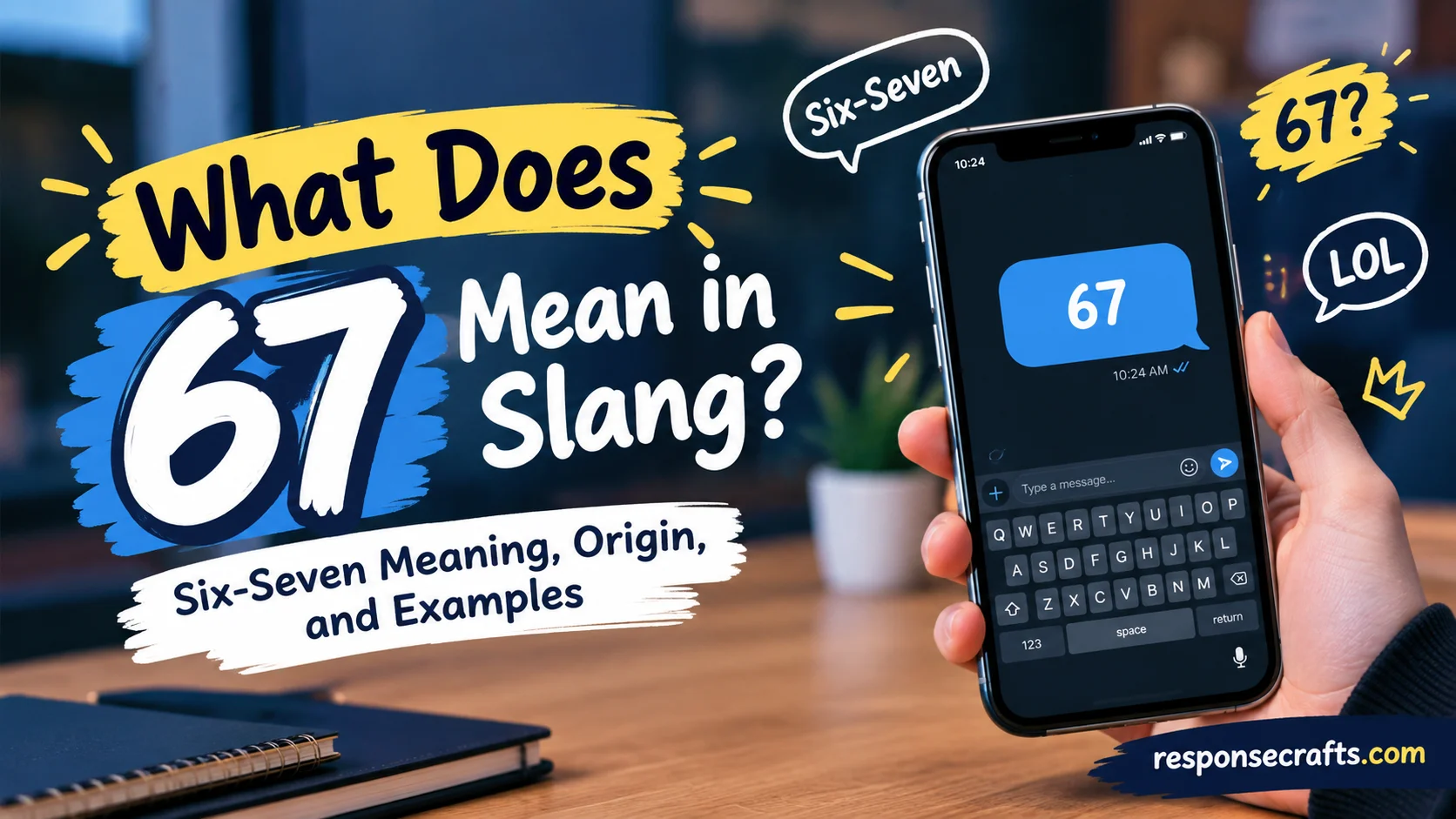
Have you ever seen someone say “67” or “six-seven” in a TikTok video, Instagram comment, or everyday conversation and wondered what it actually means? The 67 slang meaning has become popular across social media, especially among younger users who enjoy internet trends and funny expressions. Unlike traditional slang, 67 doesn’t have one fixed definition that works in every situation. People often use it as a playful expression, a random response, or an inside joke with friends. Its meaning usually depends on the conversation, tone, and context in which someone says it.
The six-seven trend gained attention through TikTok videos, viral memes, and basketball-related content. Many people connect it with the song “Doot Doot (6 7)” by rapper Skrilla, which helped spread the phrase online. The trend also became associated with basketball player LaMelo Ball, who stands 6 feet 7 inches tall. As creators began using the number in short videos and funny edits, it quickly turned into a recognizable internet expression. However, its popularity comes less from a clear dictionary definition and more from humor, repetition, and shared online culture.
Today, understanding what 67 means in slang can help you follow conversations on TikTok, Snapchat, Instagram, and group chats. Someone might shout “six-seven!” when the number appears, use it as a random joke, or repeat it simply because everyone around them recognizes the trend. In some situations, people accompany the phrase with a hand gesture, moving their hands up and down as part of the joke. Although it can seem confusing to anyone unfamiliar with the meme, its main purpose is often entertainment and social connection. Learning its origin, popular uses, and real-life examples will help you understand why people keep saying six-seven online and offline.
Quick Answer
67 in slang, pronounced “six-seven,” is a viral internet catchphrase that usually works as a playful, deliberately vague expression rather than a word with one fixed definition. It became popular through Skrilla’s song “Doot Doot (6 7),” basketball-related videos, and social media memes.
People may use 67 to:
- Make a random or humorous comment.
- Join a viral internet trend.
- Respond playfully in a conversation.
- Refer to the meme when the numbers six and seven appear together.
- Suggest something is “so-so” in certain contexts.
The key point is that 67 often functions as an inside joke, not a literal statement. The speaker’s tone, situation, and familiarity with the trend help explain what they mean.
Comparison Overview
The meaning of 67 becomes clearer when you compare it with familiar slang and other number-based internet memes.
| Expression | Common use | Main difference |
| 67 (six-seven) | A playful, viral catchphrase | Often has no precise meaning |
| LOL | Shows laughter or amusement | Communicates a recognizable reaction |
| IDK | Means “I don’t know” | Directly communicates uncertainty |
| Skibidi | Appears in absurd internet humor and meme culture | Associated with a different viral trend |
| 41 | Used in another number-based internet meme | Has its own trend history and context |
| So-so | Describes something as average or neither good nor bad | Has a clear, established meaning |
Unlike LOL or IDK, 67 doesn’t usually provide essential information. Instead, its value comes from shared humor, repetition, and recognition of the trend.
For example, if a friend texts “67” in response to an ordinary question, they might be joking rather than answering seriously. However, if someone writes “67” in a math problem or sports score, it may simply be a number.
What Does 67 Mean in Slang?
The simplest way to understand 67 is to think of it as a meme people recognize rather than a word with a strict definition. Its meaning changes with the situation, and sometimes the phrase communicates almost nothing beyond a shared joke.
Dictionary.com describes 67 as an ambiguous slang term associated with Gen Alpha culture. Its popularity comes partly from the fact that people can use it in many different situations without needing a clear explanation.
The Main Meaning of Six-Seven
Most of the time, six-seven is a playful expression used to reference the viral trend. Someone might shout it in a school hallway, post it under a basketball video, or say it when a friend mentions the numbers six and seven.
The phrase can serve several purposes:
- A joke: Someone says it simply because the moment feels right.
- A random response: A person gives a silly answer instead of responding seriously.
- A social reference: Someone uses it to show they recognize the meme.
- A playful reaction: Friends repeat it because they know the phrase and its associated gesture.
- A loose description: In some situations, people use it to suggest something is average or somewhere in the middle.
These uses aren’t interchangeable in every situation. A basketball fan commenting “67” under a highlight video may be referencing the meme, while a student saying it during a lesson might simply be trying to make classmates laugh.
Does 67 Actually Mean Anything?
This is where the slang gets interesting. The lack of a fixed definition is part of the appeal.
Many traditional expressions communicate a specific idea. For example, “I’m exhausted” describes a person’s state, while “IDK” expresses uncertainty. Six-seven works differently because the humor often comes from using it when a meaningful answer would normally be expected.
Imagine asking a friend, “How was your weekend?” Instead of describing their plans, they answer, “Six-seven!” If you both understand the meme, the unexpected response may be funny. If you don’t know the trend, the answer may seem completely random.
Some people interpret the accompanying hand gesture as “so-so,” suggesting that something falls between two choices. However, that interpretation doesn’t apply to every use of 67.
It’s best to understand the expression as a flexible internet joke rather than a word that always translates into one phrase.
Why Do People Say 67 Instead of Giving a Real Answer?
The internet has a long history of turning ordinary words, sounds, and numbers into running jokes. Six-seven follows that pattern.
Its appeal comes from three main factors:
- Surprise: The phrase can appear in situations where nobody expects it.
- Repetition: Hearing the same expression repeatedly makes it recognizable.
- Shared understanding: People who know the meme can participate without explaining the joke.
For younger users, saying six-seven may be less about communicating an idea and more about joining a group activity. The phrase becomes a kind of verbal handshake.
Think of it like quoting a famous movie line with friends. The words might not mean much outside the scene, but everyone who recognizes the reference understands why they’re funny.
Where Did 67 Come From?
The modern 67 trend developed through music, basketball, and social media. Although several people helped popularize it, the phrase’s best-known starting point is a song by Philadelphia rapper Skrilla.
Understanding the timeline helps separate the original phrase from the later videos that made it famous.
Skrilla’s Song “Doot Doot (6 7)”
Skrilla’s track “Doot Doot (6 7)” began circulating in late 2024 and became a major source of the phrase’s online popularity in 2025. The song repeats “six-seven,” giving listeners a memorable sound that creators could reuse in short videos.
The phrase originally appeared in a musical context rather than as a clearly defined texting abbreviation. As clips of the track spread, users began associating the numbers with basketball edits, jokes, and viral videos.
Importantly, the song’s popularity doesn’t prove that the numbers have one hidden meaning. Skrilla has been reported as saying he never assigned the phrase a fixed meaning. Various theories have circulated online, but they shouldn’t be treated as established facts.
How Basketball Videos Helped Make 67 Viral
Basketball played an important role in turning the phrase into a recognizable trend.
Creators started pairing the song with basketball highlights, including videos featuring NBA player LaMelo Ball. The connection was easy to understand: Ball is listed at 6 feet 7 inches tall, matching the numbers in the song.
This coincidence made the phrase particularly useful for short video edits. A creator could build anticipation, play the recognizable audio, and reveal a clip of Ball on the court.
The trend then spread beyond its original context. People who encountered the phrase through basketball videos began repeating it in other situations, including school conversations and social media comments.
The distinction matters: LaMelo Ball’s height helped reinforce the meme, but it doesn’t establish that 67 always means six feet seven inches.
Who Is the 67 Kid?
The person widely known online as the “67 Kid” helped make the phrase and its delivery even more recognizable.
A video featuring young Maverick Trevillian shouting “six-seven” at a youth basketball event spread across social media. His enthusiastic delivery and accompanying hand movement became easy for other users to imitate.
The clip helped transform the expression from a sound associated with music and basketball edits into a recognizable performance. People could now repeat not only the words but also the facial expression, rhythm, and gesture.
However, the 67 Kid didn’t create the original phrase. The song and earlier basketball-related videos came first. His contribution was helping the trend reach a broader audience.
What Does the 67 Hand Gesture Mean?
The six-seven hand gesture is one of the easiest ways to recognize the meme. People typically hold their hands in front of their bodies with their palms facing upward, then move them alternately up and down.
The movement resembles weighing two options on an imaginary scale. That visual similarity helps explain why some people connect the gesture with “so-so” or a comparison between alternatives.
Still, the gesture doesn’t have one universally accepted meaning. In many videos, it simply accompanies the spoken phrase.
How to Recognize the Six-Seven Gesture
Look for these common features:
- Both hands are held in front of the body.
- The palms face upward.
- The hands move up and down in an alternating, seesaw-like motion.
- The person says “six-seven” while performing the movement.
- The delivery may be exaggerated for comic effect.
Not everyone performs the gesture in exactly the same way. Some people make small movements, while others swing their hands dramatically.
Why Do People Use the Gesture With 67?
The gesture gives the phrase a visual identity. Instead of repeating two numbers alone, people can copy a recognizable movement that others associate with the meme.
This is common in internet culture. A popular sound becomes easier to recognize when users pair it with a dance, facial expression, or repeated physical action.
The gesture also makes the joke work without much explanation. Someone familiar with the trend may recognize it immediately, even before hearing the words.
How Is 67 Used in Text Messages and Online Chats?
Although six-seven became famous through videos, people also use it in text messages and online conversations. Its written form is usually brief, making it convenient for comments, group chats, and casual replies.
The important thing to remember is that the written number doesn’t automatically carry a slang meaning. You need to consider what the conversation is about.
67 as a Random Reply
Friends sometimes use 67 as an intentionally silly response to a question.
For example:
- Friend A: “What are we doing after school?”
- Friend B: “67.”
- Friend A: “That doesn’t answer my question.”
- Friend B: “Exactly.”
Here, the response is funny because it ignores the expected answer. It doesn’t communicate a plan or offer useful information.
Of course, not everyone will find this funny. The joke works best when both people recognize the meme or enjoy deliberately absurd humor.
67 as an Inside Joke
An inside joke is a reference that makes sense to a particular group because its members share some background knowledge.
For instance, a group chat might contain dozens of six-seven references after friends watch a viral video together. One person sends the numbers, another responds with the hand gesture emoji, and the conversation continues from there.
The phrase becomes a shortcut for recalling the original joke. People don’t need to explain the entire trend every time they use it.
67 When Someone Mentions the Numbers Six and Seven
One unusual feature of the trend is that people may react whenever they encounter the numbers together.
Imagine a teacher writes a subtraction problem on the board and the answer is 67. A student familiar with the meme might immediately say “six-seven,” even though the number has a straightforward mathematical meaning.
The same thing can happen in sports scores, countdowns, video captions, or everyday conversations.
This behavior reflects the meme’s recognizability rather than a change in the number’s literal meaning. Sometimes 67 is just 67. The joke exists in the reaction.
Read More: What Does It Mean in Text? Meaning, Uses, and Examples
Examples of 67 in Everyday Conversations
The following examples show how the expression might appear in different situations. They’re illustrative examples, not fixed definitions that apply to every conversation.
| Situation | Example | What it means in context |
| Texting with friends | “Bro really replied 67 😭” | The person is joking about a random response. |
| Social media comment | “SIX SEVEN!” | The commenter is referencing the viral trend. |
| Classroom joke | A student says “six-seven” after seeing the answer 67 | The student recognizes the meme and reacts to the number. |
| Basketball video | “6’7″ and the song starts playing” | The comment connects the player’s height with the meme. |
| Casual rating | “How was the movie?” “Six-seven.” | The speaker may be joking or loosely suggesting an average rating. |
| Group chat | “67 never gets old 💀” | The person is referring to the running joke. |
A Closer Look at Three Examples
Example one: A conversation between friends
“Are you coming to the game tonight?”
“Six-seven.”
“I’m taking that as a no.”
In this exchange, the response deliberately avoids answering the question. The humor comes from the mismatch between the question and the reply.
Example two: A comment under a basketball clip
“Bro is literally 6’7″ 💀”
Here, the number connects to basketball height and the familiar meme. The comment makes sense because the video supplies the context.
Example three: A conversation about a movie
“What rating would you give it?”
“Six-seven.”
This response might be a meme reference or a playful way to suggest an ordinary rating. You shouldn’t assume the speaker means a score of exactly 6.7 out of 10 unless the surrounding conversation makes that clear.
Why Is 67 So Popular Among Gen Alpha?
Gen Alpha generally refers to the generation born from the early 2010s onward, although exact generational boundaries vary. The six-seven trend became especially visible among younger people because it combines short-form video humor with an expression that’s easy to repeat.
Its popularity isn’t just about the numbers themselves. The trend gives people a shared joke they can use online, at school, or around friends.
The Appeal of Absurd or Brainrot Humor
The term brainrot is internet slang for content or humor that feels absurd, repetitive, or deliberately silly. People often use it jokingly to describe memes that seem meaningless but become entertaining through constant repetition.
Six-seven fits this style of humor. Someone might shout it during an ordinary conversation, repeat it under a video, or react dramatically whenever the number appears.
Why does that work? Sometimes the joke isn’t the phrase itself. It’s the fact that people keep repeating it despite its lack of a clear message.
Consider a group of friends who laugh every time someone mentions six or seven. After enough repetition, the reaction itself becomes part of the joke. A simple number turns into a shared reference.
However, not every young person enjoys this kind of humor. Some find it funny, while others consider it repetitive or annoying. Internet trends rarely appeal to everyone in the same way.
TikTok, Memes, and Peer Influence
Short-form video platforms make phrases like six-seven easy to spread. Creators can reuse a sound, copy a gesture, or put a familiar expression into an entirely new situation.
A typical trend might spread like this:
- A song introduces a memorable phrase.
- Creators use it in short videos.
- Other users imitate the audio or gesture.
- The phrase moves into comments and private chats.
- Friends begin repeating it in everyday conversations.
Each step gives the expression another chance to reach someone new. Eventually, people may recognize the phrase without knowing where it originated.
Peer influence also matters. When a joke becomes common among classmates or teammates, repeating it can help someone feel included in the group. That doesn’t mean every person uses it for the same reason. Some genuinely enjoy the joke, while others simply join in.
Main Differences Between 67 in Slang and Other Internet Expressions
Understanding how six-seven compares with other popular expressions helps explain why its meaning can feel unusual.
The main difference is that many slang terms communicate an identifiable message, while 67 often works through repetition, context, and shared recognition.
67 vs. Skibidi
Both six-seven and skibidi are associated with internet humor, especially trends that spread among younger audiences.
However, they have different origins and cultural histories. Skibidi became widely recognized through the Skibidi Toilet animated video series, while six-seven developed from Skrilla’s song and later basketball-related memes.
Neither expression has to function as a normal word in every context. Their meanings often depend on how people use them in videos, jokes, and conversations.
67 vs. 41 and Other Number Memes
Number-based memes turn ordinary digits into recognizable online references. Once a number becomes associated with a trend, people may repeat it simply because they know the joke.
The number 41 has also appeared in Gen Alpha meme culture. However, 67 and 41 shouldn’t automatically be treated as synonyms. Each trend has its own references, audio, and patterns of use.
If you see either number in a comment, look at the surrounding content before deciding whether it’s slang or a literal number.
67 vs. Traditional Texting Abbreviations
The difference becomes even clearer when you compare six-seven with everyday texting shorthand.
| Feature | 67 | LOL | IDK |
| Typical purpose | Referencing a meme or making a joke | Expressing laughter | Expressing uncertainty |
| Fixed meaning | No single agreed-upon meaning | Yes, commonly “laughing out loud” | Yes, “I don’t know” |
| Depends on context | Heavily | Sometimes | Sometimes |
| Common use | Memes, jokes, casual conversations | Texting and online comments | Texting and online conversations |
If someone texts “IDK,” you can usually understand their response immediately. If they send “67,” you may need to know the meme to understand why they sent it.
That’s why learning internet slang involves more than memorizing definitions. You also need to understand the cultural references behind the expressions.
Is 67 Appropriate to Use in Conversations?
In most ordinary settings, six-seven is a playful expression rather than an inherently offensive term. Its meaning usually comes from the meme, and people often use it for humor.
Still, whether it’s appropriate depends on the situation.
Casual conversations: Using 67 with friends who know the trend is generally fine. It can work as a lighthearted joke or a reference to a shared video.
School settings: Students may repeat the phrase because it’s popular among their peers. However, shouting it during lessons or using it to interrupt others can become disruptive.
Workplace communication: In a professional message, a clear answer is usually more helpful than a random meme reference. Save the joke for coworkers who understand the context and welcome that style of humor.
Serious conversations: If someone asks an important question, respond directly rather than using six-seven as a substitute for an answer.
There’s also no reason to assume that every appearance of 67 is inappropriate. A sports score, age, measurement, or mathematical answer may simply be a number.
Common Misunderstandings About 67
Because the trend has no single fixed definition, people can easily misunderstand it. Here are the most common mistakes to avoid.
Assuming 67 Always Means “So-So”
Some people connect the hand gesture with weighing two options, which can suggest an average or uncertain response. However, many uses of six-seven have no such meaning.
A person shouting it under a meme video probably isn’t giving a serious rating. Context matters more than any single interpretation.
Pronouncing It as “Sixty-Seven”
When referring to the slang trend, people usually say “six-seven,” not “sixty-seven.” That pronunciation reflects the two separate numbers used in the song and meme.
When discussing the actual number 67 in ordinary mathematics, “sixty-seven” remains the standard pronunciation. The difference depends on whether you’re talking about the meme or the number itself.
Treating Every Appearance of 67 as Slang
Numbers appear everywhere, including addresses, sports scores, phone numbers, measurements, and calculations.
If someone mentions 67 in a normal numerical context, there’s no reason to assume they’re referencing a meme. Look for clues such as an exaggerated delivery, the recognizable hand gesture, or a social media context.
Assuming It Has a Secret Meaning
Various theories attempt to explain the phrase’s original significance. However, those theories don’t establish a universal meaning for the modern slang expression.
The safest interpretation is that six-seven became a viral catchphrase whose humor often relies on ambiguity. You don’t need to uncover a hidden definition to understand why people repeat it.
Confusing the Song With the Viral Meme
The song helped introduce the phrase, but the wider trend developed through multiple stages. Basketball edits, the hand gesture, viral videos, and everyday repetition all contributed to its popularity.
Giving credit to one viral video as the sole origin overlooks the earlier music and social media activity that helped establish the trend.
FAQs:
What does 67 mean in slang?
67, pronounced “six-seven,” is a viral slang expression popularized through music, basketball edits, and social media memes.
What does six-seven mean on TikTok?
Creators use the phrase in basketball edits, comedy videos, and comments. Some videos include a recognizable palms-up hand gesture.
Why do kids keep saying 67?
Many kids repeat 67 because it’s a recognizable internet trend and an easy way to make friends laugh. Its popularity comes from repetition, absurd humor, and shared cultural references.
Who started the 67 trend?
The phrase is associated with Philadelphia rapper Skrilla’s song “Doot Doot (6 7),” which circulated in late 2024. Basketball-related edits helped spread it online in early 2025.
What does the 67 hand gesture mean?
The gesture usually involves holding both palms upward and moving the hands alternately in a seesaw motion while saying “six-seve.
Does 67 have a bad or inappropriate meaning?
The popular six-seven meme is generally used as a playful internet joke, not as an inherently offensive expression.
Conclusion
The meaning of 67 in slang is easier to understand once you recognize its connection to internet meme culture. Pronounced “six-seven,” the expression became popular through Skrilla’s song “Doot Doot (6 7),” basketball-related videos, and viral social media moments. Unlike traditional slang terms, six-seven doesn’t have one clear definition. People use it as a playful response, an inside joke, or a reference to the trend. Some associate it with a “so-so” meaning, but that interpretation depends on the situation.
The next time you hear someone shout “six-seven” or see 67 in a comment, pay attention to the context. If the person is joking with friends or repeating a familiar gesture, they’re probably referencing the meme. If the number appears in a calculation, score, or measurement, it may simply be a number. Ultimately, 67 is a good example of how internet culture can turn two ordinary numbers into a widely recognized catchphrase. Understanding the reference matters more than memorizing a definition.











1 thought on “What Does 67 Mean in Slang? Six-Seven Meaning, Origin, and Examples”