If someone uses the word “perpendicular” in a text, you might wonder whether they’re talking about geometry, direction, or using the word in a playful way. The confusion makes sense because perpendicular is a technical word that also appears in everyday descriptions and occasional figurative conversations. Its core meaning, however, remains quite precise.
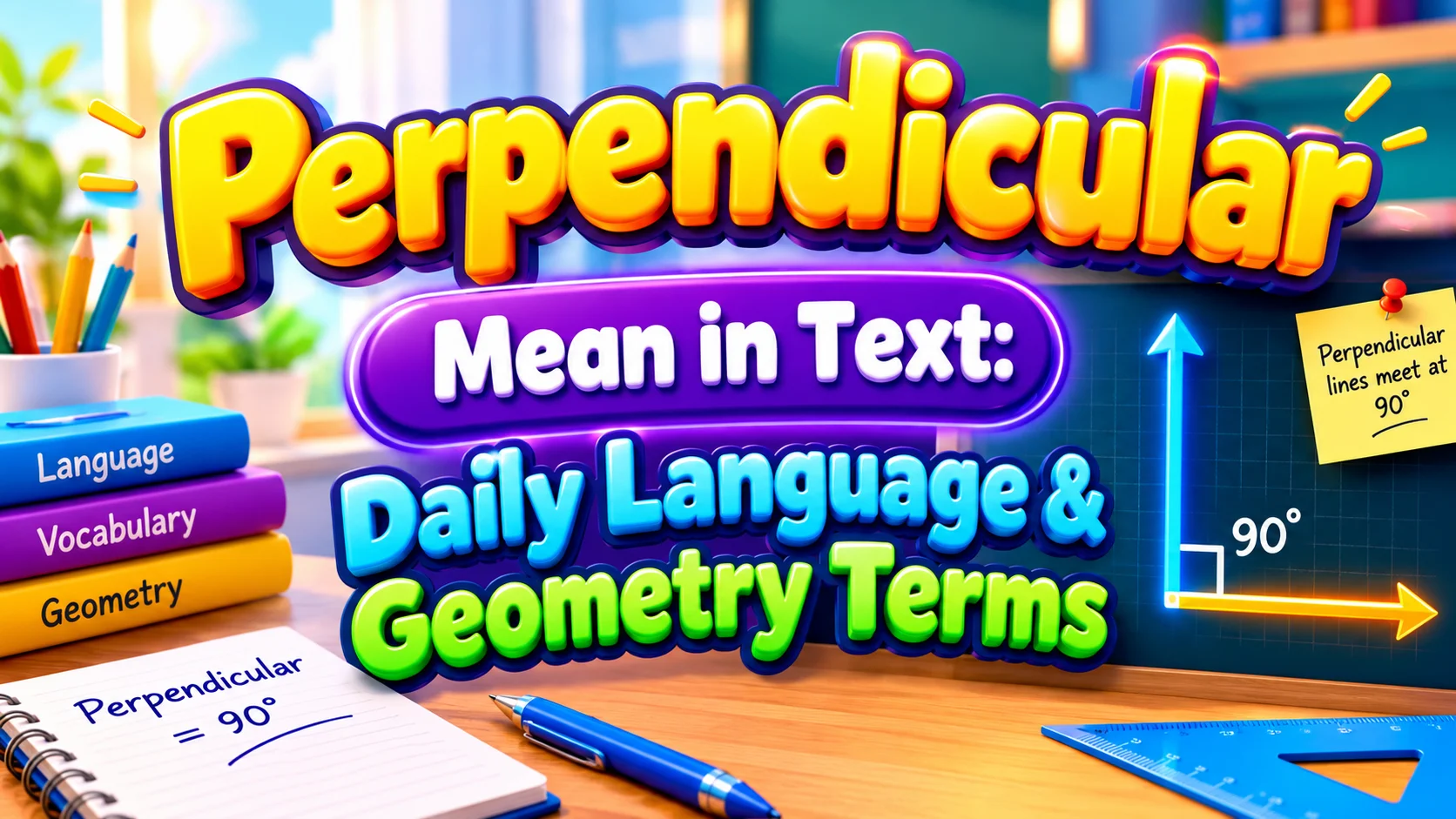
In geometry, perpendicular means meeting or crossing at a 90-degree angle. You can see this relationship in a corner where a wall meets the floor, two straight lines form a right angle, or a vertical pole meets level ground. In everyday English, the word can also describe something that stands upright or looks almost vertical. In informal conversations, someone may use it metaphorically to describe ideas that seem to go in different directions.
Understanding the context matters. A student asked, “Are these lines perpendicular?” is almost certainly talking about a right angle. Meanwhile, someone joking that a friend’s answer was “perpendicular to the question” may be saying that the answer went in a completely different direction.
This guide explains the perpendicular meaning in text, its standard dictionary definitions, geometry applications, everyday uses, figurative interpretations, related terms, and practical examples. It also separates established meanings from creative internet usage so you don’t mistake an occasional joke for official texting slang.
Comparison Overview
The easiest way to understand perpendicular meaning in text is to compare its main uses.
| Context | Meaning of Perpendicular | Example |
| Geometry | Meeting at 90 degrees | “These lines are perpendicular.” |
| Mathematics | Forming a right angle | “AB is perpendicular to CD.” |
| Everyday description | Upright or at a right angle to something | “The pole is perpendicular to the ground.” |
| Physics | Acting at a right angle to another direction or surface | “The force is perpendicular to the surface.” |
| Architecture | Objects or structural elements meeting at right angles | “The wall is perpendicular to the floor.” |
| Casual speech | Sometimes used figuratively for a different direction | “That idea is perpendicular to the discussion.” |
| Internet humor | A playful way to describe something as misaligned or unexpected | “Your reply went perpendicular.” |
This table highlights an important point: the basic idea never really changes. Perpendicularity involves a right-angle relationship. Figurative uses simply borrow that idea and apply it to thoughts, conversations, or situations.
Main Differences Between Perpendicular Mean in Text and Related Terms
The phrase “perpendicular mean in text” can create confusion because readers often compare perpendicular with words such as vertical, parallel, opposite, and unrelated. These words aren’t interchangeable.
Perpendicular vs. Vertical
Perpendicular describes a relationship between two things. Vertical describes an orientation or direction.
For example, a vertical pole can stand perpendicular to a horizontal floor.
The pole is vertical because of its upright direction. It is perpendicular to the floor because it meets the floor at a 90-degree angle.
That distinction becomes important in geometry. Saying that something is vertical doesn’t automatically tell you what it is perpendicular to.
Perpendicular vs. Parallel
Parallel lines remain the same distance apart within the same plane and don’t intersect.
Perpendicular lines do the opposite in one key respect: they intersect at 90 degrees.
| Feature | Perpendicular | Parallel |
| Do the lines intersect? | Yes | No, within the same plane |
| Angle relationship | 90° | Same direction |
| Symbol | ⊥ | ∥ |
| Example | Corner of a square | Railroad tracks |
A useful visual idea is a sheet of graph paper. Horizontal grid lines run parallel to each other. Vertical grid lines also run parallel to one another. However, each horizontal line meets each vertical line at a right angle.
Perpendicular vs. Opposite
Perpendicular does not mean the opposite.
Opposite directions typically form a 180-degree relationship. Perpendicular directions form a 90-degree relationship.
For example, north and south are opposite directions. North and east are perpendicular directions when represented on a standard compass.
So if someone says two ideas are “perpendicular,” you shouldn’t automatically interpret that as opposite. The intended meaning is closer to coming from different directions or angles.
Perpendicular vs. Unrelated
These terms can overlap in figurative speech, but they don’t have the same literal meaning.
If two subjects are unrelated, they have little or no connection. If two lines are perpendicular, they have a very specific geometric relationship.
Someone might say:
“Those points are perpendicular to each other.”
In a casual discussion, they could mean the points or ideas seem to approach a subject from different directions. That’s a metaphorical use.
Still, unrelated isn’t the dictionary definition of perpendicular.
What Does Perpendicular Mean in Text?
The phrase “perpendicular meaning in text” usually points to a simple question: What does this word mean when someone sends it in a message?
The safest answer is to start with the standard definition.
Perpendicular means forming a 90-degree angle with something else.
If someone texts:
“Line AB is perpendicular to line CD.”
They’re talking about geometry.
If someone writes:
“Your response was perpendicular to my question.”
The word has likely become figurative. The person may be saying that the response went in another direction.
Does Perpendicular Have a Special Texting Meaning?
There isn’t a universally established texting definition that replaces the normal meaning of perpendicular.
That’s worth emphasizing because internet vocabulary changes quickly. People often invent playful meanings for ordinary words. A phrase may become popular within a particular group, community, meme culture, or conversation without becoming a recognized slang definition.
Major English dictionaries continue to define perpendicular around ideas such as a right angle, upright position, and steepness.
What Does Perpendicular Mean in Casual Conversation?
A person might use the word metaphorically when two things don’t seem aligned.
For example:
“That comment was perpendicular to the conversation.”
The speaker probably doesn’t mean that the comment literally formed a 90-degree angle. Instead, they’re using geometry as a metaphor. The comment may have taken the discussion in an unexpected direction.
Possible figurative interpretations include:
- Going in a different direction
- Approaching something from another angle
- Being poorly aligned with the current topic
- Taking an unexpected turn
- Contrasting sharply with another idea
- Being disconnected from the immediate discussion
These interpretations depend heavily on tone and context.
What Does Perpendicular Mean in Geometry?
Geometry provides the clearest and most precise definition.
Two objects are perpendicular when they form right angles, which measure exactly 90 degrees.
Perpendicular Lines
When two straight lines intersect at a 90-degree angle, they are perpendicular.
Think about the shape of a capital T. The horizontal bar and vertical stem can illustrate perpendicular lines.
A square provides an even better everyday example. Every corner of a square contains a 90-degree angle. Therefore, adjacent sides of a square are perpendicular.
This relationship produces four right angles at the point where the lines intersect.
The Perpendicular Symbol
Mathematicians use ⊥ to represent perpendicularity.
For example:
AB ⊥ CD
This statement means:
Line AB is perpendicular to line CD.
The symbol makes mathematical diagrams much easier to read because it communicates the relationship without requiring a complete sentence.
Why 90 Degrees Matters
Not every pair of intersecting lines is perpendicular.
Two lines can cross at:
- 30 degrees
- 45 degrees
- 60 degrees
- 90 degrees
- 120 degrees
- And many other angles
Only a 90-degree intersection qualifies as perpendicular.
That precision matters in geometry, construction, engineering, physics, and technical design.
Perpendicular in Coordinate Geometry
The word becomes even more useful when you work with graphs and equations.
For nonvertical lines, perpendicular lines have slopes that are negative reciprocals of each other.
Suppose one line has a slope of:
2
A perpendicular line has a slope of:
−1/2
Multiplying those slopes gives:
2 × −1/2 = −1
That relationship provides a practical way to test perpendicularity.
How to Check Whether Two Lines Are Perpendicular
You can use this simple process:
- Find the slope of the first line.
- Find the slope of the second line.
- Multiply the slopes.
- If their product is −1, the nonvertical lines are perpendicular.
There is an important exception. A vertical line and a horizontal line are perpendicular even though the usual slope multiplication rule doesn’t work because a vertical line has an undefined slope.
This distinction often appears in algebra and coordinate geometry problems.
Perpendicular in Everyday Language
You don’t need to solve geometry problems to encounter the word.
English speakers sometimes use perpendicular to describe the physical position of an object.
Perpendicular Can Mean Upright
Imagine a flagpole standing straight up from level ground.
The flagpole is vertical. Because the ground is horizontal, the pole forms a 90-degree relationship with the ground.
You could therefore describe the pole as perpendicular to the ground.
However, remember the distinction between the two words:
- Vertical describes the pole’s orientation.
- Perpendicular describes its relationship with the ground.
That’s a small difference, but it prevents a lot of confusion.
Perpendicular Can Describe Something Very Steep
In ordinary English, people may use perpendicular to describe something that appears nearly vertical.
For example:
“The hikers faced a nearly perpendicular cliff.”
Here, the writer isn’t necessarily claiming that the cliff measures exactly 90 degrees. The word creates a strong image of a very steep surface.
This use appears in dictionaries alongside the geometric meaning.
It’s also why you may see the word in descriptions of:
- Cliffs
- Mountains
- Rock faces
- Steep roads
- Walls
- Ladders
- Slopes
The intended idea is often almost straight up and down.
How “Perpendicular” Is Used in Text Messages
Text messages provide a wide range of contexts. The surrounding words usually reveal which meaning the sender intends.
Academic Texts and Study Chats
Students frequently use the word in messages about mathematics.
For example:
“Are these two lines perpendicular?”
The sender is asking whether the lines meet at 90 degrees.
Another example:
“The answer should be perpendicular to the base.”
Here, the word carries its standard mathematical meaning.
Casual Conversations
A friend might use the word in a deliberately unusual way.
“Your story went completely perpendicular.”
This isn’t a standard slang expression. The speaker may simply be making a playful comparison.
The joke comes from treating a conversation as though it were a geometric diagram.
Figurative Discussions About Ideas
People sometimes borrow geometric language to explain abstract relationships.
Consider:
“Our opinions are perpendicular.”
The speaker could mean that the opinions approach the subject from very different directions.
This doesn’t mean the opinions literally form a 90-degree angle. Instead, geometry provides a vivid metaphor for intellectual contrast.
Memes and Internet Humor
Technical vocabulary often becomes funny when people use it outside its normal setting.
Words such as parallel, perpendicular, vector, tangent, and linear can appear in memes or jokes because they make ordinary situations sound unnecessarily mathematical.
For example:
“My plans and reality are perpendicular.”
The humor comes from turning a familiar disappointment into a geometry metaphor.
Again, that’s creative language, not a new official definition.
Also Read This: PMO Meaning in Text: How It’s Used on Snapchat, TikTok & Instagram in 2026
Real Text Examples of Perpendicular
Examples make the difference between literal and figurative usage much easier to recognize.
Example: Geometry
“The two lines are perpendicular.”
Meaning: The lines meet at 90 degrees.
Example: Homework
“Can you check if AB is perpendicular to CD?”
Meaning: The sender wants to verify whether the two lines form a right angle.
Example: Everyday Description
“The pole is perpendicular to the pavement.”
Meaning: The pole meets the pavement at approximately 90 degrees.
Example: Physics
“The force acts perpendicular to the surface.”
Meaning: The force acts at a right angle to the surface.
Example: Figurative Humor
“That answer was perpendicular to my question.”
Meaning: The answer went in a completely different direction.
Example: Abstract Discussion
“Those two ideas are almost perpendicular.”
Meaning: The ideas approach the subject from very different angles.
The last two examples rely on metaphor. Their interpretation depends on the relationship between the words and the surrounding conversation.
Perpendicular in Physics
Perpendicularity plays an important role in physics because direction matters.
A force can act perpendicular to a surface, for example. That relationship can affect how an object moves or how forces interact.
Vectors can also have perpendicular components. When two vectors meet at 90 degrees, they are orthogonal.
The idea appears in areas such as:
- Mechanics
- Electromagnetism
- Wave physics
- Engineering
- Vector analysis
- Structural design
A simple real-world example involves an object resting on a flat surface. The gravitational force points downward while the supporting surface produces a normal force perpendicular to that surface.
The key idea remains the same: perpendicular describes direction at a right angle.
Perpendicular in Architecture and Engineering
Architecture relies heavily on accurate angles.
Walls, floors, beams, columns, frames, and other structural components often need precise relationships. A wall that should meet a floor at a right angle needs careful measurement during construction.
A small angular error might seem insignificant at first. Across a large structure, however, tiny deviations can create visible alignment problems.
Engineers and builders therefore use tools and measurements designed to establish accurate right angles.
Common examples include:
- Squares
- Levels
- Laser measuring tools
- Theodolites
- Total stations
- Digital angle meters
The practical importance is straightforward: perpendicular relationships help create stable, aligned, and accurately designed structures.
Perpendicular in Real Life
You can find perpendicular relationships almost everywhere.
A Wall and Floor
A typical room provides a familiar example. A vertical wall meets a level floor at approximately 90 degrees.
A Table Leg and Floor
A straight table leg standing upright can form a perpendicular relationship with the floor.
A Building Corner
Adjacent walls in a rectangular room typically meet at right angles.
A Crosswalk or Street Intersection
Some roads intersect at approximately 90 degrees. Such intersections provide an easy visual example of perpendicular directions.
A Plus Sign
The vertical and horizontal strokes of a conventional plus sign create a simple visual representation of perpendicular lines.
These examples make the concept easier to remember because you can connect the mathematical definition to objects you already see every day.
Perpendicular vs. Other Common Geometry Terms
Understanding related vocabulary can make the meaning much clearer.
| Term | Definition | Simple Example |
| Perpendicular | Meets at 90° | Two sides of a square |
| Parallel | Remains the same distance apart in a plane | Railroad tracks |
| Intersecting | Crosses another line or object | Two roads crossing |
| Vertical | Extends upward and downward | A standing pole |
| Horizontal | Extends across from side to side | A level tabletop |
| Oblique | Slanted or meeting at an angle other than 90° | A diagonal line |
One especially important distinction is between intersecting and perpendicular.
Every pair of perpendicular lines intersects. However, not every pair of intersecting lines is perpendicular.
That’s because intersection simply means crossing. Perpendicularity adds the requirement of a 90-degree angle.
Common Misunderstandings About Perpendicular
The word looks simple once you know it, but several misunderstandings appear frequently.
“Perpendicular” Means “Opposite”
False.
Perpendicular means 90 degrees apart. Opposite directions are generally 180 degrees apart.
Every Crossing Is Perpendicular
False.
Two lines can cross at many different angles. They are perpendicular only when the angle equals 90 degrees.
Vertical and Perpendicular Mean the Same Thing
Not exactly.
Vertical describes orientation. Perpendicular describes a relationship between two objects.
A vertical line can be perpendicular to a horizontal line. However, saying “vertical” alone doesn’t establish perpendicularity.
Perpendicular Is Standard Texting Slang
Not generally.
Someone may use the word creatively in a message. However, there is no need to assume that it has a universal slang definition.
The safest approach is to read the sentence around it.
Nearly Vertical Means Exactly Perpendicular
Not necessarily.
Everyday descriptions often use geometric terms loosely. A cliff might look “perpendicular” while actually forming an angle slightly less than 90 degrees.
Mathematics requires precision. Casual speech often doesn’t.
How to Understand Perpendicular From Context
When you encounter perpendicular in a text, don’t overthink it. Start with the literal definition and then check the context.
Look at What Comes After “Perpendicular”
The phrase “perpendicular to” is particularly useful.
For example:
“The line is perpendicular to the base.”
This tells you that the line and base form a right-angle relationship.
Identify the Subject
Ask what the person is discussing.
If the conversation includes:
- Angles
- Lines
- Graphs
- Shapes
- Equations
- Forces
- Construction
then the word probably has its technical meaning.
If the conversation involves:
- Opinions
- Arguments
- Jokes
- Relationships
- Random comments
then the use may be figurative.
Check the Tone
A serious homework conversation usually doesn’t require a slang interpretation.
A meme or sarcastic message might.
Context is the deciding factor.
Perpendicular Meaning in Text: Quick Examples
| Text message | Likely meaning |
| “Are these lines perpendicular?” | Do they meet at 90°? |
| “AB is perpendicular to CD.” | AB and CD form a right angle. |
| “The wall is perpendicular to the floor.” | They meet at approximately 90°. |
| “The cliff is almost perpendicular.” | The cliff is extremely steep. |
| “Your answer was perpendicular to my question.” | The answer went in another direction. |
| “Our opinions are perpendicular.” | The opinions approach the issue from different angles. |
The first four examples use the word literally or in a standard descriptive sense. The last two use metaphor.
A Practical Case Study: Reading “Perpendicular” in Three Different Texts
Imagine receiving the same word in three different conversations.
Case Study: A Math Group Chat
A classmate writes:
“I calculated the slopes. They’re perpendicular.”
Because the conversation involves slopes, the meaning is clearly mathematical. The student is saying the lines meet at right angles.
Case Study: A Hiking Conversation
A friend texts:
“That final climb looked perpendicular!”
Here, nobody is solving a geometry problem. The sender is describing an extremely steep climb.
The word is being used as a strong everyday description.
Case Study: A Group Discussion
Someone replies:
“That argument was perpendicular to the point.”
Now the word is figurative. The speaker means the argument moved away from the main point or approached the discussion from a very different direction.
These examples show why the phrase “perpendicular meaning in text” doesn’t have one universal interpretation.
Perpendicular in Direction and Navigation
Perpendicular relationships also appear when describing direction.
On a standard map, north and east represent directions that are 90 degrees apart. The same applies to south and west.
This gives you a simple mental model:
- North ↔ South: Opposite
- East ↔ West: Opposite
- North ↔ East: Perpendicular
- South ↔ East: Perpendicular
- South ↔ West: Perpendicular
- North ↔ West: Perpendicular
This distinction is useful because it shows that perpendicular doesn’t mean contradictory or opposite. Two directions can be completely different while still having a precise 90-degree relationship.
Why Perpendicular Is Useful as a Metaphor
Geometry gives language a surprisingly useful way to describe abstract ideas.
Imagine two roads. One travels north while the other travels east. Neither road is necessarily “against” the other. They simply move in different directions.
That makes perpendicular an interesting metaphor for:
- Different perspectives
- Competing approaches
- Unexpected answers
- Separate lines of thought
- Ideas that don’t align
- Conversations that suddenly change direction
For example:
“Her solution was perpendicular to mine.”
This could mean the two people solved the same problem using completely different approaches.
The metaphor works because readers already understand the physical image of two lines meeting at a right angle.
Perpendicular Mean in Text: What You Should Remember
If you only remember a few points from this guide, keep these:
- Perpendicular primarily means forming a 90-degree angle.
- The mathematical symbol for perpendicularity is ⊥.
- Perpendicular lines intersect at right angles.
- Vertical and perpendicular are related but not identical concepts.
- Perpendicular does not mean the opposite.
- In everyday descriptions, perpendicular can suggest something upright or extremely steep.
- In texts and online conversations, people may use it figuratively.
- Figurative uses aren’t necessarily established slang.
- Context determines the intended meaning.
FAQs:
What does perpendicular mean in a text message?
Perpendicular usually means forming a 90-degree angle with another line, surface, or direction. In casual texting, someone may also use it figuratively to describe an idea or response that goes in a completely different direction.
Is perpendicular a slang word?
Perpendicular isn’t standard texting slang. It’s an established English word used mainly in geometry and everyday descriptions. Someone may use it creatively or humorously in a message, but that doesn’t create a universal slang definition.
Does perpendicular mean opposite?
No. Perpendicular means two directions or lines form a 90-degree angle. Opposite directions typically form a 180-degree relationship. For example, north and south are opposite while north and east are perpendicular.
What is the symbol for perpendicular?
The mathematical symbol for perpendicular is ⊥. For example, AB ⊥ CD means that line AB is perpendicular to line CD, so the two lines meet at a right angle.
Can perpendicular mean unrelated in a text?
It can have that figurative meaning depending on context. If someone says, “Your answer was perpendicular to my question,” they may mean the answer went in an unrelated or unexpected direction. However, unrelated isn’t the standard dictionary definition of perpendicular.
Conclusion
Understanding perpendicular meaning in text starts with its simplest definition: two things are perpendicular when they meet at a 90-degree angle. That’s the core meaning used in geometry, mathematics, physics, engineering, and technical writing.
In everyday English, the word can also describe something that stands upright or appears extremely steep. Online and in casual conversations, people sometimes use it playfully to describe ideas that don’t align or move in different directions.
The key is context. If the conversation involves lines, angles, graphs, or measurements, use the precise geometric meaning. If someone uses the word jokingly in an ordinary conversation, look at the surrounding message to understand the intended metaphor. Perpendicular doesn’t automatically mean slang or unrelated