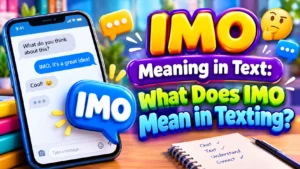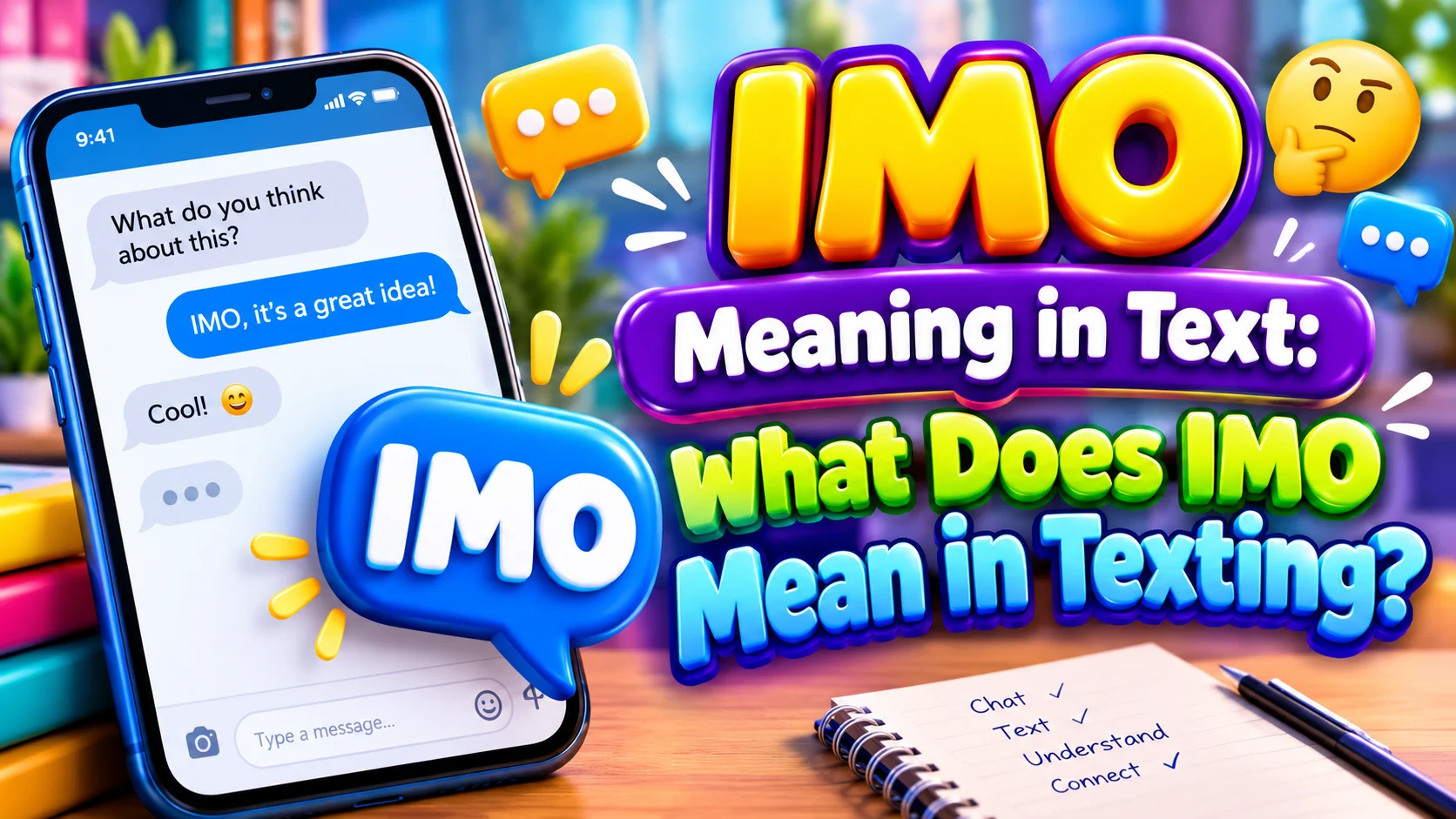
When someone writes “IMO” in a text, comment, or group chat, they usually mean “in my opinion.” It’s a short way to tell you that the statement that follows reflects the writer’s personal view rather than an established fact. You’ll commonly see IMO in texts, social media posts, online discussions, forums, and casual messages.
Although the abbreviation is simple, context matters. A student might write, “IMO, this is the easiest topic,” while a friend might say, “That movie was too long, IMO.” In both cases, the writer is clearly marking a personal judgment. Major English dictionaries also recognize IMO as a written abbreviation for “in my opinion.”
If you’re learning texting abbreviations, understanding IMO meaning in text can help you read online conversations more naturally and use the abbreviation correctly yourself.
Comparison Overview
| Term | Meaning | Common Use | Example |
| IMO | In my opinion | Personal viewpoint | “IMO, this is better.” |
| IMHO | In my humble opinion | Personal viewpoint with a humble or softer framing | “IMHO, the first option works best.” |
| FWIW | For what it’s worth | Adds a perspective or piece of information | “FWIW, I liked the original.” |
| I think | Personal belief or judgment | Casual and general communication | “I think this one is better.” |
| In my view | Personal viewpoint | More formal writing | “In my view, this approach is stronger.” |
The key difference is straightforward: IMO directly marks something as your opinion. Other expressions can perform a similar job, but their tone and level of formality differ.
Main Differences Between IMO Meaning in Text
The main difference between IMO and related expressions lies in meaning, tone, and context.
IMO is short and informal. It fits naturally into quick digital conversations. “In my opinion” carries the same meaning but works better in formal or academic writing.
IMHO is similar to IMO but adds “humble” to the phrase. Meanwhile, FWIW doesn’t literally mean “in my opinion.” It can introduce an opinion, but it can also introduce information that the writer thinks may be useful.
| Expression | Core Meaning | Tone | Best Setting |
| IMO | In my opinion | Casual | Texts, chats, social media |
| IMHO | In my humble opinion | Casual, sometimes playful | Online conversations |
| FWIW | For what it’s worth | Qualified or conversational | Chats, forums, comments |
| In my opinion | Personal viewpoint | Neutral | General writing |
| In my view | Personal viewpoint | More formal | Professional or academic writing |
This distinction becomes useful when you’re deciding whether an abbreviation actually fits the sentence.
What Does IMO Mean in Text?
IMO means “in my opinion.” It signals that the writer is sharing a personal belief, preference, assessment, or judgment.
Consider this message:
“IMO, the second design looks better.”
The writer isn’t presenting a measurable fact. They’re giving a personal assessment.
The same idea could be written as:
“In my opinion, the second design looks better.”
The meaning hasn’t changed. Only the style has.
What Does IMO Stand For?
IMO breaks down into three words:
- I = In
- M = My
- O = Opinion
Together, they form “in my opinion.”
Because online communication often favors speed and brevity, writers can replace the longer phrase with three letters.
What Does IMO Mean in Simple Words?
In simple language, IMO means “this is what I think.”
Depending on the sentence, you could replace it with:
- I think
- In my view
- From my perspective
- In my opinion
- As I see it
These expressions aren’t identical in every situation, but they can communicate a similar idea.
How Is IMO Used in Text Messages?
The most common use of IMO is to identify a statement as a personal opinion.
You can place it at different points in a sentence without changing its basic meaning.
IMO at the Beginning of a Sentence
This is one of the clearest and most common patterns.
Example:
“IMO, the blue shirt looks better.”
The abbreviation immediately tells the reader that the following statement represents the writer’s opinion.
Another example:
“IMO, you should finish the assignment today.”
Here, IMO introduces advice based on the writer’s personal judgment.
IMO at the End of a Sentence
You can also place IMO after the main statement.
Example:
“The blue shirt looks better, IMO.”
The meaning remains the same.
This structure can feel particularly natural in casual online conversations because the writer makes the statement first and then adds the opinion marker.
IMO in the Middle of a Sentence
IMO can also appear within a sentence.
Example:
“That was, IMO, the strongest part of the presentation.”
This construction is grammatically possible, although it isn’t usually necessary in casual texting.
For everyday messages, beginning or ending the sentence tends to sound more natural.
IMO Meaning in Chat and Online Conversations
In chats, IMO usually marks a personal viewpoint.
Imagine a group of students discussing which presentation topic they should choose.
One student writes:
“IMO, the climate topic will be easier to research.”
Another might respond:
“I agree. There are plenty of sources.”
The abbreviation makes the first person’s intention clear. They’re offering an assessment rather than claiming that everyone must agree.
IMO in Group Chats
Group chats often contain opinions about:
- Movies
- Food
- Music
- Games
- Schoolwork
- Travel
- Technology
- Sports
- Fashion
- Everyday decisions
For example:
“IMO, we should meet at 6 instead.”
That’s simply a personal suggestion.
IMO in Social Media Comments
You’ll also encounter IMO in opinion-based discussions.
For example:
“IMO, the original version is still the best.”
The writer is expressing a preference. They’re not claiming that the statement can be objectively proven.
IMO in Online Discussions
Online debates can become confusing when people mix facts with opinions.
Using IMO can help separate the two.
Compare:
“This is the best laptop.”
with:
“IMO, this is the best laptop.”
The second sentence clearly frames the statement as the writer’s personal assessment.
That doesn’t make the opinion correct or incorrect. It simply identifies what kind of statement it is.
What Does IMO Mean in a Conversation?
IMO doesn’t change the subject of a conversation. It changes how the following statement should be interpreted.
It tells you that the speaker is offering a viewpoint.
IMO for Personal Opinions
“IMO, the book is better than the movie.”
The writer is expressing a preference.
IMO for Recommendations
“IMO, you should take the earlier flight.”
The writer is giving advice based on their judgment.
IMO for Disagreement
“IMO, the second explanation makes more sense.”
This can disagree with someone without directly attacking them.
IMO for Evaluations
“IMO, the presentation needs a stronger conclusion.”
The writer is evaluating something according to their own judgment.
IMO for Preferences
“IMO, chocolate ice cream tastes better.”
Taste is subjective, so IMO fits naturally.
Does IMO Mean “In My Honest Opinion”?
This point causes some confusion.
The standard meaning of IMO is “in my opinion.” Some people informally interpret it as “in my honest opinion,” but “honest” isn’t required for the abbreviation to work.
For example:
“IMO, this is the better choice.”
The phrase doesn’t necessarily imply that the writer is emphasizing honesty.
If you specifically want the common abbreviation associated with “in my humble opinion,” that’s IMHO.
IMO vs. IMHO
| Abbreviation | Meaning |
| IMO | In my opinion |
| IMHO | In my humble opinion |
Both introduce personal opinions. The additional word in IMHO can give the statement a more self-effacing or playful tone.
For example:
IMO, this is the best option.
IMHO, this is the best option.
The practical difference is small in many casual conversations.
Is IMO Formal or Informal?
IMO is generally informal.
It’s perfectly understandable in casual digital communication. However, it isn’t always the best choice for formal writing.
Where You Can Use IMO
IMO works naturally in:
- Text messages
- Group chats
- Social media comments
- Online forums
- Casual emails
- Gaming chats
- Informal discussions
For example:
“IMO, the new update is much better.”
That’s perfectly natural in a casual conversation.
Where You Should Avoid IMO
You may want to avoid the abbreviation in:
- Academic essays
- Research papers
- Formal reports
- Official documents
- Professional correspondence
- Formal applications
Instead, write the phrase in full or use a more polished construction.
For example:
Informal:
“IMO, this approach works best.”
More formal:
“In my opinion, this approach works best.”
Or:
“This approach appears to be the most effective.”
The best choice depends on the audience and purpose.
Also Read This: NPC Meaning in Text | Relationship & Online Conversations in 2026
What Does IMO Mean on Social Media?
On social media, IMO usually means “in my opinion.”
You might see it in comments about movies, celebrities, products, sports, food, politics, technology, or everyday experiences.
For example:
“IMO, the first season was much stronger.”
The writer is signaling a personal judgment.
However, IMO doesn’t automatically make a comment polite. The surrounding language still matters.
Consider these two messages:
“IMO, the second option is stronger.”
“IMO, you’re completely wrong.”
Both use IMO correctly. The second one can still sound confrontational.
That’s an important lesson: an abbreviation can’t completely control the tone of a sentence.
Is IMO Rude?
No. IMO isn’t inherently rude.
It’s simply an abbreviation that identifies a statement as an opinion.
Tone depends on the words surrounding it.
Neutral IMO Example
“IMO, the first design looks cleaner.”
This sounds straightforward.
Friendly IMO Example
“IMO, pizza is always the better choice.”
This sounds casual and playful.
Blunt IMO Example
“IMO, that idea makes no sense.”
The problem isn’t the abbreviation. The phrase “makes no sense” creates the blunt tone.
If you want to disagree politely, try:
“I see your point, but IMO, the other option works better.”
That approach leaves room for another person’s perspective.
How to Use IMO Correctly
Using IMO is easy once you understand its purpose.
Use IMO to Mark a Personal View
“IMO, this is the easiest method.”
The statement is subjective.
Use IMO With Preferences
“IMO, the red version looks better.”
Personal taste is a natural situation for IMO.
Use IMO With Recommendations
“IMO, you should start with the first chapter.”
You’re sharing advice rather than stating an absolute rule.
Don’t Use IMO to Turn Facts Into Opinions
Adding IMO doesn’t change an objective fact into a personal opinion.
For example:
“IMO, the Earth orbits the Sun.”
The word IMO isn’t doing useful work there.
A better use would be:
“IMO, astronomy is one of the most interesting subjects.”
The first statement concerns an established scientific fact. The second expresses a personal judgment.
Don’t Overuse IMO
You don’t need to put IMO before every opinion.
This sounds repetitive:
“IMO, this movie is good. IMO, the acting is strong. IMO, the ending works.”
A more natural version is:
“IMO, this movie is good. The acting is strong and the ending works well.”
One clear opinion marker is often enough.
Real Text Examples of IMO
Here are practical examples showing how IMO meaning in text works in everyday communication.
Talking About Movies
“IMO, the sequel was better than the original.”
The writer is expressing a personal preference.
Discussing Food
“IMO, this restaurant makes the best burgers.”
The claim reflects the writer’s judgment.
Giving Advice
“IMO, you should talk to your teacher before changing the topic.”
The abbreviation introduces personal advice.
Discussing School
“IMO, the second topic will be easier to explain.”
The student is sharing an assessment.
Discussing Sports
“IMO, that was the best play of the game.”
The writer is giving a subjective evaluation.
Talking About Technology
“IMO, the older version was easier to use.”
The statement reflects the user’s personal experience or preference.
Friendly Disagreement
“I understand your point, but IMO, the first option makes more sense.”
This example combines disagreement with a respectful tone.
IMO vs. I Think
IMO and “I think” often communicate a similar idea.
Compare:
“IMO, this is the better choice.”
“I think this is the better choice.”
Both indicate a personal judgment.
The major difference is style.
I think works naturally in speech and writing. IMO is especially associated with informal digital communication.
| Feature | IMO | I think |
| Meaning | Personal opinion | Personal belief or judgment |
| Style | Informal abbreviation | Natural everyday phrase |
| Texting | Very common | Very common |
| Speech | Unusual | Very common |
| Formal writing | Usually avoided | More acceptable |
If you’re writing an academic essay, “I think” still may not be the strongest option. A more precise sentence often works better.
IMO vs. FWIW
FWIW means “for what it’s worth.”
It can introduce an opinion or piece of information that the writer believes might be useful.
Compare:
“IMO, the first restaurant is better.”
and:
“FWIW, I preferred the first restaurant.”
IMO directly identifies the statement as an opinion. FWIW adds a qualification that essentially says the information may or may not be useful.
Key Difference
- IMO: “This is my opinion.”
- FWIW: “This may be useful to you.”
They can overlap, but they’re not exact substitutes.
Can IMO Have Other Meanings?
Context matters because IMO can refer to something other than “in my opinion.”
In maritime and international policy contexts, IMO can mean the International Maritime Organization, a specialized agency of the United Nations.
That meaning is completely different from the texting abbreviation.
IMO in Texting
“IMO, that movie was excellent.”
Here, IMO means “in my opinion.”
IMO in a Maritime Context
“The IMO adopted new maritime safety measures.”
Here, IMO refers to the International Maritime Organization.
The surrounding words make the intended meaning clear.
This is why you shouldn’t assume every abbreviation has only one possible expansion.
Is IMO Still Used in 2026?
Yes. IMO remains a recognized abbreviation for “in my opinion” in online and informal written communication.
Major English-language dictionary sources continue to list the abbreviation with this meaning. Cambridge Dictionary describes IMO as a written abbreviation for “in my opinion.”
The abbreviation also continues to appear naturally in:
- Text messages
- Social media
- Online comments
- Forums
- Group chats
- Informal emails
- Digital discussions
Its exact frequency can vary between communities. However, its basic meaning remains stable.
Common Mistakes With IMO
Even though IMO meaning in text is simple, beginners sometimes misunderstand how to use it.
Mistake: Thinking IMO Means a Fact
IMO introduces an opinion.
“IMO, this is the best restaurant.”
That’s a personal judgment.
It doesn’t mean everyone would agree.
Mistake: Assuming IMO Always Means “Honest”
The standard expansion is “in my opinion.”
The word “honest” isn’t required.
Mistake: Using IMO in Formal Documents
An abbreviation that works perfectly in a group chat may look too casual in an academic paper.
Use “in my opinion” or revise the sentence according to the context.
Mistake: Assuming IMO Automatically Makes a Message Polite
It doesn’t.
“IMO, you’re wrong.”
can still sound harsh.
The entire sentence determines the tone.
Mistake: Using IMO Repeatedly
One abbreviation can clarify your viewpoint. Repeating it every few words makes the writing feel mechanical.
IMO Examples: Correct vs. Less Suitable Usage
| Situation | Example | Assessment |
| Personal preference | “IMO, the first design looks better.” | Natural |
| Recommendation | “IMO, you should start early.” | Natural |
| Casual disagreement | “IMO, the second option works better.” | Natural |
| Objective fact | “IMO, water freezes at 32°F under standard conditions.” | Unnecessary |
| Formal essay | “IMO, this theory is stronger.” | Too informal |
| Casual group chat | “IMO, let’s meet at six.” | Natural |
| Social media comment | “IMO, the original is still better.” | Natural |
The important distinction isn’t whether IMO is grammatically complicated. It isn’t. The real question is whether the context calls for an informal abbreviation.
How to Reply When Someone Says IMO
You don’t need a special response when someone uses IMO.
Respond to the opinion itself.
If You Agree
You could say:
- “I agree.”
- “Same here.”
- “I think so too.”
- “Exactly.”
If You Disagree Politely
Try:
- “I see your point.”
- “That’s fair, but I prefer the other one.”
- “I look at it differently.”
- “I get what you mean, but I disagree.”
If You Want More Explanation
Ask:
- “Why do you think that?”
- “What makes you prefer it?”
- “What makes the second option better?”
This keeps the conversation moving instead of turning a simple disagreement into an argument.
A Simple Case Study: Understanding IMO From Context
Imagine a student sends this message to a class group:
“IMO, Topic B will be easier for our presentation.”
What does it tell you?
First, the student is expressing a judgment.
Second, the student isn’t claiming that Topic B is objectively easier for everyone.
Third, the student is opening the door for other opinions.
Another student might answer:
“I agree. There’s more research available.”
Or someone might respond:
“I disagree. Topic A has fewer sections to cover.”
Neither response conflicts with the meaning of IMO. The abbreviation simply establishes that the original statement was the speaker’s opinion.
Quick Facts About IMO Meaning in Text
- IMO stands for “in my opinion.”
- It is commonly used in informal digital communication.
- It can appear at the beginning or end of a sentence.
- It can introduce a preference, judgment, recommendation, or viewpoint.
- IMO doesn’t automatically make a statement true or false.
- IMO isn’t inherently rude.
- IMHO means “in my humble opinion.”
- FWIW means “for what it’s worth.”
- The full phrase “in my opinion” is better suited to formal contexts.
- IMO can have other meanings in specialized contexts, including International Maritime Organization.
FAQs:
What does IMO mean in texting?
IMO means “in my opinion.” People use it to identify a personal viewpoint in texts, chats, comments, and other informal online conversations.
What does IMO stand for?
IMO stands for “in my opinion.”
Is IMO slang?
IMO is best described as an internet or texting abbreviation. It’s widely understood in informal digital communication.
Is IMO rude?
No. IMO isn’t inherently rude. The tone depends on the complete message and the relationship between the people communicating.
Can I use IMO in formal writing?
You can, but it’s usually better to write “in my opinion” or use a more formal construction. IMO is strongly associated with informal digital communication.
Conclusion:
Understanding IMO meaning in text is simple: IMO normally means “in my opinion.”
People use it to show that they’re sharing a personal viewpoint rather than presenting an objective fact. You’ll often see it in text messages, social media comments, group chats, forums, and other informal online conversations.
For example, “IMO, this is the better choice” simply means “In my opinion, this is the better choice.”
The abbreviation is short, useful, and easy to recognize. Just remember to match it to the setting. It works naturally in casual digital communication, while formal writing usually benefits from spelling out “in my opinion.”