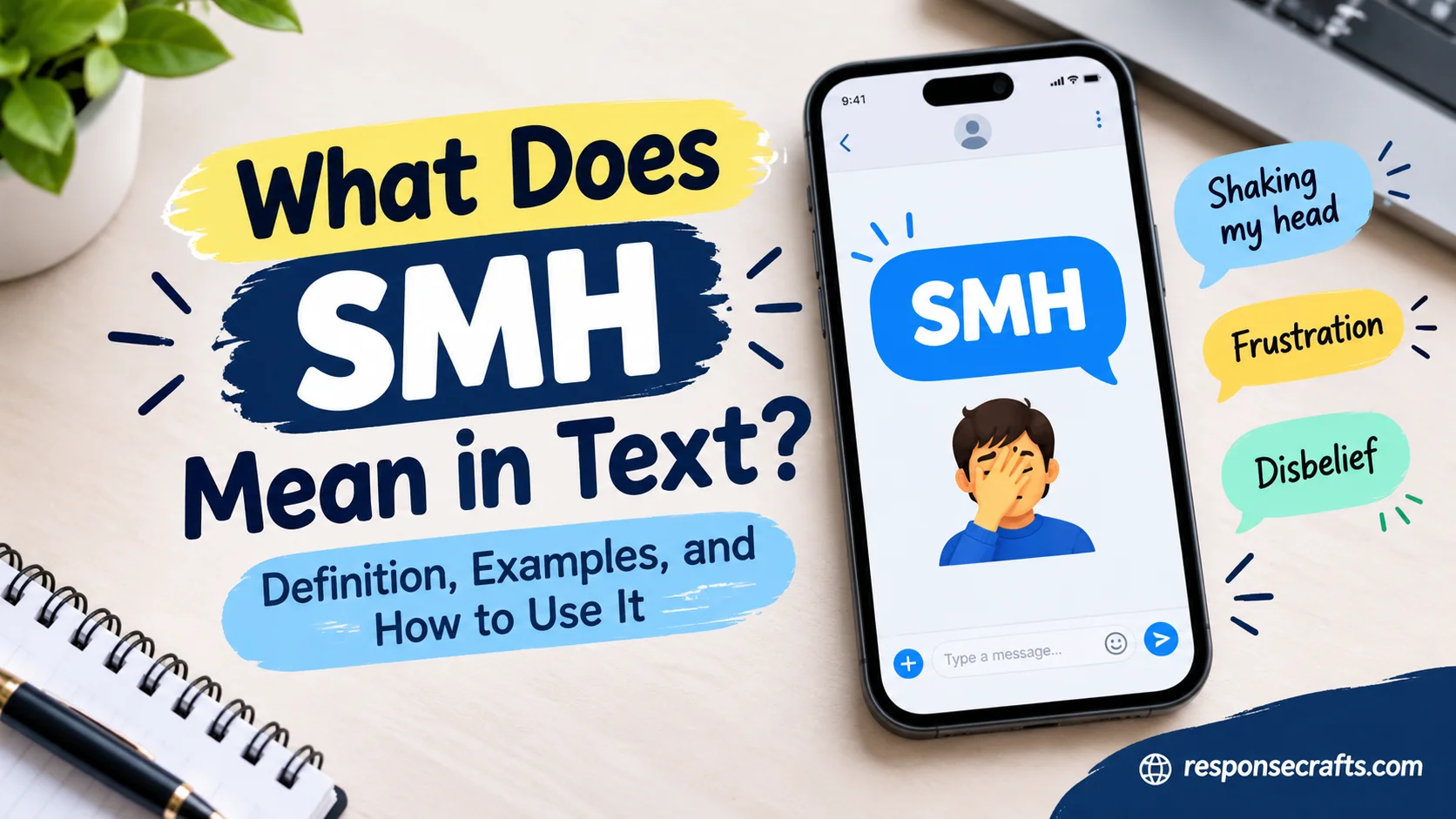
The abbreviation SMH is widely used in text messages, social media posts, and everyday online conversations. SMH stands for “shaking my head,” an expression people use to show disappointment, disbelief, frustration, or disapproval about something. Instead of typing a long reaction, someone can simply write SMH to communicate how they feel about a situation. For example, if a friend forgets an important appointment again, you might reply, “SMH, you forgot again!” The expression is especially common on TikTok, Instagram, Snapchat, and Facebook, where short and casual messages are popular.
People use SMH in texting for different reasons, depending on the situation and their relationship with the person receiving the message. Sometimes, it expresses genuine annoyance or disappointment, while in other cases, it communicates amusement or playful disbelief. For instance, someone might text, “SMH, I left my keys inside the house,” to show frustration with their own mistake. Friends may also use it jokingly when someone makes an obvious error or shares an unbelievable story. Although SMH can sound critical, its meaning often depends on the conversation’s tone and context.
Learning how to use SMH correctly can make your texting style feel more natural and help you follow modern internet slang. You can use the abbreviation in casual chats, comments, and messages when something leaves you disappointed, confused, or shaking your head in disbelief. For example, “SMH, people really need to read the instructions first” expresses mild frustration, while “SMH I can’t believe I did that” shows humorous embarrassment. However, SMH is generally better suited to informal communication than professional emails or formal discussions.
Quick Answer:
SMH means “shaking my head.” It’s a common internet abbreviation people use when something seems silly, frustrating, disappointing, surprising, or hard to believe.
For example:
- Friend: “I stayed up all night watching videos and forgot to finish my homework.”
- You: “SMH 😂”
Here, SMH expresses playful disbelief at your friend’s decision.
The abbreviation usually communicates a reaction rather than a complete thought. Its precise meaning depends on the situation and the sender’s tone.
- Full form: Shaking my head
- Primary meaning: Disbelief, disappointment, frustration, or disapproval
- Typical setting: Casual texts, social media, and online chats
- Formality: Informal
- Common variation: SMDH, meaning “shaking my damn head”
In short, when someone sends you SMH, they’re usually reacting to something they find unbelievable, foolish, irritating, or disappointing.
Comparison Overview
SMH can communicate several emotions, so the surrounding conversation matters. The following table compares its common uses with related expressions.
| Term | Full Meaning | Common Use | Typical Tone |
| SMH | Shaking my head | Disbelief or disappointment | Mild to strong, depending on context |
| SMDH | Shaking my damn head | Stronger frustration or disbelief | More emphatic |
| LOL | Laughing out loud | Amusement or laughter | Playful or humorous |
| OMG | Oh my God | Surprise, excitement, or shock | Depends on context |
| Facepalm | A gesture covering the face with a hand | Embarrassment or frustration | Often humorous |
| WTF | What the fuck | Shock, confusion, or anger | Usually blunt and sometimes offensive |
| FFS | For fuck’s sake | Exasperation or impatience | Frustrated and potentially offensive |
These expressions aren’t interchangeable. For instance, LOL usually highlights laughter, while SMH often signals disbelief or disappointment. Someone might combine them when a situation is both ridiculous and funny.
Example: “He put his phone in the refrigerator instead of his lunch bag. SMH LOL.”
The sender finds the mistake amusing while also questioning how it happened.
Main Differences Between SMH in Text and Similar Expressions
Although SMH is easy to recognize once you know its meaning, several related expressions can create confusion. Understanding their differences helps you choose the right abbreviation for each conversation.
SMH vs. SMDH
SMH means “shaking my head,” while SMDH means “shaking my damn head.”
Both expressions communicate disbelief, frustration, or disappointment. However, SMDH usually adds emphasis and can sound more exasperated.
Consider these examples:
- SMH: “You forgot your keys again. SMH.”
- SMDH: “You forgot your keys again after I reminded you twice. SMDH.”
The first message might express mild annoyance. The second sounds more frustrated because the sender emphasizes the repeated mistake.
SMDH also contains profanity, so it may feel too strong for some conversations. If you want to keep your message mild, SMH is generally the safer choice.
SMH vs. LOL
LOL stands for “laughing out loud.” People use it to express amusement, soften a message, or signal that they’re joking.
SMH, by comparison, usually reacts to something unbelievable, frustrating, or disappointing.
For example:
- LOL: “That joke was hilarious LOL.”
- SMH: “You watched the entire movie and fell asleep during the ending. SMH.”
- SMH LOL: “You walked into the wrong classroom and sat there for ten minutes. SMH LOL.”
The third example combines disbelief with humor. The sender isn’t necessarily angry; they’re laughing at an awkward or ridiculous situation.
SMH vs. Facepalm
Facepalm refers to the gesture of placing a hand over your face, often because of embarrassment, frustration, or disbelief.
SMH describes a different physical gesture: shaking your head. Online, both expressions can communicate similar reactions, but they aren’t identical.
| Expression | Main Idea | Example |
| SMH | Disbelief or disappointment | “He forgot his own birthday plans. SMH.” |
| Facepalm | Embarrassment or exasperation | “I sent the message to the wrong person. Facepalm.” |
Use SMH when reacting to someone’s behavior or a frustrating situation. Facepalm often works when you or someone else makes an awkward mistake.
SMH vs. OMG
OMG stands for “oh my God.” It can communicate excitement, surprise, shock, disbelief, or concern.
SMH usually suggests that something deserves a disappointed or disapproving reaction. OMG doesn’t necessarily carry that judgment.
For example:
- “OMG, I got the job!” expresses excitement.
- “SMH, he missed the interview because he overslept” expresses disappointment.
- “OMG, he actually showed up an hour late!” expresses surprise and may also suggest disapproval.
The context can make their meanings overlap. Still, OMG generally highlights the intensity of a reaction, while SMH highlights the kind of reaction.
SMH vs. WTF and FFS
WTF means “what the fuck,” while FFS means “for fuck’s sake.” Both expressions can convey stronger frustration than SMH.
WTF often expresses shock or confusion. FFS typically communicates impatience or exasperation.
For example:
- SMH: “You deleted the file without saving a copy.”
- WTF: “WTF happened to the file?”
- FFS: “FFS, I told you to save a copy.”
These examples show different levels and types of reactions. Because WTF and FFS contain profanity, consider your audience before using them.
What Does SMH Stand For?
The Full Form of SMH
The full form of SMH is “shaking my head.” It describes the physical action of moving your head from side to side.
People often shake their heads when they disagree with something, feel disappointed, or find a situation difficult to believe. Online conversations use the abbreviation to communicate that reaction in writing.
Imagine watching someone ignore a simple instruction and then make the exact mistake you warned them about. You might shake your head in disbelief. Writing “SMH” sends a similar message without requiring a physical gesture.
The abbreviation became part of internet slang and everyday digital communication. Today, people use it across different social platforms and messaging services.
What Does Shaking My Head Mean in a Conversation?
Shaking your head can communicate several emotions, depending on the circumstances. In written conversations, SMH carries many of those same meanings.
For example, imagine your friend says, “I spent my rent money on concert tickets, and rent is due tomorrow.”
You might respond, “SMH, what were you thinking?”
Here, the abbreviation signals disapproval and concern about the decision. However, if your friend says, “I tried to open my front door with my car key,” SMH might express friendly amusement instead.
The important distinction is that SMH doesn’t identify one specific emotion on its own. You need the surrounding message to understand whether the sender feels annoyed, amused, disappointed, or shocked.
What Does SMH Mean in Different Contexts?
SMH appears in many digital settings. Although its basic definition stays the same, the tone can change depending on where and how someone uses it.
SMH Meaning in Text Messages
In ordinary text messages, people use SMH to react quickly to something a friend, relative, or partner says.
It can replace a longer response when the situation already explains the sender’s feelings.
For example:
Conversation one:
- Alex: “I left my lunch on the kitchen counter again.”
- Jordan: “SMH 😂”
Jordan is probably teasing Alex about being forgetful.
Conversation two:
- Alex: “I told everyone a secret you asked me to keep.”
- Jordan: “SMH. I trusted you.”
Here, SMH communicates genuine disappointment rather than playful teasing.
The abbreviation works well when both people understand the context. However, a short response can feel cold if the other person expects a thoughtful explanation.
SMH Meaning on Snapchat
On Snapchat, SMH can appear in private chats, replies to snaps, and conversations between friends.
Someone might send it after receiving a silly photo, hearing surprising news, or watching a friend make an avoidable mistake.
For example:
- Friend: “I snapped a picture of my outfit and realized my shirt was inside out.”
- Reply: “SMH 😭”
The reply probably expresses playful embarrassment or disbelief.
SMH doesn’t have a separate official Snapchat meaning. It retains its usual definition, and the surrounding conversation determines the intended tone.
SMH Meaning on Instagram
Instagram users may include SMH in comments, direct messages, captions, and replies to posts.
A person might comment “SMH” on a video showing an avoidable mistake or use it while discussing disappointing news.
For example:
“People really leave shopping carts in parking spaces instead of returning them. SMH.”
In this example, SMH signals disapproval of the behavior.
However, social media comments often lack the context found in private conversations. A short SMH comment can appear harsher than intended, especially when strangers read it without knowing the person who posted it.
SMH Meaning on TikTok
TikTok users may write SMH in comments or captions when reacting to funny clips, unexpected outcomes, or controversial behavior.
For example, someone might comment “SMH 😂” under a video showing a person attempting a simple task in an unnecessarily complicated way.
The laughing emoji makes the reaction feel more humorous. Without that emoji, the comment might sound more critical.
As with other platforms, SMH doesn’t automatically mean the person is angry. The video, caption, and other comments provide useful clues.
SMH Meaning in Group Chats
Group chats often involve jokes, teasing, and fast-moving conversations. SMH provides a quick way to react without interrupting the discussion.
Imagine a group planning a weekend trip:
- Mia: “I booked our hotel for the wrong weekend.”
- Chris: “SMH.”
- Taylor: “How did you manage that? 😂”
- Mia: “I clicked the wrong date!”
Chris’s response might express surprise or mild frustration. Taylor’s reply makes the playful tone more obvious.
Still, group conversations can create misunderstandings. If someone already feels embarrassed, several SMH reactions may make them feel as though everyone is criticizing them.
SMH Meaning in Serious Conversations
SMH can also express genuine disappointment during serious discussions.
For example, if someone repeatedly breaks a promise, another person might write, “SMH, I thought you would keep your word.”
The abbreviation reinforces the disappointment behind the message. However, it can also make the response seem dismissive.
When the subject involves trust, grief, family conflict, or another sensitive issue, a clear sentence may communicate your feelings more effectively.
Instead of writing only “SMH,” you might say, “I’m disappointed because I thought we had agreed on this.”
That response explains the problem rather than leaving the other person to guess.
Different Emotions Expressed by SMH
SMH doesn’t have one fixed emotional tone. The same three letters can communicate several reactions.
SMH Meaning: Disappointment
People often use SMH when someone fails to meet an expectation or makes a poor decision.
Example: “He promised to help us move and didn’t show up. SMH.”
The sender feels let down by the person’s behavior. Depending on the relationship, the message may sound mildly disappointed or openly critical.
SMH Meaning: Disbelief and Shock
Sometimes, SMH expresses a reaction to something that seems impossible, unexpected, or hard to understand.
Example: “She finished the entire project in one afternoon. SMH, that’s unbelievable.”
Here, SMH emphasizes surprise rather than disapproval. The sender might even admire the person’s achievement.
SMH Meaning: Frustration and Annoyance
Repeated mistakes can make people feel frustrated. SMH provides a short response when someone doesn’t know what else to say.
Example: “The internet stopped working right before my online meeting. SMH.”
In this situation, the sender might be annoyed by the circumstances rather than another person.
SMH Meaning: Disapproval
People may use SMH when they believe someone’s actions are careless, unfair, or inappropriate.
Example: “He made fun of someone for asking a simple question. SMH.”
The abbreviation communicates that the sender disagrees with the behavior.
Because it can sound judgmental, use it carefully when discussing personal mistakes or sensitive subjects.
SMH Meaning: Amusement
SMH can also be playful, especially when combined with laughing emojis or used between close friends.
Example: “You put your phone in the fridge and your drink in your bag. SMH 😂”
The sender is probably laughing at a silly mix-up rather than expressing serious disapproval.
The key takeaway: Look at the entire message instead of assuming SMH always signals negativity.
Read More: Sigma Mean in Text: Meaning, Uses, Examples, and Internet Slang
Examples of SMH in Text Conversations
Realistic examples make the meaning easier to recognize. The following situations show how people might use SMH in everyday digital communication.
| Situation | Text Example | Likely Meaning |
| Forgetting something | “You forgot your lunch again. SMH.” | Mild frustration or teasing |
| Making a silly mistake | “I wore two different shoes to work. SMH 😂” | Embarrassment or amusement |
| Hearing surprising news | “He won the competition without practicing. SMH.” | Disbelief or surprise |
| Witnessing poor behavior | “She blamed everyone else for her mistake. SMH.” | Disapproval |
| Dealing with repeated problems | “The printer jammed for the third time. SMH.” | Frustration |
| Reacting to a joke | “You really thought the Earth was flat? SMH 😂” | Playful disbelief |
| Feeling let down | “You canceled again at the last minute. SMH.” | Disappointment |
| Seeing an unexpected result | “He studied the wrong chapter for the exam. SMH.” | Disbelief or frustration |
A Closer Look at SMH in Everyday Conversations
Consider these three short exchanges.
Example: A conversation between friends
- Sam: “I walked into the wrong meeting room and started introducing myself.”
- Riley: “SMH 😂”
- Sam: “Everyone just stared at me!”
Riley’s response expresses amusement and disbelief. The laughing emoji suggests that the reaction is friendly rather than hostile.
Example: A family conversation
- Dad: “I drove to the store and realized I had left my wallet at home.”
- Daughter: “SMH. Again?”
- Dad: “Unfortunately!”
Here, SMH highlights a repeated mistake. The word “Again?” adds a teasing tone.
Example: A disagreement
- Taylor: “I shared your private message with the group.”
- Morgan: “SMH. That wasn’t yours to share.”
This exchange has a more serious tone. Morgan uses SMH to express disapproval and follows it with a direct explanation.
These examples demonstrate why context matters more than the abbreviation alone.
How to Use SMH Correctly in Texting
Using SMH is simple once you understand its meaning. The trick is knowing when it fits the conversation and when another response would work better.
When Should You Use SMH?
SMH works best in informal conversations where a short reaction feels natural.
You can use it when:
- Reacting to silly mistakes: “You forgot your password again. SMH.”
- Expressing disbelief: “He actually believed that story. SMH.”
- Showing frustration: “My computer crashed right before I saved the file. SMH.”
- Teasing friends: “You burned instant noodles. SMH 😂”
- Commenting on social media: “Why would anyone think that’s a good idea? SMH.”
You can also use SMH by itself when the situation makes your reaction obvious. For instance, a friend might tell you they accidentally locked their keys inside their car. A simple “SMH 😭” could be enough.
However, if the situation requires empathy or a meaningful response, don’t rely on the abbreviation alone.
When Should You Avoid Using SMH?
Although SMH is widely understood in casual online conversations, it doesn’t fit every situation.
Avoid using it when:
- Writing a formal email to a client or manager.
- Responding to someone who shares painful or sensitive news.
- Discussing a serious disagreement that needs a clear explanation.
- Communicating with someone who might interpret your message as mockery.
- You need to explain why someone’s actions upset you.
For example, if a coworker makes a mistake during an important presentation, replying “SMH” could embarrass them without helping solve the problem.
A more constructive response would be, “Let’s review what happened and figure out how to prevent it next time.”
Can You Use SMH by Itself?
Yes. SMH can function as a complete reaction in a text conversation.
Suppose your friend says, “I left my phone at home and didn’t notice until I reached work.”
You might simply respond:
“SMH 😂”
The message communicates your reaction without adding unnecessary words.
However, a standalone SMH can seem cold or sarcastic when the situation is serious. When you’re unsure, add a few words to clarify your meaning.
For example, “SMH, that’s frustrating” expresses sympathy more clearly than “SMH” alone.
What Does SMH Mean With Different Emojis?
Emojis can change how readers interpret SMH. They provide emotional clues that plain text sometimes lacks.
SMH 😂
SMH 😂 often communicates humorous disbelief, playful frustration, or amusement.
Example: “You spent an hour looking for your glasses while wearing them. SMH 😂”
The laughing emoji makes it clear that the sender finds the situation funny.
SMH 🙄
SMH 🙄 usually conveys annoyance, sarcasm, or strong disapproval.
Example: “He said he was late because his alarm didn’t go off for the fifth time. SMH 🙄”
The eye-roll emoji makes the reaction sound more impatient or judgmental.
SMH 🤦
SMH 🤦 combines the head-shaking expression with the facepalm gesture.
Example: “I sent the unfinished document to my boss. SMH 🤦”
This combination often communicates embarrassment, frustration, or disbelief about a mistake.
SMH 😭
SMH 😭 can express exaggerated frustration, humorous despair, or emotional overwhelm.
Example: “My favorite show ended right before the big reveal. SMH 😭”
The crying emoji doesn’t necessarily mean the sender is genuinely upset. In casual online communication, it can emphasize a dramatic or funny reaction.
SMH ❤️
When paired with a heart, SMH may soften the message or communicate affectionate teasing.
Example: “You forgot where you parked again. SMH ❤️”
The heart suggests warmth, although the precise tone still depends on the relationship and context.
Remember: Emojis don’t have identical meanings for everyone. Read them alongside the message rather than treating them as fixed definitions.
Is SMH Rude or Disrespectful?
SMH isn’t inherently rude. However, it can sound disrespectful when someone uses it to dismiss another person’s feelings, criticize a mistake, or show contempt.
Consider two situations.
A playful reaction:
- Friend: “I just put salt in my coffee instead of sugar.”
- You: “SMH 😂”
Because the mistake is harmless and the conversation is casual, the response probably feels friendly.
A hurtful reaction:
- Friend: “I failed my driving test, and I feel terrible.”
- You: “SMH.”
This response might make your friend feel judged rather than supported. They may interpret it as criticism, even if you intended no harm.
If someone shares disappointing news, consider responding with empathy first. You can always discuss the mistake later if necessary.
How to Tell Whether Someone Means SMH Negatively
Look for a few clues:
- The surrounding words: “SMH, you never listen” sounds more critical than “SMH 😂.”
- The relationship: Close friends may tease each other in ways strangers cannot.
- The situation: A silly mistake invites a different reaction than a personal struggle.
- The emojis: An eye-roll may signal annoyance, while a laughing emoji often suggests humor.
- The conversation history: Repeated arguments or unresolved disagreements can make a short message feel harsher.
Even with these clues, you can’t always know someone’s intention from three letters. If the message genuinely confuses you, asking what they meant is often the simplest solution.
Does SMH Have Other Meanings Beyond Texting?
In everyday internet slang, SMH primarily means “shaking my head.” That’s the interpretation most readers will recognize in ordinary text messages and social media discussions.
However, abbreviations can have specialized meanings in particular industries, organizations, or technical settings. In those situations, the surrounding subject helps establish the intended definition.
For example, an abbreviation in a medical document or workplace report might refer to a specific organization, system, or technical term. You shouldn’t automatically assume every occurrence means “shaking my head.”
When you encounter SMH, consider the context:
- Casual text message: It almost certainly means “shaking my head.”
- Social media comment: It usually expresses disbelief, disappointment, or frustration.
- Technical document: Check the surrounding terminology before interpreting it.
- Unfamiliar group conversation: Ask for clarification if the meaning isn’t obvious.
The key is to interpret the abbreviation within the conversation rather than relying on the letters alone.
Common Mistakes to Avoid When Using SMH
Even a familiar abbreviation can cause confusion when people use it without considering tone or context.
Assuming SMH Always Means Anger
SMH can express disappointment, but it can also communicate amusement, disbelief, or surprise.
For example, “You tried to open the car door with your house key. SMH 😂” is probably playful rather than angry.
Always consider the surrounding message before deciding what the sender feels.
Confusing SMH With SMDH
SMH means “shaking my head,” while SMDH means “shaking my damn head.”
The extra word adds emphasis and may make the message sound more frustrated. If you want a milder reaction, SMH is generally more appropriate.
Using SMH in Formal Communication
Abbreviations such as SMH usually belong in informal conversations. Using them in a professional email can make your message sound dismissive or overly casual.
Instead of writing “SMH, the report is wrong,” explain the issue directly.
For example: “I noticed a few errors in the report. Could we review them together?”
Misreading Sarcasm
Someone who writes “SMH 😂” might be joking, while someone who writes “SMH. Seriously?” may feel genuinely annoyed.
Still, punctuation and emojis aren’t perfect indicators of emotion. If a message seems ambiguous, avoid jumping to conclusions.
Using SMH When Someone Needs Support
When someone shares a difficult experience, SMH alone can sound like criticism.
A thoughtful response should acknowledge their feelings before offering advice or discussing what went wrong.
For example, “I’m sorry that happened. That sounds frustrating” is more supportive than a bare SMH.
Conclusion
Understanding what SMH means in text helps you follow everyday online conversations and recognize how people express their emotions through internet slang. SMH stands for “shaking my head” and is commonly used to show disappointment, frustration, disbelief, or playful annoyance. Whether you see it in text messages, TikTok comments, Instagram posts, or Snapchat chats, its exact meaning depends on the situation and the tone of the conversation. Although SMH works well in casual communication, it is generally best to avoid it in formal or professional writing. By learning its meaning and exploring real-life examples, you can use SMH confidently and understand this popular abbreviation whenever it appears in your messages.
FAQs
1. What does SMH mean in text?
SMH stands for “shaking my head.” People use it in text messages to express disappointment, frustration, disbelief, or disapproval about something.
2. What does SMH mean on Snapchat and Instagram?
On Snapchat and Instagram, SMH has the same meaning: “shaking my head.” Users often include it in messages, comments, and captions to react to something surprising, frustrating, or silly.
3. Is SMH positive or negative?
SMH is usually negative or disapproving, but it can also be used humorously. Its meaning depends on the context, tone, and relationship between the people communicating.
4. How do you use SMH in a sentence?
You can use SMH to express disappointment or disbelief in a casual conversation. For example: “SMH, I can’t believe I forgot my wallet again!” This shows frustration with your own mistake.
5. Is SMH appropriate for professional messages?
Generally, SMH is best for informal communication, such as chatting with friends or commenting on social media. In professional emails, it is better to express your thoughts using clear, polite, and professional language.










1 thought on “What Does SMH Mean in Text? Definition, Examples, and How to Use It”